This website is preserved for historical and scholarly reference and is no longer actively maintained.
Clemson University WiMAX Research
Warning: Page Under Construction:
(
New:
Click here for information about our
'ns' simulation model)
- This
project
was supported by Grant No. 2006-IJ-CX-K035 awarded by
the National
Institute of Justice, Office of Justice Programs, US
Department of
Justice.
- Points of
view in
this document are those of the author and do not necessarily
represent
the official position or policies of the US Department of
Justice.
Contents
Project Objectives
The core objective of our research is to further develop the
WiMAX MAC
protocol. There are many interesting protocol research
issues. For example:
- How to optimally pack an OFDMA frame over both time and
frequency that contains of bursts of data from
multiple
users
- How should a scheduler deal with channel performance feedback.
There are two approaches: adaptive modulation or
'opportunistic scheduling'.
- How can advance PHY capabilities such as MIMO and adaptive
antennas be used effectively (this is the cross layer
optimization
problem)
- How can high resolution, variable bit rate video (i.e., such
as
from an H.264 encoder) operate more efficiently than the rtPS
service
WiMAX, in the near term using 4.9 GHz equipment or in the longer
term
at 700 MHz, offers significant promise for public safety.
A
further project objective of our research agenda is to
evaluate
and develop the usefulness of WiMAX as a communication technology
for
public safety.
Along with 900 Mhz two-way voice radios, some public safety
agencies are using packet radio networks to obtain data in the
field.
Several states have built dedicated wireless wide area networks to
provide data and voice service that can be shared by all public
service
organizations in the state. For example, the South Carolina’s
Department of Public Safety, along with the state’s CIO office,
operates the Palmetto 800 radio and mobile data system. Based
on
Motorola’s dataTAC wireless data technology and
radioIP’s Mobile TCP/IP Gateway products, the Palmetto 800
provides voice and data connectivity over most of the state. Data
rates
up to 19 Kbps are supported which is sufficient for real-time access
to
data from the field. Based on interviews with Clemson
University
police and fire department officials and with the City of Clemson
police department officials, connectivity with the network is
spotty,
the mobile data terminals are expensive ($3000- $5000 each), and the
low data rates are restrictive.
Other public safety radio systems that are in use include paging,
short
messaging, two-way mobile relay, trunked radio, personal
communications
(PCS), cellular digital packet data (CDPD) and microwave.
Wireless WAN network technology is advancing rapidly. Low
speed,
data networks like the Palmetto 800 will eventually be replaced by
3G/3G+/4G wireless data services. These public networks will
be
able to provide broadband access sufficient to support voice, video
and
data to desired coverage levels throughout a state.
A different set of technologies, including 802.11 mesh
networks,
802.16 broadband wireless access (WiMAX) and 802.20 mobile broadband
wireless access, offer low cost choices to provide access to the
Internet or to provide a metropolitan area network (MAN) wireless
infrastructure for temporary or permanent use. Throughout this
proposal, we refer to these networks as broadband wireless access
(BWA)
networks. BWA networks play a complementary role to larger
wireless WANs. A city might decide to operate a BWA network to
support its local public safety needs. A homeland security
organization might have mobile BWA equipment that can be instantly
deployed to disaster locations. In emergency situations, voice
and data services provided by public network providers are likely to
be
overloaded or damaged and therefore unusable . Emergency
situations are likely to involve multiple public service
agencies. A BWA infrastructure based on industry standard will
enhance interoperability.
802.20 is several years from standardization. While 802.11
mesh
networks are available, they are more complex and less versatile
than
802.16. Therefore, in the proposed research, we focus on WiMAX
technology. We propose to create a 802.16 testbed using WiMAX gear
that
is appropriate for public safety operations. Working with
Clemson
University’s police and fire departments, and with the local
municipal police department, we provide a proof-of-concept
demonstrating how 802.16 can be utilized by several public safety
organizations. A further component of the research validates
an
802.16 network simulation tool that we have developed by running
equivalent experiments in a testbed environment and in a simulated
environment and comparing results. We will then use the
simulator
to run a set of experiments that would be difficult to do in the
testbed. The experiments are designed to provide provisioning
guidance such as expected application level performance as the
number
of users increase.
Preliminary Results
simulation results:
We are developing a simulation model of WiMAX using the open
source 'ns2' simulation tool. We currently have our DOCSIS MAC
protocol operating in FDD mode using a pair of wireless channels.
The WiMAX parameters are:
Frequency Division Duplex (FDD)
Frame Time: .002 seconds
Service rates: none, 2Mbps/256Kbps
Channel BW: 5 MHz
Effective data rates: 10Mbps up and down
Physical Layer Attributes: ‘ideal’
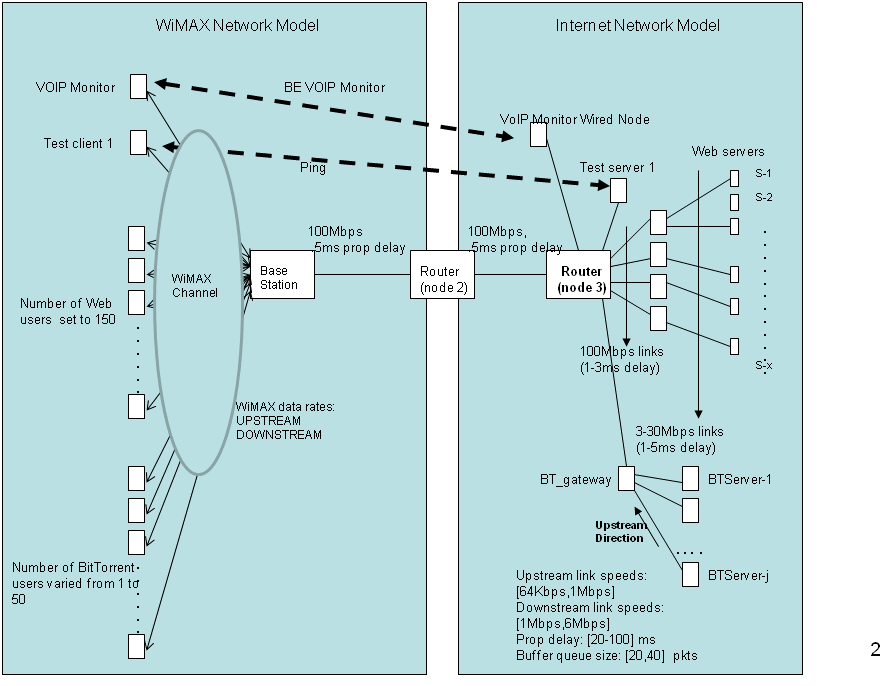
Figure 1. Simulation model
Figures 2a-d illustrate preliminary simulation results.
We modeled a WiMAX
broadband access network based in part on ClearWire's
(www.clearwire.com) wireless Internet access service.
Subscriber
services rates are 2 Mbps downstream and 256Kbps upstream. The
channel capacity in each direction is 10 Mbps. A number of
subscribers (150) are performing web browsing. The results
show
the impact as a second set of subscribers operates the BitTorrent
P2P
application. Figure 2a shows the network becomes saturated
when 25 BitTorrent users are active. Figure 2b (labeled
P2PTCP Throughput) shows the average throughput consumed by each TCP
session used by the BitTorrent application model. Figure 2c
(labeled network latency) plots the network access delay (this
is the curve that has the largest values). The figure also plots the
access delay of a test subscriber that is operating a VoIP traffic
model (this test subscriber does not generate any other traffic
aside
from VoIP). Figure 2d plots an estimate of the perceived call
quality over the network experienced in the upstream direction by
the
test node that generates realistic G.711 VoIP data. The
quality is assessed using the standard
e-model that computes an R value based on the latency, loss,
and
jitter experienced by the test flow. An R value greater than
70
is considered acceptable quality. The call quality becomes
unacceptable once 30 subscribers operate BitTorrent.
Our simulation work is just getting under way. Next steps
include:
- Complete our ns simulation model (it does not fully
model WiMAX yet)
- Perform simulations that model the testbed network
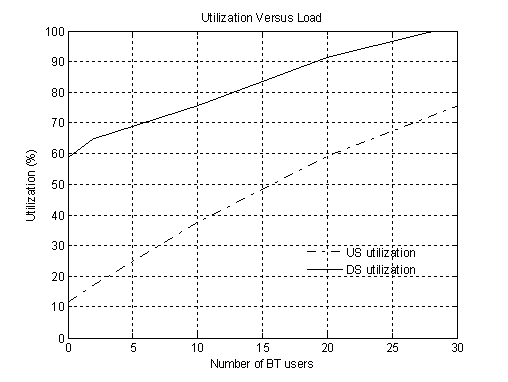
Figure 2a: Preliminary simulation results
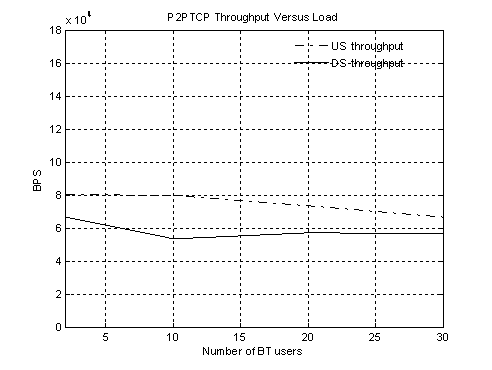
Figure 2b.
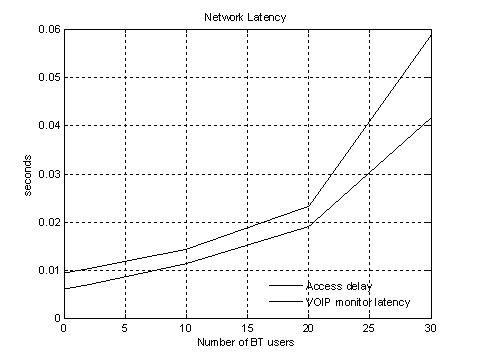
Figure 2c.
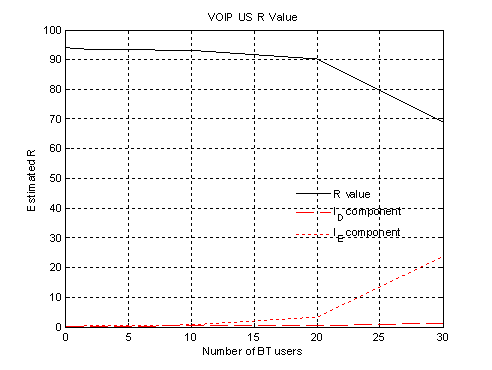
Figure 2d.
testbed results:
We have a small WiMAX network operational in our lab. The
equipment is provided by M/A-COM (equipment link: http://www.macom-wireless.com/products/broadband/default.asp).
Figure 3
illustrates the testbed network (the video camera has not yet
arrived).
The network operates at 4.9 GHz. The Clemson University Police
Department has obtained a license for this spectrum. Once the
equipment gets deployed on campus, we will have the campus police
trial
the network using voice, video and best-effort data applications.
The M/A-COM base station has the following characteristics:
IEEE 802.16e function – although just supports Fixed/Nomadic clients
5MHz channels at 4.9GHz
27dBm output power
TDD operation, 10ms frame time, variable US/DS split
Interfaces:
RJ-45 Ethernet
24 V DC Power
4.9 GHz RF and GPS Antenna
Managed by M/A-COM UAS Admin software
Our measurements suggest a maximum upstream and downstream
application
throughput of just under 5Mbps. After some analysis, this
seems
about right. Please refer to the following document for details on
how
to estimate application throughput over a WiMAX channel : wimax performance
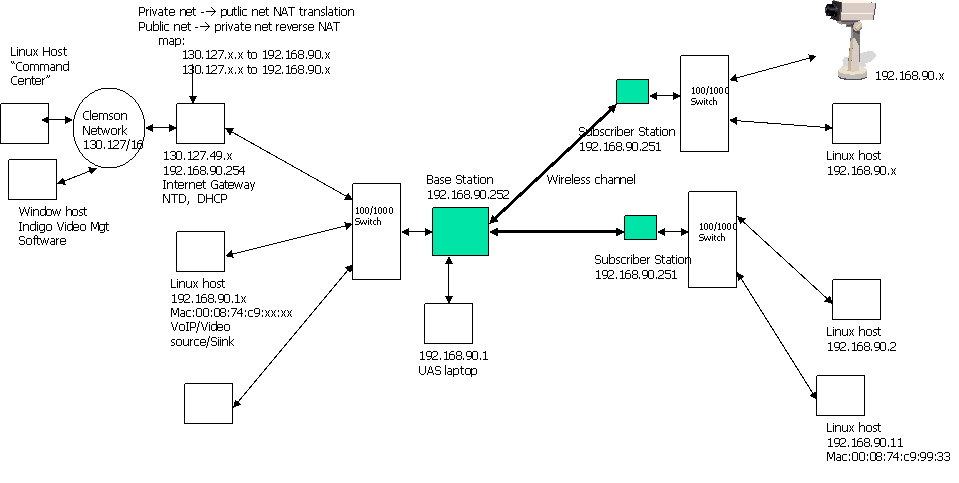
Figure 3. WiMAX testbed network diagram
Papers
J. Martin, B. Li, W. Pressly, J. Westall, “WiMAX
Performance at 4.9 GHz", Proceedings of the 2010 IEEE
Aerospace Conference, (Big Sky, Montana, March 2010).
J. Martin, J. Westall, "Evaluating
WiMAX for Public Safety", Proceedings of the Wireless
Symposium @ Virginia Tech, June 2010.
J. Deng, R. Brooks, J. Martin, “Assessing
the Effect of WiMAX System Parameter Settings on MAC-level Local
DoS Vulnerability”, to appear in International Journal of
Performability Engineering, (2011).
J. Westall, J. Martin, "Performance
Characteristics of an Operational WiMAX Network",
IEEE Transactions on Mobile Computing, Vol. 10 no. 7, pp.
941-953 (2011).
Simulation package and
documentation:
To get access to our ns simulation code - please send me an email
(jim.martin@cs.clemson.edu).
Public Safety and WiMAX
Back to Jim
Martin's Home Page
8/26/2011
