This website is preserved for historical and scholarly reference and is no longer actively maintained.
Application Performance Prediction and Autonomic Computing
This project has been funded in part by IBM
corporation.
Corporate IT professionals struggle with complex and evolving
information systems on a daily basis. Autonomic computing
addresses the complexity of today’s IT environment and is positioned to
meet future on demand environments by providing self-managing
systems. Application level performance prediction can be an
integral component of the monitor, analyze, plan and
execute control loops that form the backbone of an autonomic
system.
As an example, a self-managing system must be able to predict if a
dynamic
resource request will meet service level objectives. Application
performance
prediction based on either current or anticipated network and server
conditions
is fundamental to configuration and workload management
activities.
We have two research projects that fall under this theme. First
is the project done as part of an IBM University Partnership Program
(UPP) grant. The second involves network protocol extensions
that
allow hybrid-fiber coaxial (HFC) cable broadband access networks adapt
system
behavior based on predefined policy.
Many students and several faculty have been involved either directly
or indirectly with this project. I list the key contributors.
Faculty:
Dr. Jim Martin (http://www.clemson.edu/~jmarty)
Dr. Murali Sitaraman (http://www.cs.clemson.edu/~murali/)
Dr. Mike Westall (http://www.clemson.edu/~westall)
Students:
Eric LaForce (May 2007)
Dan Schomburg, (May 2006)
Shobhana Kirtane (PHDCS), “Predicting Application Performance in a
WebServices Environment”, (December 2006).
John Parramore (MSCS), “Adaptive MAC Parameters in DOCSIS Networks”,
(May 2006).
Zhixin Li (MSCS), “Adaptive MAC Parameters in 802.11b/e Networks”, (May
2006).
Arvind Swaminathan, “Fairness Issues in Hybrid 802.11b/e
Networks”, (May 2005).
Prabu Surendra (MSCS), “Modeling Packet Loss over the Internet”,
(August 2005).
Jeff Vales (MSCS), “Mapping Quantifying User Level to Network
Measurables”, (May 2005).
Himadeepa Karlapudi (MSCS), “Web Application Performance Prediction”,
(August 2004).
Service Management Project Overview (IBM UPP Grant)
We have been funded by IBM for two years. We summarize the
objectives and accomplishments from each year.
Description of the project
Application performance prediction based on either current or
anticipated
network and server conditions is fundamental to configuration and
workload management activities. For example, to determine how a system
is
performing requires a predetermined idea of how the system should
behave.
This can be viewed as predicting how the system will perform during
'good'
conditions. Prediction is commonly used to perform 'whatif' analysis of
a
system to determine appropriate performance objectives and subsequent
configuration
and provisioning settings. The ability to predict application
performance
can also be useful for admission control, dynamic provisioning,
and
SLA definition and validation all of which are key components of
an
autonomic system. These capabilities help build self-managing systems
that
are designed to maximize the value or utility of system performance to
an
organization.Figure 1 illustrates the role that prediction might have
in
an autonomic system.

Figure 1
Year 1: Developing Application Level Prediction
Services in WebSphere and Globus Grid Environments
In this project, we developed analytic performance models for Web
applications. The models are end-to-end by incorporating the impact of
the network as
well as the impact of the server. The research community has
developed
a stochastic model of TCP performance that takes as input the
observed round trip time (RTT) and the TCP loss rate and returns
the throughput
achieved by a TCP flow in steady state. We will build upon this
model
to reflect specific application behavior based on anticipated network
and
server load.
Accomplishments
• Developed an architecture for prediction-based
service management
• Developed and validated performance prediction
models of transactions
• Prototyped portions of the architecture in a
WebSphere environment
• Deliverables (all complete)
o System architecture
o Prototype code
o Design documentation
o ACM SouthEast Conference
2006 paper "Service
Management Using Application Performance Prediction"
Year 2: Developing a Prediction-based
Service Management System
In year 2, we continued with the development of the service management
system. The main objective was to evolve the prototype done in
year 1 to a framework that can be used to develop new models. The
most
significant motivator for this second year of research is that there
has
not been a significant effort to couple WebServices performance with
prediction.
Methods and frameworks for WebService performance management, namely
WebServices
Distributed Management (WSDM), have been proposed. WSDM
provides a framework by which a WebService can be managed. The
system that
we have developed is complementary to WSDM.
The latest documentation and status of this project can be found at :
http://www.cs.clemson.edu/~elaforc/main.htm
Accomplishments
The framework is operational (although there are several
interface changes that we need to make so the code matches the design
described in
this document). In year 1 we tested the system using a simple web
server application. In year 2 we used a WebService as the
application to
test the prediction system. A WebService (based on IBM's
WebSphere
v5.02) allowed us to better define the interfaces required by
WebServices
and servers that participate in the prediction system. In addition to
the
interfaces, we defined a technique by which a WebService can describe
its
behavior. We refer to this as the operational model.

Figure 2
We summarize the underlying assumptions behind the overall approach
(please refer to
"Service Management Using Application Performance Prediction"
for details).
- The performance quantification for a WebService is response time.
- The response time for a WebService that does not invoke any
additional WebServices consists of the network delays from data
that is sent
and received between the client and the application AND delays that
occur
at the server as the WebService executes the application.
- The external prediction system will compute the network delays
and then it will ask the WebService to compute its expected server
delay
contribution
- If a WebService does invoke additional web services, the web
service will engage the prediction system recursively to find the
predicted response time for WebServices that it will call.
Figure 2 identifies the components of a server that hosts two
WebServices
that participate in the prediction system. In order for a
WebService
to participate in the prediction system, it must provide two well known
interfaces, one accessible by clients and the other accessible by
the
prediction system. We define a client as a program that will use
the
prediction system to obtain a prediction of a particular WebService.
The
client invokes a method in the WebService to obtain the prediction
parameters.
These are the parameters that the WebService decides to expose
as
the 'knobs' of the prediction. Consider a WebService that
1)receives
a request; 2)invokes two additional web services concurrently;
3)collects
the data; 4)creates a response back to the original caller. Once
the
application is developed, the developer or an automated tool would
generate
an operational model of the application. The operational model of
the example application is shown below. We have not yet developed
the modeling language-the example below illustrates our current
thinking.
The operational model decomposes the application into functional pieces
that contribute to application performance delays. For example,
the
ENTRY section indicates that the application begins to run in response
to
the transmission of a request from a client. The request size is
less
than 20Kbytes and is on average 500bytes. The EXIT section
indicates
that the application terminates with a transmission of results
back
to the client. The size of the results message is specified.
OPERATION_MODEL {
ENTRY{
RX client request1 <max 20Kbytes,mean 500bytes>
}
PROCESS request1 <max 20 lines to parse,mean 1 line>
CONCURRENT{
TX request2 to WebService 2 <max 5Kbytes, mean 100
bytes>
TX request3 to WebService 3<max 5Kbytes, mean 100
bytes>
}
COLLECT {
RX results2 WebService 2 <max 5Kbytes, mean 2Kbytes>
RX results3 WebService 3 <max 10Kbytes, mean 2Kbytes>
}
PROCESS results2&results3 <max 20 lines to parse & 30 lines,
mean 2 lines & 4 lines>
EXIT {
TX results4<max 20Kbytes, mean 2Kbytes>
}
}
PREDICTION_PARAMS {
RX client requestInput
TX client resultsOutput
}
The client that wants a performance prediction invokes the
getPredictionParams interface to obtain the prediction parameters. The
WebService decides what
parameters the client can specify for the performance prediction.
In
the example, only the amount of data sent by the client and the amount
of
data returned by the application can be specified. For all but
trivial
applications, there will be other parameters that will impact
performance
and that can not be known statically. The developer of the WebService
is
presumably the author of the code that computes the performance
prediction
and would have a good feel for realistic values for internal parameters
that
are used in the performance prediction.
The client will then invoke the prediction server's method to
obtain a prediction of the WebService. The client will pass
to the prediction server the name of the target WebService and values
for the prediction parameters. The prediction service then
invokes the target WebService's getPrediction interface asking it for
its predicted application delay passing to the target service the
client's prediction parameters. The WebService's
getPrediction method knows how to compute its service delay
(based on the operational model) and will return the result to the
prediction system which in turn returns the prediction result to the
client. In the example operational model shown above, the target
WebService would engage the prediction service recursively to obtain
the predicted delays for WebService 2 and WebService 3. The
operational model indicates these WebServices are invoked concurrently.
So it would use the larger delay as it computed the total delay.
All WebServices interact with a service on each server to obtain
system performance information. We refer to this component as the
server delay service. For example, the when the web service
computes
the expected delay for the PROCESS request1 block, it will know roughly
how
many instructions are run. To obtain an estimate of the run time
the
WebService invokes a method in the server delay service. If the
WebService
was to read or write data to the disk, the getPrediction code would
invoke
a method in the server delay service to obtain an estimate of how long
the
I/O operation would take.
WebSphere Performance Model
As we were testing the system, it became clear that the internal delays
of middleware such as WebSphere are significant. For a very
simple web server application, we relied on the fact that the local
delays at the server were independent and therefore additive to network
delay. WebServices in fact greatly complicates performance
prediction. By its nature, WebServices encapsulates significant
functionality from the application.
Due to this complexity, WebServices increases the load on server
machines. The figure below shows measured delays of a WebService
we developed for test purposes. The target WebService is passed a
small request
message. It in turn transfers a block of data to a second
WebService.
The size of the transfer was sent in the original client request
message.
The two WebServices are on two different gigabit LANs.
There
was no other traffic on the network other than that produced by the
WebServices. Figure 3 plots the observed response time as the
transfer size increases. Each point is the mean of 5 repetitions.
The predicted results (which we have not plotted) are off by more than
100%. The next steps would be to analyze and characterize the
system delays associated with WebServices running on WebSphere.
Then, an appropriate server delay component
could be developed that would assist in an accurate prediction of
WebSphere's impact on WebService applications.
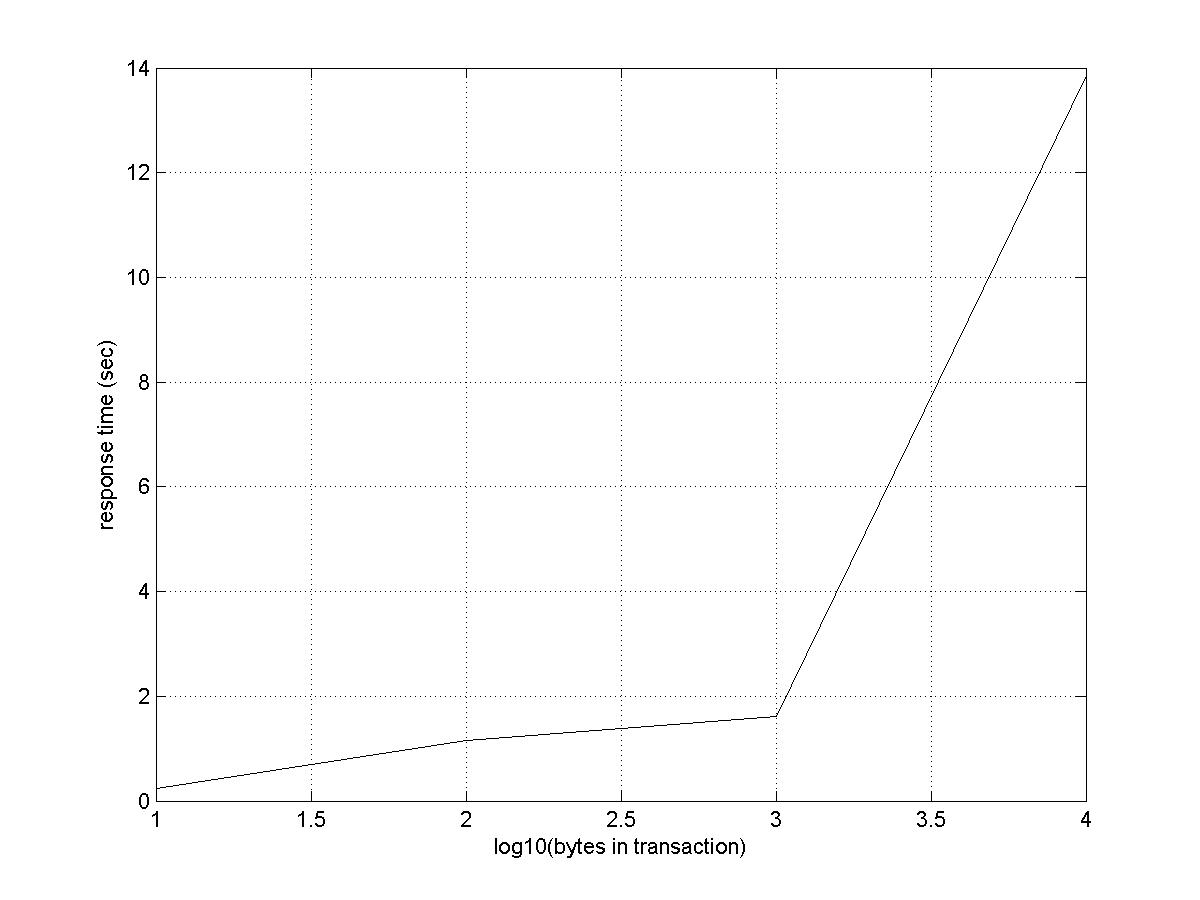
Figure 3
Future directions:
We plan to continue the development of the prediction framework.
Of particular interest is to develop an operational modeling
language (with compiler support) and to develop the performance models
of a WebService
environment.
All of our code is available. Please send us an email and we will
get it to you. We would welcome collaboration with others from
academia or industry.
Self-Managing cable broadband access networks: an approach for
handling P2P traffic
The Data Over Cable Service Interface Specification (DOCSIS) defines
a set of standards that support the transport of data over a cable
network. The MAC layer used in DOCSIS systems is specified in the
Radio Frequency Interface []. The current version of DOCSIS
(v2.0) supports symmetric (upstream and downstream) throughputs in
excess of 30Mbps. The next version (v3.0) increases channel
capacity by over an order of magnitude
through channel bonding techniques. It is unclear how these
higher
access speeds will be offered to subscribers. The cable industry
is
in turmoil trying to manage subscribers at today's service rates (6Mbps
downstream and 1 Mbps upstream are considered typical). The
problem
is that the vast majority of bandwidth is consumed by a small number of
subscribers who operate peer-to-peer (P2P) applications. Of
particular
concern is BitTorrent as it was designed to operate efficiently in
broadband
access environments.
BitTorrent is a peer-to-peer (P2P) protocol that provides scalable file
sharing capabilities. As in other P2P systems, BitTorrent
provides an overlay network that runs over the Internet. BitTorrent is
unique from other P2P protocols in several aspects. The most
notable of these are: 1) the use of swarming; 2) the use of incentives
to prevent free-riding. BitTorrent, frequently the dominant
application in a network, poses a dilemma for cable network service
providers. In general, P2P applications are broadband
application that contribute to the demand for high speed broadband
access. This usage is driven by younger Internet users. In a recent
study, it was estimated that about 58% of American teenagers with
broadband access have downloaded audio and/or video files from the
Internet using P2P networks. However, BitTorrent can
consume tremendous amounts of bandwidth in both
the upstream and downstream directions. The primary incentive used by
BitTorrent to prevent free-riding is that the protocol mandadtes that a
file-downloader must make some content available for upload. One study
found that 18% of
all traffic is BitTorrent . The government and the cable industry are
addressing the evolving economic and policy issues. We have
recently completed a study that explores the impact that
BitTorrent users can have on
a cable network. Please refer to this paper for preliminary results.
The bottom line is that a small number of BT users can impact other,
more well behaved, users. So how does all this relate to
autonomic
computing? We believe that broadband access can benefit
greatly
from autonomic technology. In our current research, we are
modifying
the DOCSIS protocol to apply a bias against the subscribers that
consume
large amounts of bandwidth. The level of bias can be set by the service
provider. The project moves the monitor, analyze, plan and
execute
control loops that are required away from higher layer control
software
and instead integrates the capability within the protocol. The
research
issue is to understand the implications of this approach in addition to
developing
the protocol algorithm support.
Back to Jim Martin's Home Page

