This website is preserved for historical and scholarly reference and is no longer actively maintained.
Clemson University iTiger Project:
Developing the 'connected campus'
- This
project was supported by an internal grant from
CoES, Athletics, and CCIT at Clemson University
Contents
- Overview and
Project Objectives
- Project Status
- Project Results
- iTiger
Stadium Product: Architecture and Design
- Publications
- M.
Juang,
K. Wang, J.Martin, “A Measurement Study on
Link Capacity of a High Stress IEEE 802.11b/g
Network”, Proceedings of the 2008 IEEE International
Conference on Computer Communications and Networks (ICCCN
2008), (St. Thomas, Virgin Islands, August 2008).
- J. Martin, M. Westall,
"Broadcasting Video in Dense 802.11g Networks Using
Application FEC and Multicast", submitted and under
review.
- MS Thesis Rob Johnson, "Evaluating
the USE of SNMP as a Wireless Monitoring Tool for IEEE
802.11 Wireless Networks", May 2009.
- Press
Overview and
Project Objectives
The iTiger project is a synergistic partnership of athletics,
business, academia, and industry with a common goal of shaping and
realizing a new mobile wireless experience. The iTiger concept will
ultimately lead to real time communication from a person’s mobile
device to an interactive landscape that is prevalent, useful,
entertaining, and location sensitive. The initial phase will focus
on creating a student-driven living laboratory within Clemson’s
athletic facilities.
We have created a course
to help nurture student involvement in the iTiger project.
For now, this course is at the 'pre-Creative Inquiry' stage.
Our goal is to develop sufficient interest in the student
population in the iTiger campus project to sustain a multi-year
Creative Inquiry. To achieve the full potential we would
like undergrads from many different colleges and programs to
participate.
iTiger is best described as a vision. We are
developing the concept of the 'connected
campus'. As you drive on campus, your personel
communications device (phone, netbook, ...) informs the 'cyber
system' that you are on campus. Once you have activated the
system, location-aware and context-aware applications
come alive to serve you! What a
concept!
Research Objectives
The research
perspective includes developing innovative cyberinfrastructure to
support the applications and services, exploring wireless
issues specific to an athletic stadium venue, and developing
the idea of the ‘next generation’ stadium.
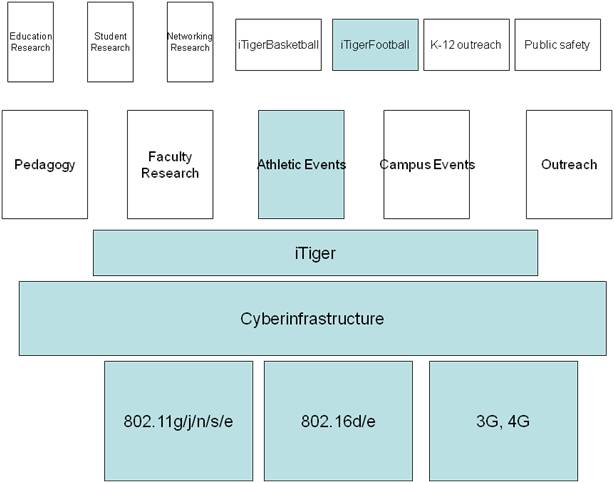
Figure 1. System Overview
Figure 1 illustrates the iTiger concept. iTiger is a domain specific
component of the larger issue which is to extend the scope of
‘cyberinfrastructure’ for devices connected by broadband wireless
networks. iTiger provides a focus (in an athletics venue) allowing
us to develop our ideas. iTiger is middleware that enables
applications that cater to powerful handheld devices that have
connectivity to broadband wireless networks. A recent article in ACM
Communications magazine ("Get Smart" by Alex Wright, Communications
of the ACM Volume 52, Number 1, 2009) correctly points out that the
current generation of smartphones are "little more than
stripped-down PCs, with tiny screens and maddening keyboards".
Next generation devices such as Apple's iPhone are addressing
this. Future devices will have radically different user
interfaces, enabling users to participate in immersive,
context-aware (possibly virtual) environments.
Research Problems
iTiger is fertile ground for new, impactful research. Examples
include:
- Systems and Networking
research: Basic questions such as how can dense
deployments involving thousands of be supported. Related,
how can bandwidth demanding applications such as video
streaming, gaming, or virtual reality environments be
supported. How can heterogeneous wireless systems interact
and cooperate to serve as a single, unified, wireless cloud?
- Human Computer Interface:
Next
generation
mobile
devices will offer radically different user interfaces. Our
current experience with iTiger at Clemson football games
confirms that current HCI based on web 1.0 or even web 2.0 will
be of interest to a small subset of users. New approaches
are required.
- Cyberinfrastructure:
There
is
a
uniqe opportunity to define and standardize the
cyberinfrastructure required to support the 'connected campus'.
In order to support tens of thousands of devices in dense
deployments, the underlying architectures must support
scale. How can this be done?
- The Stadium of the Future:
We
have
the
unique opportunity to create, develop, and study the next
generation athletics stadium. The stadium of the future
will offer the 'wired spectator' a radically different
experience. We envision a 'cyber stadium' active concurrent with
the live event on the field. Fans, in the form of avators,
participate in activities in the 'cyber stadium'.
What happens in a stadium when 50,000 fans operate their mobile
device as a pointing device in a virtual cyber
environment? What happens when the cyber stadium
environments go behond the walls of the stadium? There is
no reason (well....content ownership laws do come into play) why
fans from one stadium can not participate in the cyber stadium
experience occuring at a stadium located across the world.
There is no reason why video content production (either for
broadcast cable/TV or for the Internet) has to be physically
done within the stadium? What is required to create a
virtual content production site that can be physically
located anywhere in the world?
Tiger
Stadium Product: Architecture and Design
- System Diagrams
- System Description and Design
Back to Jim
Martin's Home Page
8-17-2011