Developing the CyberInfrastructure to Support
the Emerging Smart Grid
Warning: Page Under Construction:

Developing the CyberInfrastructure to Support
the Emerging Smart Grid
James Martin
Associate Professor
School of Computing
Clemson University
211 McAdams
Clemson, SC 29634-0974
Email: jim.martin@cs.clemson.edu
Phone: 864 656 4529
Fax: 864 656 0145
Students:

Abstract
The Smart
Grid will modernize the current power grid by adding support for
communication, monitoring, and device control. Networking is crucial to
the Smart Grid. While there has been significant debate over the
details of the Smart Grid, it is clear that there will be a
“cloud” component that interacts with a large number of Smart Grid
enabled cyberinfrastructures. The research addresses problems
caused by network issues that could impede the adoption of Smart
Grid technology in residential or small business environments. For
example, in a residential environment, the Smart Grid will have to
deal with multiple, diverse independent networks ranging including
802.15.4, 802.11, and broadband access (both wired and wireless). Using simulation, our
goal is to show that an unmanaged collection of non-cooperating
wireless networks is not able to support critical applications
required by the Smart Grid. We
propose a novel architecture that addresses the core issues. Our approach is
motivated by the tremendous advances that are occurring in
reconfigurable hardware. We assume that future devices (from
refrigerators, to sensing devices to smartphones) will not be
limited to static, single-purpose radios but instead will offer
reconfigurable capabilities. Using simulation, the proposed
research will develop, demonstrate, and evaluate an architecture
and a system that creates a unified wireless network based on
multiple underlying networks of different radio technologies but
where the devices are highly adaptive. The goal of the research
is to quantify the potential improvements the proposed system
offers compared to the current model where a Smart Grid overlay
exists in an area where non-cooperating wireless networks provide
network access. We study residential scenarios to help provide
focus to the proposed year-long project, however the all aspects
of the project (i.e., the methods, analysis, and results) apply
directly to small businesses.
Description
of the Project
The United
State’s Department of Energy has been mandated to modernize the
national electric grid.
The DOE states that the objectives include increasing the
reliability of the Nation’s power distribution, maintain its
affordability, reinforcing the Nation’s global competitiveness,
accommodating renewable as well as traditional energy sources,
reducing the Nation’s carbon footprint, and enabling advancements
that have not yet been envisioned.[1] Two of the five
core technologies that the DOE has identified to achieve the
objectives include integrated
communications and sensing/monitoring. Our proposed project is
designed to explore the underlying networking issues that are
firmly engrained in these core areas.
In this
proposal, we cast the discussion to a residential or home office
environment. The
ideas and results developed in this research are directly
applicable to many small business environments. A portion of the ideas
and results are applicable to large businesses, although
additional factors need to be considered in larger size
organizations.
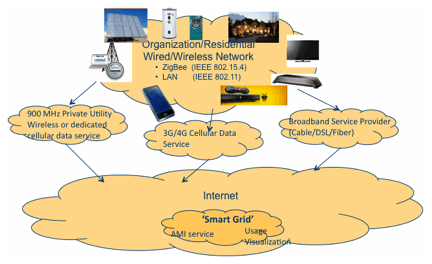
Figure 1
illustrates the essence of the Smart Grid. The cloud will provide a
set of services such as the Advanced Metering Infrastructure (AMI)
and usage visualization.
The AMI provides a standards-based system to facilitate
economic models for consuming or sharing energy. Visualization services
will allow organizations (i.e., energy consumers) to monitor how their
energy consumption compares to desired or expected behavior.
[1]
From “The Smart Grid: An Introduction”, available online at
http://www.oe.energy.gov/DocumentsandMedia/DOE_SG_Book_Single_Pages(1).pdf
Network
communication is fundamental to the model illustrated in Figure 1. The Smart Grid will be
an overlay network that operates over multiple underlying
networks. The
Internet is used to connect individual sites to the cloud. For residential (and
small business) a wired broadband access service will likely be
used such as Cable, DSL, or fiber-based services. At a site, there
will likely be multiple wireless access technologies that come
into play. Smartphones
are expected to make up over 50% of all cell phones that are in
use by 2014[1].
Therefore, wireless service based on cellular-based 3G or 4G
technology will be a connectivity option in many residential
environments. The
current generation of access to the Smart Grid is likely to
involve a dedicated broadband wireless service either operated by
the utility company or operated by a cellular provider. Unlicensed spectrum
operating at the 900 MHz ISM band is widely used.
A
cyberinfrastructure supporting a Smart Grid will provide one or
more wireless networks. There has been tremendous debate as to
whether radio access technology based on IEEE 802.15.4 or IEEE
802.11 should be used. Devices
that have extreme power limitations (e.g., sensing devices) are
much better suited for 802.15.4.
Devices that are not as constrained or that have direct
access to the power grid are better suited for 802.11. In the future, we
anticipate that either new wireless connectivity options or hybrid
options based on current wireless technologies will be introduced
further adding to the debate.
The
current trends, therefore, suggest that emerging Smart Grid
cyberinfrastructures will have to support a mix of diverse
wireless technologies that form independent, non-cooperative, and
sometimes competing wireless networks. The problem that we
address in the proposed research is to develop methods by which
underlying independent wireless networks can cooperate to form a
unified wireless network that better serves critical applications
and services that are required by the Smart Grid. We identify the
following specific problems that must be solved:
Using simulation we will
analyze networking issues in a Smart Grid. We identify two
phases of the study. The first phase, which is
the scope of this proposal, will focus on the resource
management problem (number 1 listed above). In phase 2, which could
potentially be year 2 of this project, would focus on problems 2
and 3 listed above.
Project
objectives and goals
We define
the following objectives and goals of the proposed research:
·
Provide results that
demonstrate the capabilities of the emerging Smart Grid, focusing
on the ability of the cyberinfrastructure to support the necessary
applications and services. For example, in the infrastructure
visualized in Figure 1, it is reasonable to assume that the Smart
Grid will involve time-sensitive command and control messaging
between devices and the cloud.
Our goal is to show that in an unmanaged network (i.e.,
when the cyberinfrastructure consists of independent wireless
systems making their own resource allocation decisions, it is not
possible to support critical applications. The expected
results will provide a framework for assessing the effectiveness
of the Smart Grid at a residential or small business location. The
analysis will identify and quantify network design decisions and
configuration settings that have the most impact on the
performance of Smart Grid applications and services.
·
We propose a novel
architecture that addresses the core issues. Our approach is
motivated by the tremendous advances that are occurring in
reconfigurable hardware. We assume that future devices (from
refrigerators, to sensing devices to smartphones) will not be
limited to static, single-purpose radios but instead will offer
reconfigurable capabilities. Using simulation, the proposed
research will develop, demonstrate, and evaluate an architecture
and a system that creates a unified wireless network based on
multiple underlying networks of different radio technologies but
where the devices are highly adaptive. The goal of the research
is to quantify the potential improvements the proposed system
offers compared to the current model where a Smart Grid overlay
exists in an area where non-cooperating wireless networks provide
network access.
Deliverables
·
All simulation code
·
A conference paper
evaluating the ideas will be presented at IBM’s Academic
Conference held in RTP, NC.
·
One or more papers will be
published at a top level IEEE or ACM academic conference.