This website is preserved for historical and scholarly reference and is no longer actively maintained.
Brickles
This
game is very similar to Breakout, one
of the first commercial video games and a popular game played on Apple II
computers. This example has its origins in a course we developed to
teach object-oriented design concepts and C++ programming. Our goal was to
find an application whose design was simple enough to understand and complete
in a week of training while at the same time be both conducive to enhancements
and interesting to programmers whose backgrounds range over a variety of
application domains and environments.
Basic Brickles Components
Brickles is an arcade game whose
starting configuration is shown in Figure
1.
The play field is rectangular, bounded by two walls, a ceiling, and a floor.
The play field contains an array of bricks, referred to as the “brick pile.” A
player’s objective is to break all the bricks in the brick pile by hitting
each brick with a puck that can be struck by a paddle under player control.
When the puck hits a brick, the brick breaks. A puck bounces off walls, the
ceiling, bricks (as they break), and the paddle. At the start of play, a player
is given three pucks with which to destroy the bricks. A player wins a game
when all bricks have been broken. A player loses if the supply of pucks is
exhausted before all of the bricks are broken.
Figure 1 The Brickles Startup Configuration
When play starts, a puck placed in the center of the play field
begins to move in a downward direction. The paddle is controlled by the player
via a mouse attached to the computer. The player must move the paddle so that
the puck hits the paddle and not the floor. When the puck hits the paddle, it
bounces upward. Whenever the puck hits a brick, the brick is destroyed. If the
puck misses the paddle and hits the floor, it is removed from play and one of
the remaining pucks is put into play. If all pucks are lost to the floor, play
ends and the player loses.
Brickles Physics
As the puck moves through the play field, it encounters various components
of the play field. The interactions between them are as follows [see also Figure
2,
Figure 3,
and Figure 4].
Ceiling
and walls
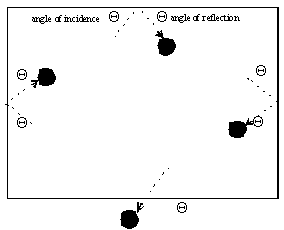
The puck bounces off the ceiling and walls in accordance with the
laws of physics, neglecting friction and gravity—that is, angle of reflection
equals angle of incidence.
Figure 2 Interactions between Puck and
Boundaries
Floor
The floor absorbs pucks. A puck that hits the floor does not
rebound, but is removed from play.
Bricks
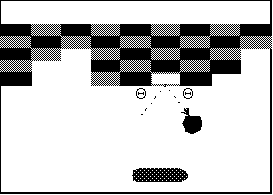
The puck bounces off a brick such that the angle of reflection
equals the angle of incidence. Upon being struck, a brick is destroyed. Note
that bricks can be hit by a puck from above as well as from below. They also
have sufficient thickness that they can be hit from the side. For the sake of
simplicity, it is acceptable to assume that bricks are treated as though they
have no thickness. Thus, it is only the vertical component of the puck’s direction
that is changed when the puck hits the brick.
Figure 3 Puck interactions with bricks.
Paddle
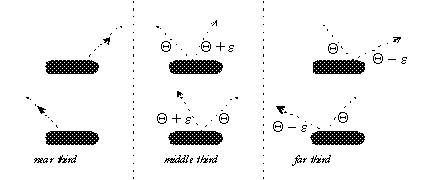
The player uses a paddle to control the direction of the puck.
The puck bounces off the paddle based on the direction of the puck as it hits
the paddle and on which part of the paddle is hit. Divide the paddle into
thirds and define the near third as
being the left third of the paddle if the puck is coming in from the left and
the right third if the puck is coming in from the right. Define the far third similarly, and the middle third as the remaining third. The
rules of reflection are as follows:
·
If the puck hits the paddle on its near third then the
puck returns in the exact opposite direction from which it came.
·
If the puck hits the paddle on the middle third then
the angle of reflection is a little steeper than the angle of incidence. The
puck’s movement is constrained such that it must never be completely vertical.
·
If the puck hits the paddle on the far third then the
angle of reflection is a little shallower than the angle of incidence. The
puck’s movement is constrained such that it must never be completely
horizontal.
Figure 4 Puck interactions with the paddle.
Puck
The player is given a fixed number of pucks at the beginning of
the game, but only one is in play at any given time. Once one puck hits the
floor, the next is brought into play, assuming another is available. The puck
has a current direction and speed and moves according to an automatic timer. As
seen above, collisions may change the direction of the puck, but not the speed.
Game Environment
The first implementation of Brickles
is to run as an application within a Microsoft Windows® environment
and behaves as follows:
·
The game shall start when there is a left mouse button
click.
·
A player can “exit” the game at any time before it is
won or lost.
·
A player can “pause” the game at any time until play
ends.
·
A player can “resume” a paused game.
·
A congratulatory message shall be displayed in the case
of a player winning the game. Similarly, a consolation message shall be
displayed in the case of a player losing the game.