This website is preserved for historical and scholarly reference and is no longer actively maintained.
Pong
In this document we will explain the game of Pong, an interactive computer game. This implementation is
very similar to a number of other
versions of the game.
Basic Pong Components
Pong is an arcade game whose
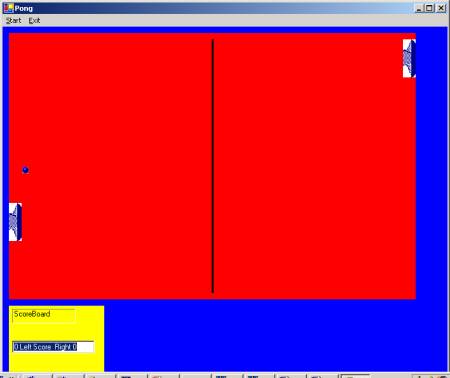
starting configuration is shown in Figure
1.
The play field is rectangular, bounded by two walls, a ceiling, and a floor.
The play field is empty except for a black strip for decoration.” A player’s
objective is to get a puck past his opponent. A puck bounces off the ceiling
and floor, and the paddles. A player scores a point for every puck absorbed by
the opponent’s wall.
Figure 1 The Pong Startup Configuration
When play starts, a puck placed in the center of the left wall
and begins to move the right and down. The paddle is controlled by the player
via a mouse attached to the computer. The player must move the paddle so that
the puck hits the paddle and not the wall behind the paddle. When the puck hits
the paddle, it bounces backward. If the puck misses the paddle and hits the
wall, it is removed from play and one of the remaining pucks is put into play.
Pong Physics
As the puck moves through the play field, it encounters various
components of the play field. The interactions between them are as follows [see
also Figure 2
and Error! Reference source not found..
Ceiling
and floor
The puck bounces off the ceiling and floor in accordance with the
laws of physics, neglecting friction and gravity—that is, angle of reflection
equals angle of incidence.
Figure 2 Interactions between Puck and
Boundaries
Wall
The wall absorbs pucks. A puck that hits the wall does not
rebound, but is removed from play.
Paddle
The player uses a paddle to control the direction of the puck.
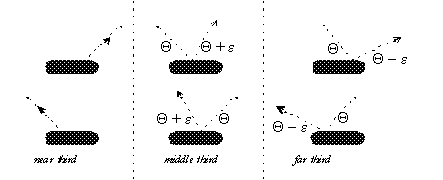
The puck bounces off the paddle based on the direction of the puck as it hits
the paddle and on which part of the paddle is hit. Divide the paddle into
thirds and define the near third as
being the left third of the paddle if the puck is coming in from the left and
the right third if the puck is coming in from the right. Define the far third similarly, and the middle third as the remaining third. The
rules of reflection are as follows:
·
If the puck hits the paddle on its near third then the
puck returns in the exact opposite direction from which it came.
·
If the puck hits the paddle on the middle third then
the angle of reflection is a little steeper than the angle of incidence. The
puck’s movement is constrained such that it must never be completely vertical.
·
If the puck hits the paddle on the far third then the
angle of reflection is a little shallower than the angle of incidence. The
puck’s movement is constrained such that it must never be completely horizontal.
Figure 3 Puck interactions with
the paddle.
Puck
The player is given a fixed number of pucks at the beginning of
the game, but only one is in play at any given time. Once one puck hits the
wall, the next is brought into play, assuming another is available. The puck
has a current direction and speed and moves according to an automatic timer. As
seen above, collisions may change the direction of the puck, but not the speed.
Game Environment
The first implementation of Pong
is to run as an application within a Microsoft Windows® environment
and behaves as follows:
·
The game shall start when there is a left mouse click.
·
A player can “exit” the game at any time before it is
won or lost.
·
A player can “pause” the game at any time until play
ends.
·
A player can “resume” a paused game.