
Warning: This page is under development. Material on this page was last updated: 8/28/2018
Summary:
By the end of the decade, it is expected that the US Department of Transportation (DOT) will require all new vehicles to be capable of communicating with other vehicles and roadside infrastructure through wireless communications. The primary motivation of connected vehicles (CV) envisioned by the US DOT is to reduce the number of crashes that cost more 30,000 lives every year on the US highways. The crash avoidance applications supported by vehicle to vehicle (V2V) and vehicle to infrastructure (V2I) connectivity exchange safety critical information such as speed, location and direction of movement to assess the crash risk based on the proximity of vehicles. It is expected that connected vehicle technology (CVT) will also provide additional benefits in terms of improved traffic operational performance, reduced energy consumption, and reduced pollutant emissions. These applications have diverse goals, properties, and network requirements.
The US DOT has developed a roadmap for CVT referred to as the Connected Vehicle Reference Implementation Architecture (CVRIA). The CVRIA provides a guide for the research and development of CVT by providing a detailed system architecture that involves vehicles and road side equipment equipped with communications and information processing capability, allowing vehicles to be aware of their status and to communicate with each other, with surrounding infrastructure, and consequently with state DOT transportation management systems located in a hierarchical manner throughout an area, city, and state. CVRIA assumes a vehicle platform on a vehicle that represents the interface to the vehicle’s sensor, GPS, automotive systems, safety devices, and information and entertainment systems. The vehicle also contains On-Board Equipment (OBE) which provides the vehicle-based processing, storage and communications functions necessary to support vehicle operations. The OBE interacts with Roadside Equipment (RSE) and other vehicles (referred to as Remote Vehicle OBEs) using specific messages, communications protocols over a dedicated wireless network operating at licensed spectrum at 5.9 GHz. A set of IEEE standards, collectively referred to as Wireless Access for Vehicular Environments (WAVE), specifies security mechanisms, network services, and a variant of Wi-Fi, IEEE 802.11p, for the radio access layer. The term Dedicated Short Range Communications (DSRC) is also used to identify CV wireless technology. Figure 1 illustrates a simple CV scenario. Vehicles 1 – 3 arrive to find an unexpected event in the road (e.g., accident or perhaps an object blocking the lane). Vehicle 1 might detect the event, and send a message to Vehicle 2 through a DSRC, which forwards to Vehicle 3. The RSE would be informed and could broadcast a message alerting Vehicle 4 of the situation.
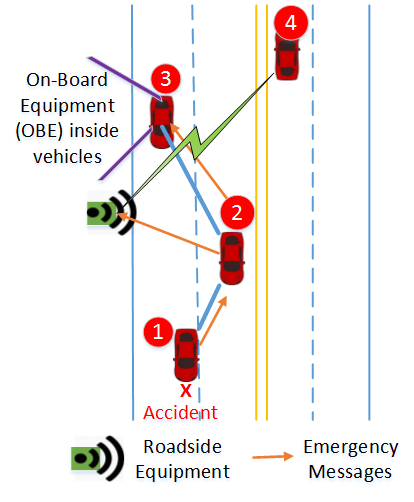
Figure 1. Simple CV Scenario
While DSRC has been considered as the primary technology for CV safety critical applications, other wireless technologies, such as LTE, WiMAX, and Wi-Fi, are also easily accessible by connected vehicles. These technologies can supplement availability, coverage, and peak data rate requirements that could not be supported by DSRC communications alone. It has been pointed out that DSRC will not be sufficient to support the breadth of applications outlined by CVRIA. The issue of how non-DSRC wireless networks can embellish vehicular networks is a widely studied research area. The automotive industry is adopting these network technologies to enable CVT to provide applications supporting navigation, safety, vehicle maintenance, and entertainment.
Non-DSRC network technology, in particular LTE-A, is rapidly advancing. The main benefit of LTE-A is data rates that can offer peak speeds of up to 1 Gbps. Actual download and upload speeds depend on many factors but sustained download speeds of 40 Mbps have been observed. Other features of LTE-A will be added and deployed in the future include support for Machine-to-Machine (M2M), carrier aggregation, and support for heterogeneous wireless networks (i.e., HetNets). Currently LTE considers a HetNet to be a cellular network that includes small cell technology, such as pico or micro cells. However, cellular operators are adding other HetNet techniques including coordinated use of WiFi or LTE operating at unlicensed spectrum.
It is clear that broadband wireless networks will continue to improve. Other advanced networking technologies, such as software defined networks (SDN) and network function virtualization (NFV) will also have an impact on CVT over the next decade. These networking advances motivate the proposed research. Leveraging ongoing NSF-funded wireless infrastructure research projects at Clemson University, and partnering with the South Carolina Department of Transportation (SC DOT), we plan to develop a CV testbed. The South Carolina Connected Vehicle Testbed (SC-CVT) will be located along a 10 mile segment of Interstate I-85 near Clemson’s International Center for Automotive Research (ICAR) campus in Greenville South Carolina. Clemson University and SC DOT have a Memorandum of Understanding (MOU) that will allow Clemson researchers utilize the communication and other roadway infrastructure owned and maintained by SC DOT, and install connected vehicle equipment, such as on-board equipments (OBEs) on SC DOT vehicles and road side equipments (RSEs) on highways, to perform CVT research for the proposed project.
Figure 2 illustrates how SC-CVT co-exists and co-mingles with SC DOT infrastructure that is co-located in the area. Aside from the actual road, SC DOT has other infrastructure at the SC-CVT location, which includes dark fiber that runs under the road, signage, and video cameras. SC-CVT will use SC DOT’s fiber and infrastructure to contain (and power) SC-CVT equipment. SC DOT obtains sensing data that is used by traffic management systems in their production network (we will provide more details on this in the next section). They provide web APIs allowing third parties or the public to access information, such as traffic congestion conditions. CVT effectively allows all cars to serve as sensors. In SC-CVT, at least initially, vehicles that are operated and maintained by SC DOT will be equipped with CVT hardware and software. These vehicles will generate sensing data. We will make our data available to SC DOT through a web API.
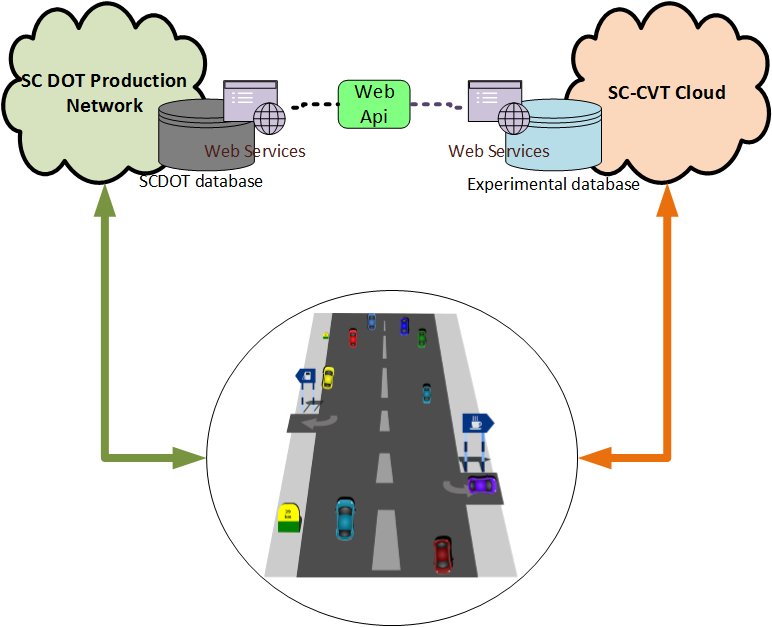
Figure 2. SC-CVT co-existence with SC DOT infrastructure
We are developing a number of CV applications, including queue warning, traffic incident detection, collision avoidance and cooperative and adaptive cruise control. These applications provide a convenient starting point for illustrating how CV applications can benefit from advanced wireless network infrastructure. The application concepts are not new. Queue Warning is a well understood traffic management application which has been been modernized by the US DOT to work in a DSRC environment. As our results show, there is sufficient functional dependency over a number of CV applications that is best addressed through a cloud to th edge software systems model. The further benefit of this approach is that it is naturally supportive of a shared infrastructure paradigm which would be timely given the current interest on smart cities and the Internet of Things.
Links:
Other material