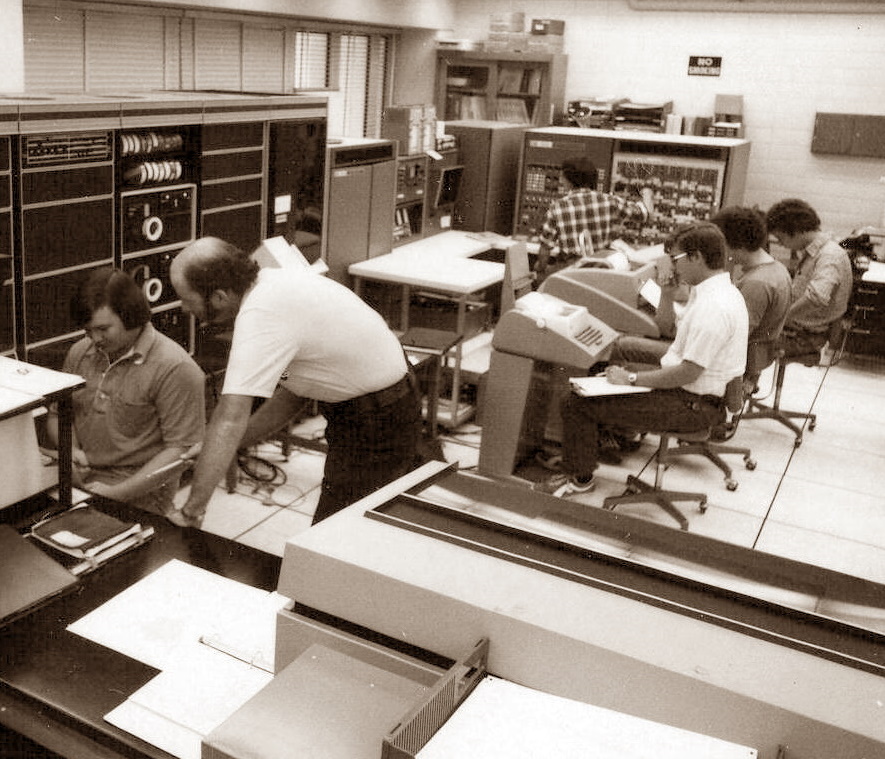
Major Computer Systems at Clemson University
updated March 18, 2026
Corrections are welcome!
The purpose of this page is to provide a list of the major
computer systems that have been installed at locations
owned or operated by Clemson University over the years.
This list does not include the numerous personal computers
and workstations that became common at Clemson University
from the 1980s onwards unless they were organized into a
cluster. Note that many of the clusters listed below were
upgraded over the years, and what appears below is typically
the initial configuration.
This list omits the large secondary storage systems
installed at Clemson University over the years, including
a StorageTek STC 4305 early solid-state disk in 1980,
a StorageTek STK 4400 Library Storage Module for automatic tape
cartridge handling in 1988, and the Indigo Data Lake in 2024,
and the many special purpose I/O
devices acquired over the years, including large plotters
and numerous head-mounted displays for virtual reality.
It is noteworthy that in 2008 Clemson University had two
computer systems appear in the
TOP500 supercomputers in the world list:
the Palmetto cluster at #61 and the CCMS cluster at #100.
In addition to the university-wide Computer Center systems,
many colleges, departments, and research centers have their
own computers and labs. There are multiple reasons for this
decentralized structure, including:
- alternate operating systems and software packages
to support curriculum and research
- special purpose hardware and software for research
- special security and access privileges for faculty and
students to support research
- directed gifts to that academic unit
The College of Agriculture and the College of Engineering,
and the Department of Chemical Engineering, the Department of Computer
Science, and the Department of Electrical and Computer Engineering
were early users of minicomputers, microcomputers, and workstations
as well as software that differed from what the Computer Center
supported. This started in some cases as early as the 1960s. By the
1990s, many additional academic units and research centers had their
own computer systems and labs.
It is also noteworthy that Walt Ligon's Parallel Architecture Research
Lab in the Department of Electrical and Computer Engineering not
only built multiple Beowulf cluster computing systems in the 1990s
and 2000s, including the Minigrid cluster that became part of Palmetto,
but also between 1999 and 2003 PARL hosted the Beowulf Underground,
which was an important early source of information for research
groups around the world on how to build and use relatively
inexpensive Beowulf clusters.
Major Sections
This page is one of a series of timelines and highlights
about the history of computing at Clemson University:
Note on DCIT/CCIT acronyms: the Clemson University Computer Center
became part of the Division of Computing and Information Technology
(DCIT) in 1985, which was renamed as Clemson Computing and Information
Technology (CCIT) in 2007.
Computer Center
Link to references and further discussion
about the Computer Center in general
First Computer
- RPC 4000, 8,008-word magnetic drum memory, installed 1961

Sarah Skelton and Merrill Palmer at RPC 4000.
Photo courtesy of Don Fraser.
- References and further discussion
Mainframes
- IBM S/360 Model 40, 64 KiB magnetic core memory, 1966
- memory upgrade to 128 KiB core memory in 1967
- memory upgrade to 256 KiB core memory, 1968

George Alexander at the Model 40 console.
Photo from 1970-1971 Student Handbook.
- IBM S/360 Model 50, 512 KiB core memory, 1970
- IBM S/370 Model 155, 1 MiB core memory, 1972

Matt Laiewski at the Model 155 console.
Photo from clipping of Anderson
Independent, December 15, 1972, in
Series_0037_Computer Center 1970s_A.
- IBM S/370 Model 158, 1.5 MiB core memory, 1974
- later memory upgrade to 3 MiB core memory
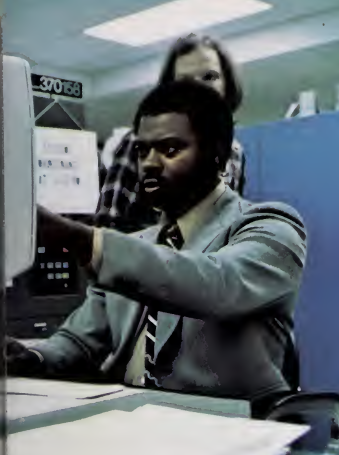
Doug Dawson at the Model 158 console.
Photo from 1976 TAPS yearbook.
- IBM S/370 Model 165-II, 4 MiB core memory, 1976
- later memory upgrade to 8 MiB core memory
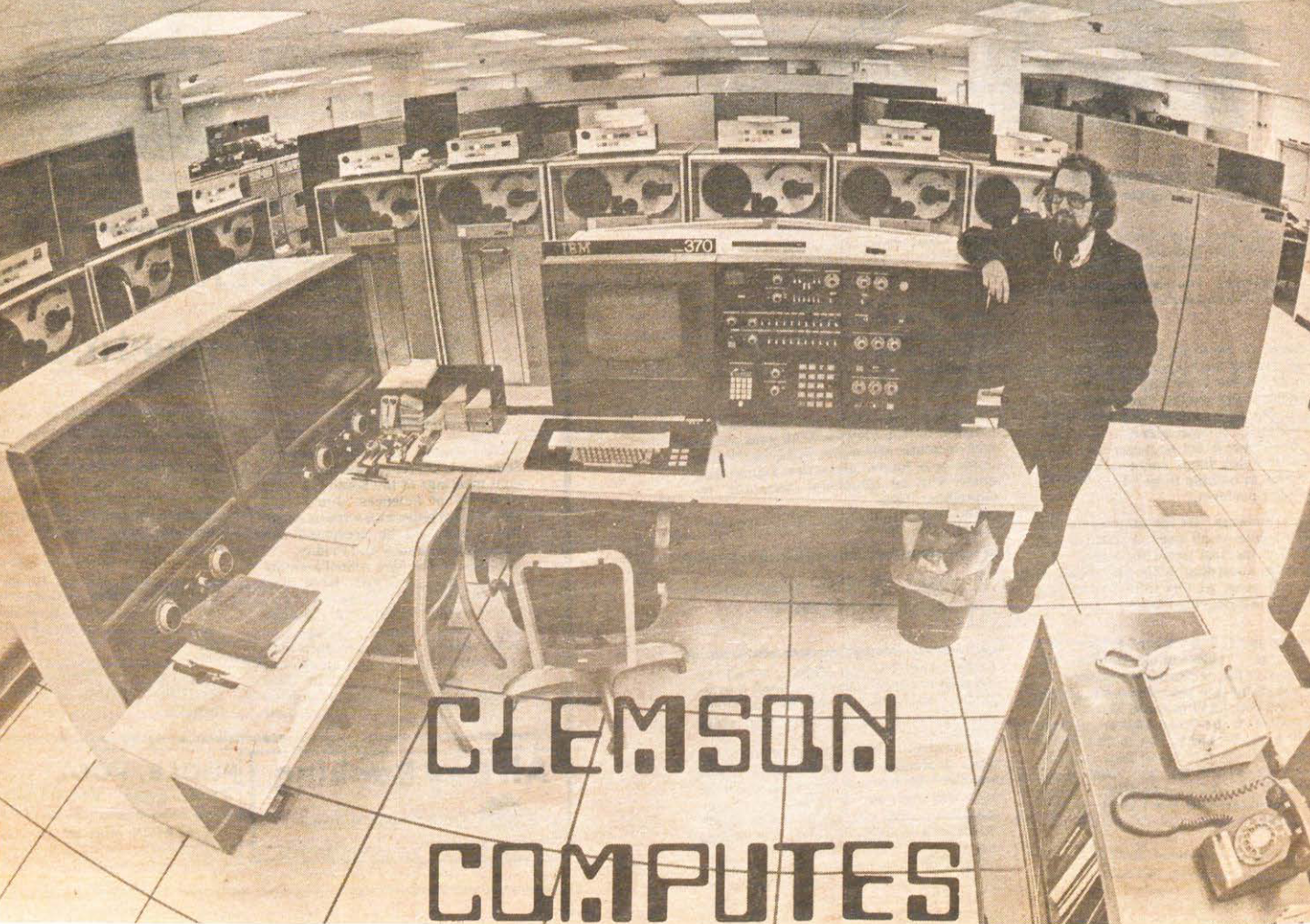
Page Hite, Jr., standing beside the 165-II console.
Photo from The Tiger, March 31, 1978.
- IBM 3033, 8 MiB semiconductor memory, 1979
YouTube video,
"Clemson Computer Center Tour, 1980,"
including a line printer playing the Tiger Rag at minute 9:30 of the video
- memory upgrade to 12 MiB memory, 1981
- IBM 3081-K, 24 MiB memory, 1982
- later memory upgrade to 32 MiB memory
- NAS AS/XL-60, 128 MiB memory, 1986
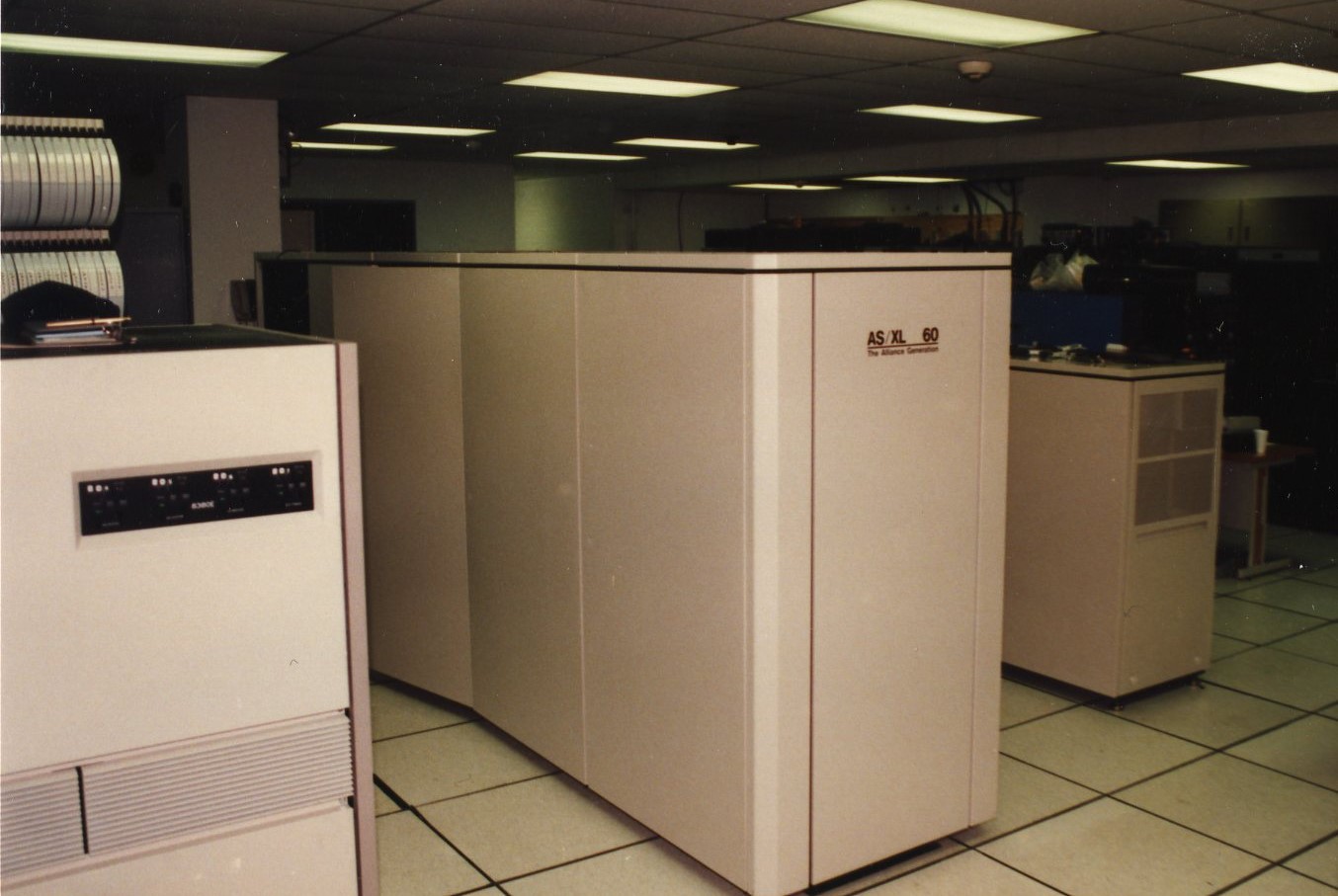
AS/XL-60 when being installed.
Photo courtesy of Clemson University Libraries
Special Collections and Archives.
- vector processor upgrade to NAS AS/VXL-60, 1987
- Note that Hitachi bought NAS in 1989, so NAS systems then
became HDS systems.
- HDS AS/EX-80, 128 MiB memory, 1990
- extra processor upgrades to HDS AS/EX-90 then
HDS AS/EX-100, 1994

Photos from computing@clemson.edu
newsletter, vol. 3, no. 3, Spring 1998.
- HDS Pilot 25, 1 GiB central memory,
215 GiB expanded memory, 1997
- extra processor upgrade to HDS Pilot 35, 1999
- reversion to HDS Pilot 25, 2000
- back to HDS Pilot 35, 2002
- IBM z800, 8 GiB memory, 2002

Photo from computing@clemson.edu newsletter,
vol. 8, no. 2, Winter 2002-2003.
- IBM z10 Business Class, 2009
- ca. 2015 the final enterprise mainframe applications for the
university were converted to or replaced by software packages that
run on other platforms.
At this point, the mainframe runs only SC DHHS applications.
- IBM z14, 2019
- References and further discussion about
the mainframe computers
VAX and Sun Servers
- Clemson University acquired two VAX-11/780 computers in 1982,
one in January and the second in July. They were first located in
Poole Hall, awaiting the renovation of Room 10 in the basement of
Riggs Hall, called the "Graphics and Research Center".
By fall 1983 both were in Riggs and had been assigned the system
names Grafix and Eureka, to match their intended usage. Later more
VAXes were added, and additional system names, such as Prism, were used.
System names were retained as older VAXes were retired and newer
ones replaced them; however, in one case in 1993 two existing VAXes,
Eureka and Gemini, switched names so that the more capable VAX 8820
could take over the name and role of Eureka to better meet user demands.

Gair Williams in Riggs Room 10, ca. 1983.
One of the VAX 11/780 systems is on the left wall,
behind the row of disk drives, and the other is on
the back right wall, behind an air conditioning unit.
Photo courtesy of Don Fraser.
-
Note: Clemson University had acquired some PDP-11s for the Computer Center
and later some microVAX II systems for Housing, University Relations,
and other groups; however, I am not cataloging these smaller machines.
- Eureka
- DEC VAX-11/780, 6 MiB, running VMS (primarily for research)
- DEC VAX 8600, 12 MiB, 1986
- DEC VAX 8650, 32 MiB, 1990
- DEC VAX 8820, 128 MiB, 1993
- retired 1994
- Grafix
- DEC VAX-11/780, 6 MiB, running VMS (for graphics applications,
with graphics workstations attached)
- retired 1986
- Prism
- DEC VAX-11/780, 8 MiB, running VMS, 1986 (for email?)
- DEC VAX 8650, 32 MiB, 1986
- DEC VAX 6000-410, 64 MiB, 1988
- became one of the two paired CLUST1 machines of the VAXcluster, 1990
- DEC VAX 6000-610, 256 MiB, running OpenVMS, 1994
- was scheduled to be decommissioned in summer 1997
- hubcap
- DEC VAX-11/750, 6 MiB, running Ultrix, 1985
- DEC VAX-11/780, 8 MiB, running Ultrix, 1986
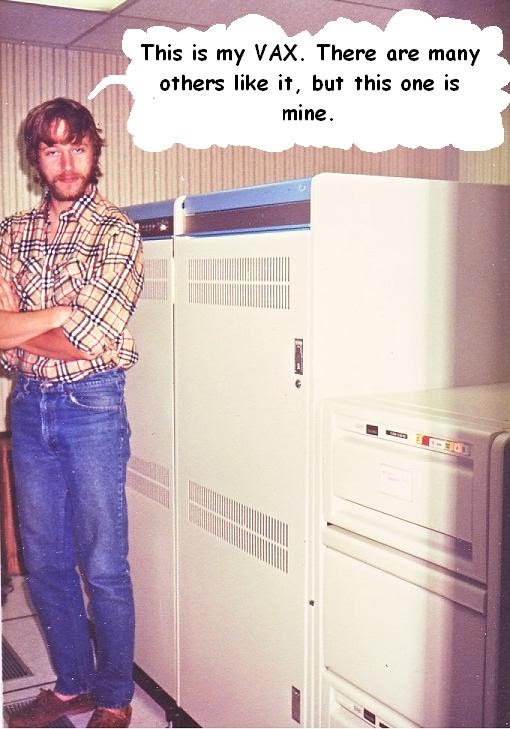
Mike Marshall standing
beside hubcap in 1987.
Photo courtesy of Mike Marshall.
- DEC VAX 8810, 112 MiB, running ULTRIX, 1988
- DEC 3000 model 500, 96 MiB, running OSF/1, 1994
- DEC Alpha 2100 4/275, running Digital UNIX, 1996
- Sun HPC 3000, running Solaris 2.6 (SunOS 5.6), 1998 to at least 2005
- 1.5 GiB of main memory, six 275 MHz processors, and a
refrigerator-sized RAID disk subsystem containing more
than 135 GB of disk storage [Condrey, et al., 1998]
- CUFAN (Clemson University Forestry and Agriculture Network)
- running on Eureka, DEC VAX 8600, 12 MiB, 1986
- running on Eureka, DEC VAX 8650, 48 MiB, 1990
- funded by College of Agriculture
- see
more information on the CUFAN network and videotex system
- CC
- DEC VAX-11/750 running VMS, 1986
- this may have been a machine that was used to develop
the videotex system as well as some research on multi-vendor
office automation interoperability
- DISD
- DEC VAX-11/750 running VMS, 1986
- used to develop administrative software for
many of the SC technical colleges
- Gemini
- DEC VAX 8820 dual processor, 128 MiB, 1988
- became one of the two paired CLUST1 machines of the VAXcluster, 1990
- DEC VAX 8650, 32 MiB, 1993
- retired 1994
- VAXcluster with shared disk pool
- started with the two 11/780 computers
- ca. 1985: three 11/780s
- ca. 1986: 8600 (Eureka), 8650 (Prism)
- ca. 1988: 8600, 8650, 8820
- ca. 1992: 8650, 8820, and 6000-410
- DEC VAXstation 4000-90 ("BATCH1") added to cluster in 1993
- Sun SPARCserver 1000, 1994
- a production system platform used for hosting the Clemson University
Data Warehouse and for gaining further experience in migrating
several online transaction processing applications from the
mainframe environment to a client/server environment
- Helios
- Sun HPC 6000, research-only, 1998
- 4 GiB of main memory, sixteen 275 MHz processors, and a
RAID subsystem similar to hubcap [Condrey, et al., 1998]
- computing@clemson.edu newsletter vol. 4, no. 1, says the
processors were initially 250 MHz and funding was committed
to upgrade to 336 MHz each
- mail servers after hubcap
- Sun Ultra Enterprise 3000, 1996
- four 248 MHz processors, 1 GiB memory
- Storage Works RAID Array 410 with a 24 GB RAID-5 RAIDset
- Sun Sunfire V880, 2003
- eight 750 MHz UltraSPARC III processors, 32 GiB memory
- T3 Fiber storage array
- References and further discussion about
the VAX and Sun servers
Condor
- Condor was a distributed system designed at the University of
Wisconsin in the mid-1980s to achieve high throughput computing
by scavenging unused cycles on otherwise idle computers. Starting
in 2007, Sebastien Goasguen led a team at Clemson University
to deploy Condor on the CCIT lab computers.
- References and further discussion
Palmetto
-
initial description in October 2007:
A "condo cluster" with 20 TF peak performance using 256 nodes;
8 cores per node; 12 GB/node; and 80 GB disk/node. This system
also contains 120 TB of large-scale, high performance disk
storage and is housed at Clemson's Information Technology Center.
- Palmetto was listed in November 2008 as the 61st fastest
supercomputer in the world in the
TOP500 list.
- As the cluster grew, faster nodes and faster interconnect
were added in phases. This type of cluster is termed as "heterogeneous",
and you can see changes in the system characteristics over the years
at the
Clemson University entry at top500.org.
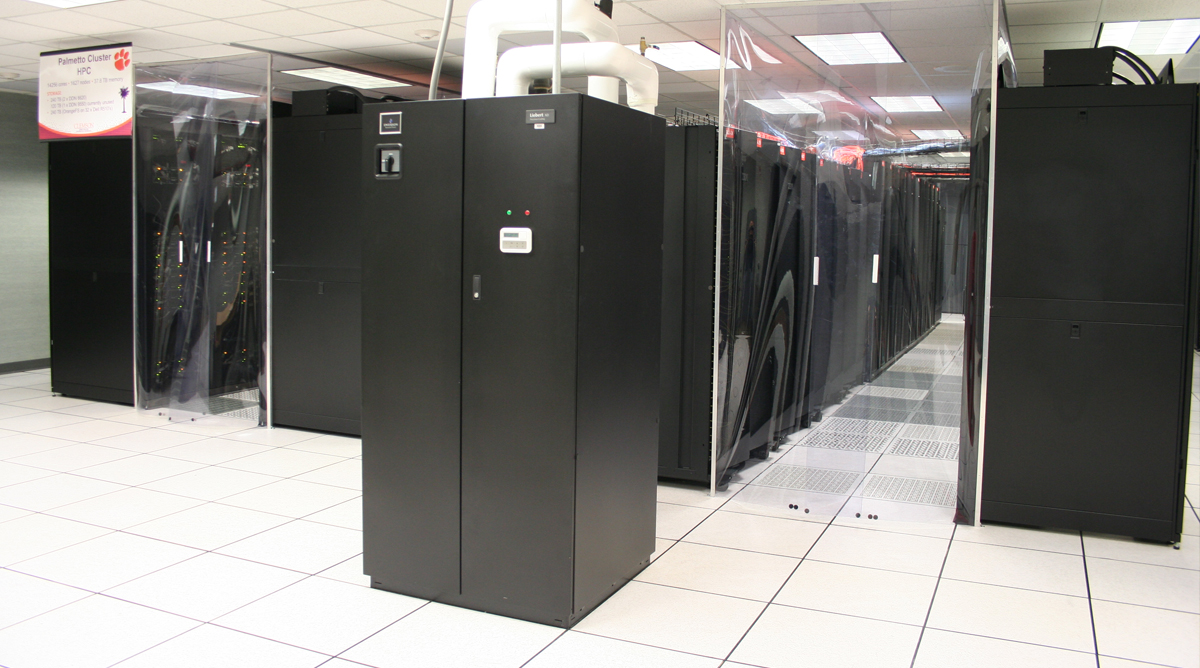
Promotional photo, not dated.
-
CCIT video of Palmetto for Supercomputing 2020,
which documents the early phases of Palmetto
-
CCIT time lapse video of installing 65 new nodes in Palmetto, 2024
- A brief history of Palmetto and a discussion of the
transition to Palmetto 2 are given in Asher Antao, et al.,
"Modernizing Clemson University's Palmetto Cluster: Lessons
Learned from 17 Years of HPC Administration,"
Practice & Experience in Advanced Research Computing (PEARC)
Conference, article 14, 2024, pp. 1-9.

Figure from the Antao, et al., paper.
- References and further discussion
Palmetto 2
- In 2024, CCIT introduced Palmetto 2, a "second iteration" of
Palmetto. See
Bailey Troutman,
"Palmetto 2 Goes Live to Elevate Clemson Research and Computing,"
Clemson News, May 13, 2024.
- As of January 2026, Palmetto 2 contains:
- 1,201 compute nodes, totaling 54,636 cores
- 21 large-memory nodes with over 1.5 TB of RAM each
- 3 extra-large-memory nodes with over 3 TB of RAM each
- 10 and 25 Gbps Ethernet networks
- 56, 100, 200, and 400 Gbps Infiniband networks
- benchmarked at 3.0 PFlops
- See the current description
here.
- References and further discussion
Cypress
-
a dedicated Hadoop environment integrated with Palmetto
-
3.64 PB (petabyte) global Hadoop Distributed File System (HDFS)
-
40 worker nodes (responsible for computation and data storage)
-
256 GiB of RAM per node
-
16 nodes each have 12 1-TB local disks
-
24 nodes each have 24 6-TB local disks
-
one dedicated Cypress Cluster user node for job submission
and data staging
Lakeside
- A research cluster that was built for a partnership with Dell.
This partnership opportunity, however, did not materialize, and the
cluster was later merged into Palmetto.
- 1 head node Dell PowerEdge R620 with 2 x Intel Xeon E5-2665
@ 2.4 GHz CPUs / 32 GiB RAM
- 1 scheduler node Dell PowerEdge R620 with 2 x Intel Xeon E5-2665
@ 2.4 GHz CPUs / 32 GiB RAM
- 1 login user node Dell PowerEdge R620 with 2 x Intel Xeon E5-2665
@ 2.4 GHz CPUs / 32 GiB RAM
- 88 Dell PowerEdge C6220 compute nodes with 2 x Intel Xeon E5-2665
@ 2.4 GHz CPUs / 64 GiB RAM
- 8 Dell PowerEdge R720 GPU Compute nodes with 2 x Intel Xeon E5-2665
@ 2.4 GHz / 64 GiB RAM / 2 x Nvidia M2070 GPUs
- 40G QLogic Infiniband interconnect
CloudLab
- CloudLab is an NSF-funded testbed to allow
researchers to build distributed computer systems along with
administrative privileges for research experiments in cloud computing.
Clemson has been involved and providing hardware resources to the project
since 2014 under the leadership of K.C. Wang.
- References and further discussion
Current Facilities
College of Engineering
- Engineering Computer Laboratory
- Engineering Sun Network / Computer and Network Services (CNS)
- several Sun servers starting in the 1980's, including omni,
which in 1989 was a Sun 4/280
- a dedicated system staff supported the numerous workstations,
servers, personal computers, and laptops within the college
Chemical Engineering
- Process Control Computer Laboratory
- EAI TR-48/DES-30 analog/hybrid computer, 1968 or earlier
- GE 312 process control computer, 1968

Robert Edwards (University President),
Duane Bruley, and Charles Littlejohn, Jr.,
with the EAI system against the back wall on
the left side and the GE 312 on the right.
Photo from The Tiger, August 30, 1968.
- References and further discussion
Electrical and Computer Engineering
- DEC CLASSIC 8, 1966
- a 1975 equipment list included the CLASSIC 8 and the two College of
Engineering systems listed above, plus:
- DEC PDP-8 with laboratory hardware interface
(for a gas chromatograph or sampling oscilloscope)
- DEC PDP-8/EAI TR-48 Hybrid
- DEC PDP-11 running RSTS
- DEC PDP-16
- INTEL INTELLEC-8/Mod 80 microcomputer development platform
- ECE Graduate Computer Laboratory
- established by Jim Leathrum
- Harris 800, 512 KiB, 1983
- Parallel Architecture Research Lab (PARL)
- established by Walt Ligon
- Clemson Dedicated Cluster Parallel Computer, ca. 1996
- 12 DEC Alpha CPUs at speeds ranging from 175-300Mhz
- connected by a fiber optic crossbar switch

Photo courtesy of Walt Ligon.
- Grendel, also known as the Clemson Beowulf Cluster, ca. 1997
- 16 150MHz Pentium processors with 64 MiB of RAM and 2 GB of
disk each
- an additional processor used as the system host
- two switched 100 Mbps fast ethernet networks
- a bus network using a stack of AsanteFast 100 Hubs
- a full-duplex switched network using a Bay Networks 28115/ADV
fast Ethernet switch
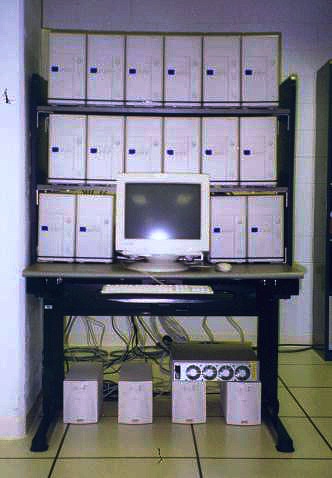
Photo courtesy of Walt Ligon.
- 5-node Travelwulf, ca. 2000
- each node could fit in a suitcase and then be assembled
into a cluster at a travel destination
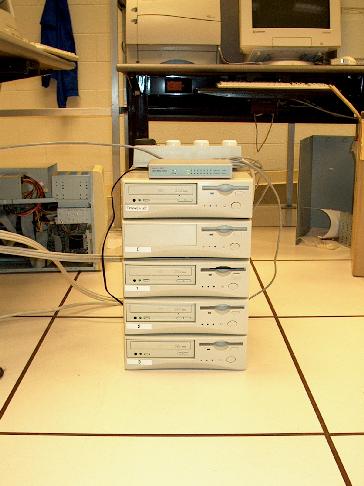
Photo capture from PARL
page on Internet Archive.
- 8-node Webwulf, ca. 2000
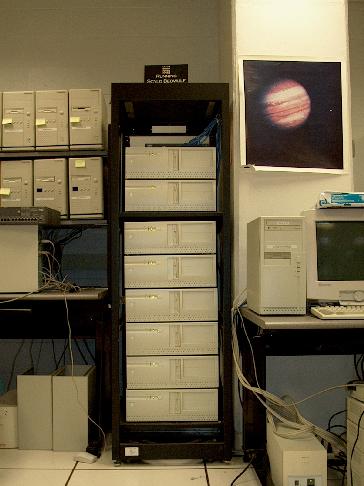
Photo capture from PARL
page on Internet Archive.
- 10-node Aetherwulf, ca. 2002
- description from an
archived PARL web page:
Aetherwulf is a small rack-mountable Beowulf cluster made from
10 single board computers. Each node consists of a 1GHz Pentium
3 processor, 30GB IBM Travelstar laptop drive, 256MB ram, and
build in NIC and video. The case was designed to be clear for
demonstration purposes.
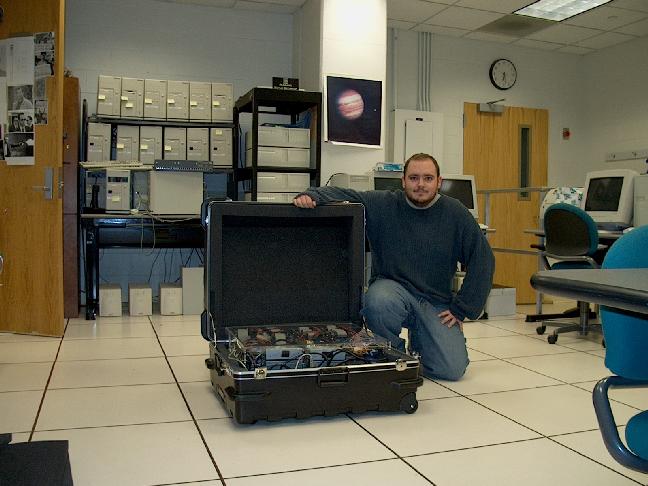
Nathan DeBardeleben and Aetherwulf.
Photo capture from PARL
page on Internet Archive.
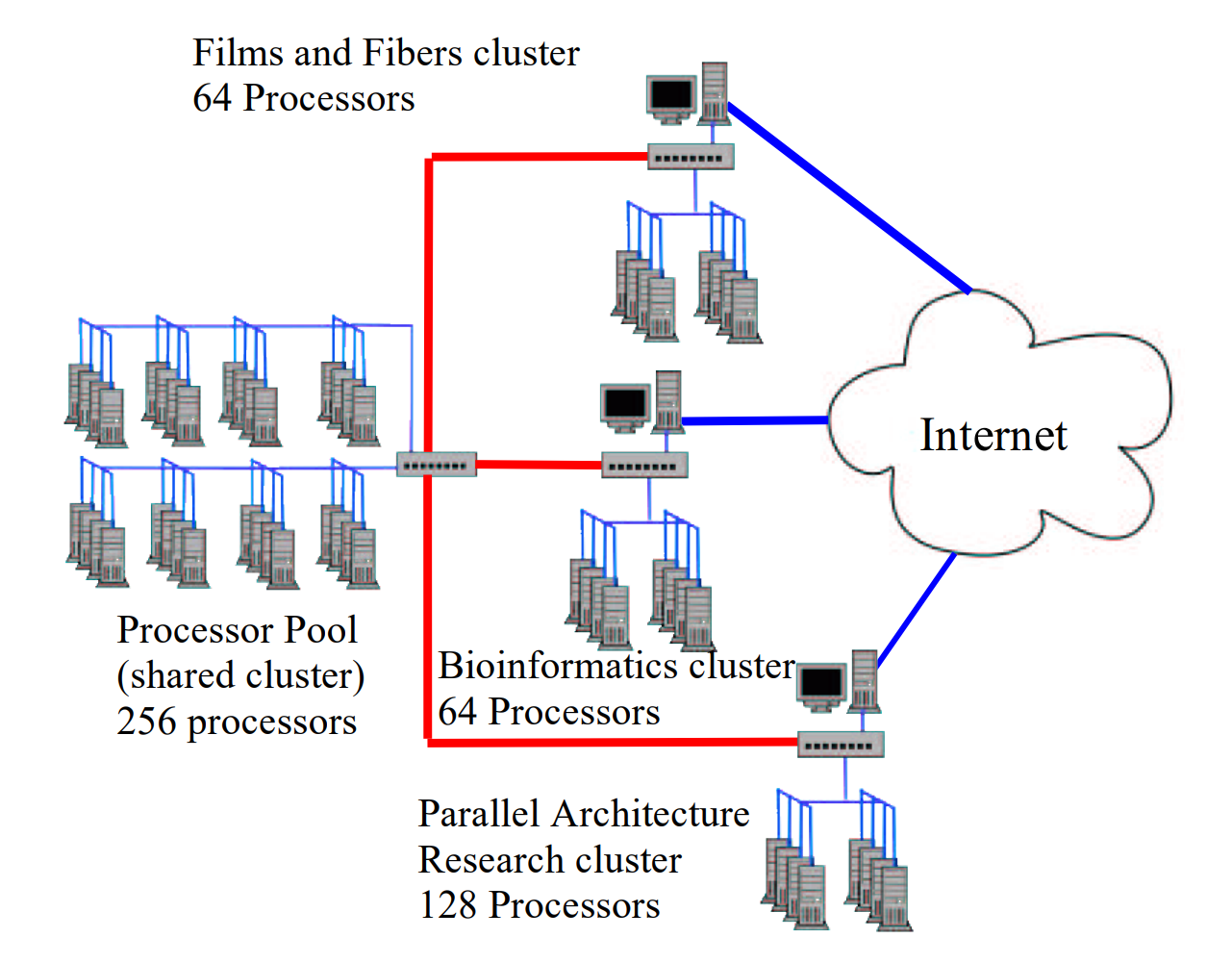
- Clemson Computational Minigrid Supercomputing Facility
- description and diagram from
"Computational Mini-Grid Research at Clemson University,"
in November 2002:
At first glance, the mini-grid may appear to be distinguished
from a conventional computational grid only in scope. A mini-grid
is limited to a campus-wide setting, while a conventional grid in
national or global in scope. However, a mini-grid also has two
distinctive architectural features:
- The grids are composed entirely of Beowulf Clusters
- The internal networks of the client clusters are
interconnected through dedicated links.
These features add an additional layer of complexity in producing
software for these grids. Resources may be shared through the
private network links, so an understanding of some grid services
must be integrated into the system software at the node level of
the client clusters, rather than simply at the head of the cluster.
However, this arrangement provides two primary advantages:
- Finer granularity control of resources within the grid
- Predictable, reliable bandwidth between grid resources
(as opposed to internet connected grids).
The additional granularity of control comes from the fact that
is possible to allocate resources to a particular job on a per
node basis, rather than having to allocate entire clusters or
supercomputers connected to the grid to a single task. In the
Clemson mini-grid, we have developed the facility to "loan" nodes
between clusters, allowing for jobs to span multiple clusters.
- Minigrid racks in PARL
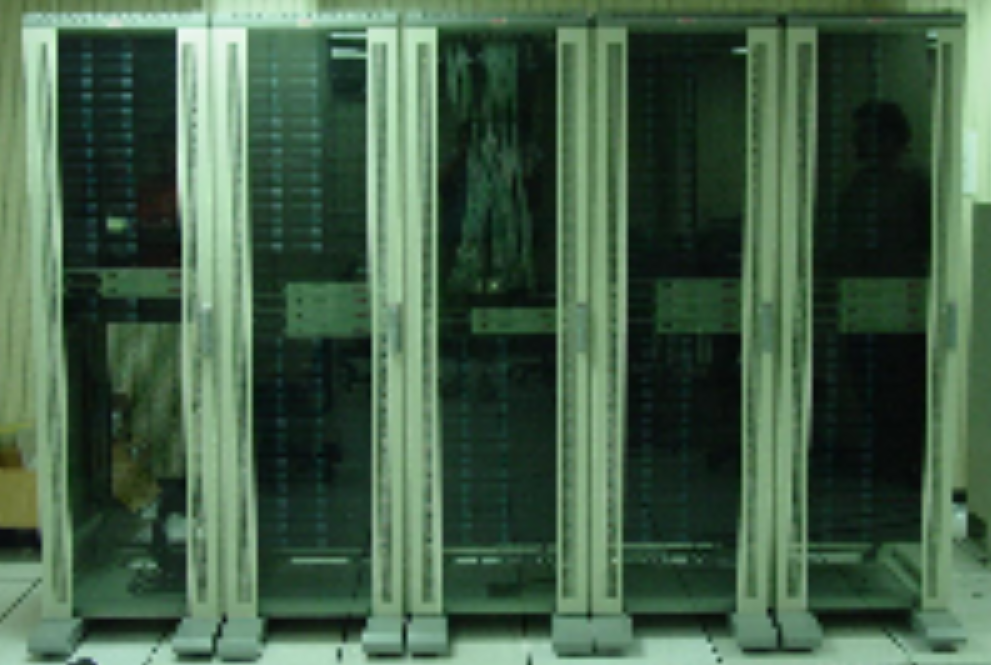
Photo capture from PARL
page on Internet Archive.
- Wireless Communications and Networks research group
- Mike Pursley, Carl Baum, Dan Noneaker, and Harlan Russell
- Holcombe Laboratory for Digital Communications
- "Sun SPARC computational server with 20 processors," rack mounted in
EIB, ca. 2000
- WCNITC cluster, 2007
- one of the first systems housed in CCIT's Palmetto condominium cluster
operations at the ITC
- 1 head node Dell PowerEdge 1950 w/ 2x Intel Woodcrest @ 2.66 GHz CPUs
/ 4 GiB RAM
- 68 compute nodes Dell PowerEdge 1950 w/ 2 x Intel Woodcrest
@ 2.66 GHz CPUs / 8 GiB RAM
- 1 spare Dell PowerEdge 1950 node
- Ethernet 1G interconnect
- ECE references and further discussion in general
- PARL references and further discussion
Chemistry
Computer Science (later School of Computing)
- Test and Evaluation Community Network (TECNET)
- led by Ed Page, Wayne Madison, and Harold Grossman
- four NCR Tower 1632 computers, 1983
- Gould PowerNode 9005, 1988
- departmental Unix machines for research
- all were acquired as partial or full donations based on the efforts
of Robert Geist
- Perkin Elmer 3230, 1984
- AT&T 3B2/300, 1984
- Concurrent (Masscomp) 6700 (4 processors), 1989
- AT&T 3B2/1000 (4 processors), 1989
- Sun 4/330 Workstation, 1990
- multiple systems from Data General Corporation, including
an AViiON 5120 Dual Processor Server and HADA disk array in 1993
- research efforts led by Roy Pargas
- Intel Personal SuperComputer iPSC/2, 1988
- departmental Unix machines and PCs for instruction and research
- several Sun servers starting in the 1980's, including citron,
which in 1989 was a Sun 4/280
- a dedicated system staff supported the numerous workstations,
servers, personal computers, and laptops within the department
and later the School of Computing
- research efforts led by Robert Geist and Mike Westall
- IBM eServer BladeCenter with NetApp NAS, 2004
- initially at most 28 blades, with eventually additional racks
and three generations of blade servers
- e.g., ca. 2010 there were at least six IBM 8853-AC1 dual-Xeon blades
[as described in Zachary Jones' dissertation]
- Digital Production Arts
- led by Jerry Tessendorf
- computer animation pipeline and render farm initiated in 2013
- a user-space queue, called Chessyq, scheduled frame rendering across
the DPA desktop Linux computers and desktop Linux computers in the
McAdams 110 computer lab (later expanded to other computers)
- at its peak, cheesyq rendered 12,000 frames per day sustained
for a week or so
- Data Intensive Computing Ecosystems (DICE) lab
- led by Amy Apon
- yoda, ca. 2015
- 1 primary Dell Precision 330, 2.4 Intel Core 2 Quad processor and 4 GiB
of memory, dual port Gigabit Ethernet card
- 12 client work stations: Sun Ultra20-M2, Dual AMD Opteron, 2 GiB of RAM,
three dual-port Gigabit Ethernet card per station
- 2 Pica8 Pronto 3290 48-port Gigabit Ethernet switches,
with OpenFlow enabled
- holocron, 2015
- designed as a Hadoop machine
- 18 nodes, each with a dual 10-core Intel Ivy Bridge at 2.2 GHz,
256 GiB memory, 8 x 1 TB local HDD, 8 x 6 TB storage array, and
10 Gbps Ethernet connection
- the nodes are connected to a 40Gbps switch with SDN support
- Holocron was hosted in Clemson University's data center and
operational from 2015-2018, then it was folded into Clemson
University's portion of CloudLab.
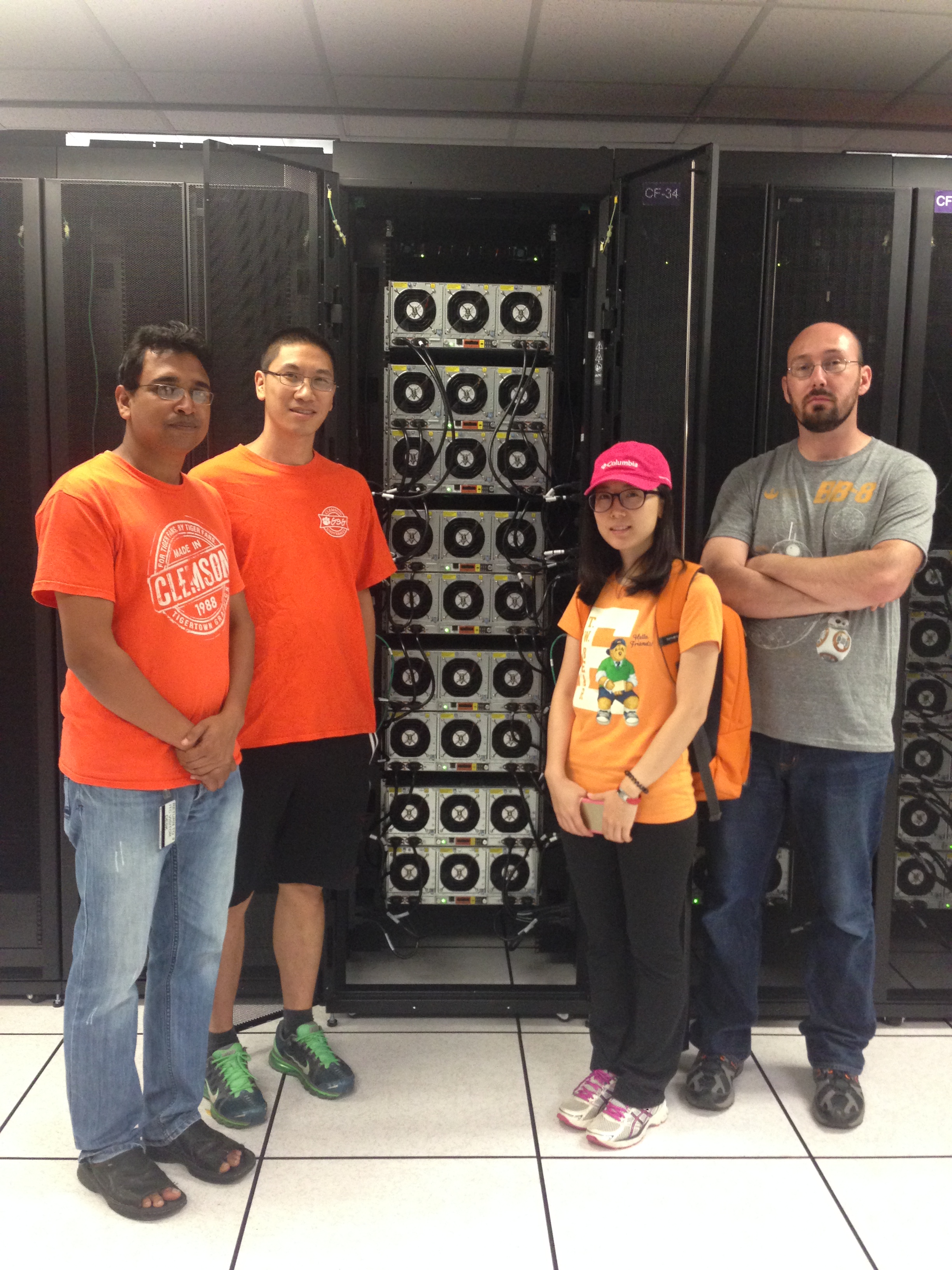
Yash Mishra,
Yuheng Du,
Lili Xu, and
Jason Alexander
in front of holocron.
Photo courtesy of Linh Ngo.
- ScaLab (Scalable Computing and Analytics Lab)
- led by Rong Ge
- Ivy, 2016
- two login nodes and eight compute nodes
- each node has two 12-core Intel Xeon
CPU E5-2670v3 @ 2.30 GHz processors and 128 GiB DDR4 DRAM
evenly distributed between two NUMA sockets
- each node additionally has 1 Nvidia Tesla K40 GPU accelerator
and 1 Intel Knight's Corner Xeon Phi accelerator
- DeepGreen, 2020
- five nodes from the original Ivy cluster
placed in a liquid immersion cooling pod
- a server node has two Nvidia TITAN V GPU cards
- References and further discussion
Mathematics
- Floating Point Systems (FPS) T-20 16-node hypercube, 1986
- each node contained:
- a 15 MHz T414 Transputer with 2 KiB of on-chip SRAM
- a vector processor capable of running 16 MFLOPS
- a multiported 1 MiB local memory module
- four communication links, each capable of being
multiplexed four ways, to provide a
hypercube interconnection network
- a DEC MicroVAX II running ULTRIX served as the front end
- axiom - IBM OpenPower cluster, 2005
- 48 compute nodes, 4 interactive nodes, and a head node,
each with two dual-core Power5 64-bit processors @ 1.65 GHz, 4 GiB of
memory and 80 GB of disk
- connected via 2 GB/sec Myrinet
- 550 GB of shared RAID10 disk
- Red Hat Enterprise Linux 5 Advanced Server, GNU and IBM XL
compilers, torque and maui queue manager
- References and further discussion
Physics and Astronomy
Office for Business and Finance
- IBM S/360 Model 20, 8 KiB, 1966
- located in basement of Tillman Hall with separate data processing staff
- memory increased to 16 KiB
- became a Remote Job Entry (RJE) site for the IBM S/360
Model 50 in the Computer Center in 1971
- retired in 1978 and replaced by an IBM 3777-II communications terminal,
which had a card reader and line printer
- References and further discussion
Center for Advanced Engineering Fibers and Films (CAEFF)
- W.M. Keck Visualization Lab in Rhodes Hall
- Silicon Graphics Onyx equipped with the Reality Engine 2 (RE2)
graphics subsystem, 1994
- two 150 MHz MIPS R4400 processors, 128 MiB main memory,
and 4 GB of disk
- RE2 subsystem contains 12 Intel i860XP processors that
serve as Geometry Engines
- Silicon Graphics Onyx2 Infinite Reality Dual Rack,
Dual Pipe System (Reality Monster), 1997
- known as "mickey"
- 8 raster managers and 8 MIPS R10000 processors,
each with 4 MiB secondary cache
- 3 GiB of main memory and 0.5 GiB of texture memory
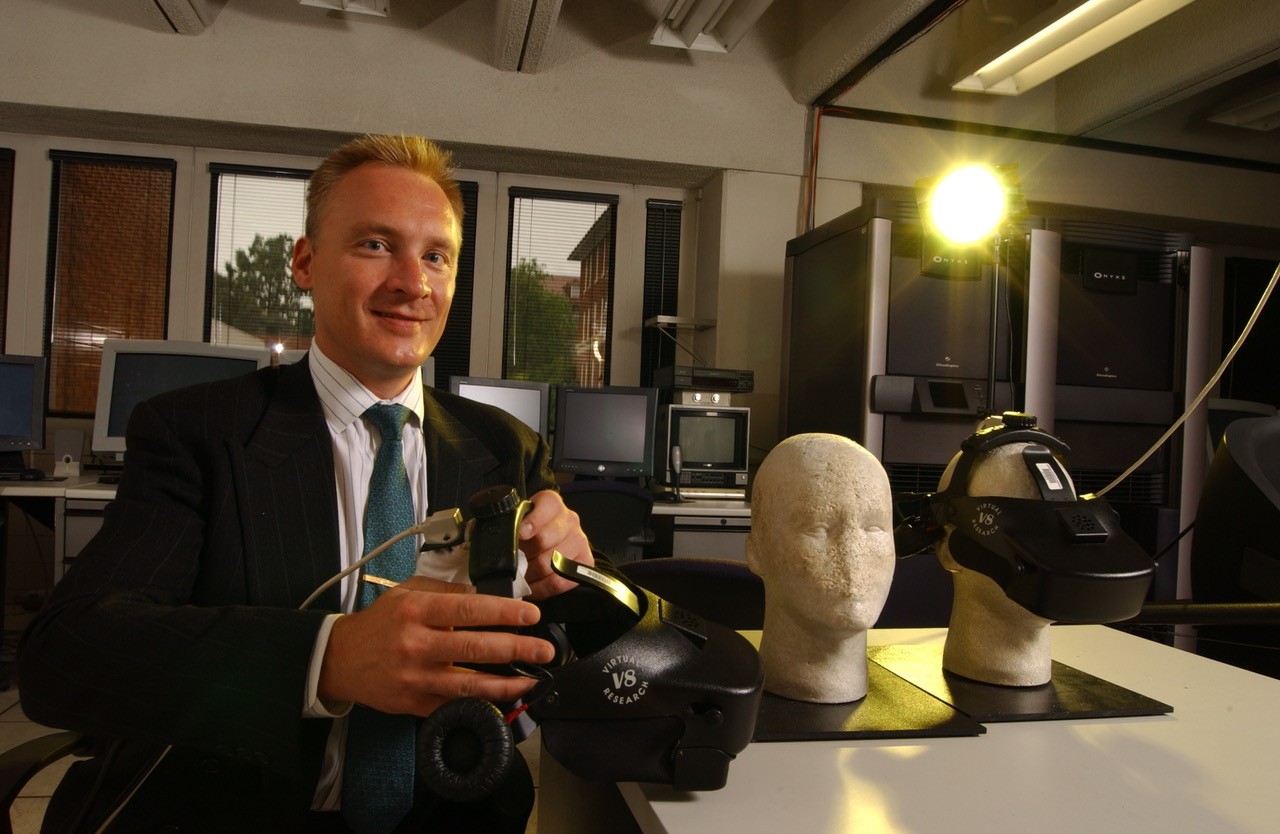
Andrew Duchowski with head-mounted
displays and Onyx2 system in back right.
Photo courtesy of Andrew Duchowski.
- equipment located in basement of Riggs Hall
- 64-node cluster, 2000
- 265-node distributed rendering system using
commodity components with tiled viewing screen, 2002
- generates images of 6,144 x 3,072 pixels and projects them across a
14' x 7' display at 30 frames per second
-
each node has a 1.6 GHz Pentium 4 CPU,
a 58 GB IDE drive, and dual Ethernet cards (NICs)
- each of the 240 nodes used for geometry generation and rendering
have 512 MiB main memory, an Nvidia GeForce4 TI 4400 graphics card,
an Intel e100 100 Mb NIC, and a 3Com 905c 100 Mb NIC
- each of the 24 nodes used for display have 1 GiB main memory,
a Matrox G450 graphics card, a 1 Gb Intel e1000 NIC and a
100 Mb Intel e100 NIC
- all nodes are connected via a dedicated, eXtreme Networks,
BlackDiamond, Gigabit Ethernet switch
- the tiled screen is driven by a 6 x 4 array of Benq 7765PA DLP projectors
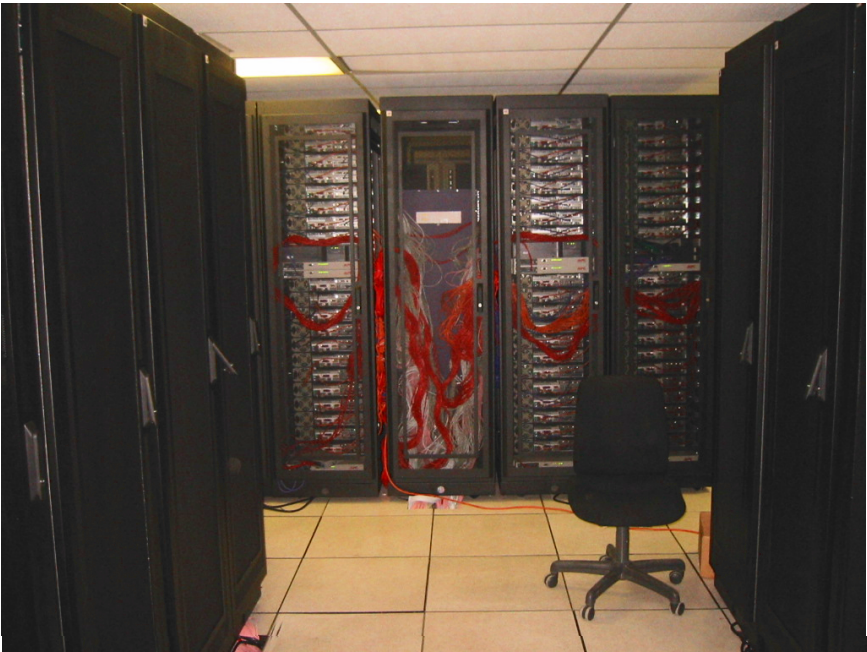
Distributed rendering system racks.
Photo courtesy of Robert Geist.
- References and further discussion
Clemson Center for Geospatial Technologies (CCGT)
- GalaxyGIS Cluster
- This is a collection of over 30 Windows computers, providing over
700 cores, with installed GIS programs and uses HTCondor to distribute
GIS jobs for high throughput processing on the available computers.
- References and further discussion
Computational Center for Mobility Systems (CU-CCMS)
- initial cluster, 2007
- Arev cluster, 2008
- 430 SunBlade x6250 nodes with a total of 3,440 processing cores
- 20 Gbps Infiniband
- SLES 10 SP1 64bit
- 35 Tflops total computing power
- listed in November 2008 as the 100th fastest computer in the world
in the
TOP500 list
- Aris - one of two Sun Fire E6900 servers, 2008
- 24 quad-core UltraSparcIV+ processors
- 384 GiB shared memory
- Solaris 10
- Sun E25k Server, 2008
- 144 processing cores
- 680 GiB RAM
- References and further discussion
Clemson University Genomics Institute (CUGI)
Photo of CUGI computer room, 2006.
Photo from Internet Archive.
- "ten-node Beowulf cluster of Linux computers", 2000
- 32-node cluster ("Guanine"),
each node contains two 1 GHz Pentium III processors
- "138 processor UNIX cluster"
[could this be a reference to the shared 128-node Cytosine cluster
in the Minigrid?]
- Mac cluster is that block of 1U silver-colored machines in the black racks
- References and further discussion
Clemson University Institute for Human Genetics (IHG)
- Secretariat cluster, 2019
- four compute nodes with 40 cores and 192 GB RAM each
- two high memory compute nodes with 44 cores with 1.54 TB RAM each
- dedicated HA-NFS with 500 TB of storage
- located at the Self Regional Hall in Greenwood, SC
- References and further discussion
Interdisciplinary
- Nvidia DGX-2, 2019
- ONR provided a $316,000 grant for six faculty members to acquire
an Nvidia DGX-2 server, which has dual Intel Xeon Platinum 8168,
2.7 GHz, 24-cores, and sixteen Nvidia Tesla V100 GPUs. The
server is able to achieve processing speeds of 2 petaFLOPs.
- References and further discussion
References (with Further Discussions)
Computer Center
- Merrill Palmer of the Department of Mathematics served
as the first Director of the Computer Center. A list of
Directors, and later Vice Provosts of Computing and Information
Technology, and Chief Information Officers is given by Jerry Reel
in volume 2 of The High Seminary,
which I have corrected below and extended to the present:
- Merrill C. Palmer, 1961-1975,
obituary
- Russell S. Schouest, (acting) 1975, (permanent) 1975-1977
- Thomas E. Collins, (acting) 1977-1978
- Christopher J. Duckenfield, 1978-2004,
obituary
- David B. Bullard, (interim) 2004-2006
- James R. Bottum, 2006-2016
- Brian D. Voss, (interim) 2016-2017
- Russell Kaurloto, 2017-2021
- Brian D. Voss, (interim) 2021-2022, (permanent) 2022-present
- notes on corrections and dates:
- Palmer, 1961-1975, - not sure why Reel lists
Palmer's start as 1966 instead of 1961, perhaps because of the arrival of
the S/360 Model 40 mainframe in 1966;
resignation announced in Compusion Newsletter, March 20, 1975
- Schouest, (acting) 1975, (permanent) 1975-1977 -
see "Director Named," The State, May 29, 1975, p. 3-B;
resigned August 18, 1977
- Collins, (acting) 1977-1978 - Reel misspelled
his last name and should have indicated his temporary status;
resigned March 16, 1978
- Duckenfield, 1978-2004 -
see
"Head of Computer Center Named," Clemson University Newsletter,
vol. 17, no. 5, April 1, 1978, p. 2 (page 345 of the pdf); passed away
on April 21, 2004
- Bullard, (interim) 2004-2006 - retired August 2006
- Bottum, 2006-2016 - see the
announcement released May 10, 2006, that Jim has been named
Chief Information Officer and Vice Provost for Computing and
Information Technology effective July 17, 2006
- Voss, (interim) 2016-2017 - named as interim in July 2016
- Kaurloto, 2017-2021 - began the role July 17, 2017
- Voss, (interim) 2021-2022, (permanent) 2022-present -
named as interim in May 2021 and permanent in February 2022
- The Computer Center became part of the Division of Computing
and Information Technology (DCIT) in 1985, which was renamed as
Clemson Computing and Information Technology (CCIT) in 2007.
See Chris Duckenfield, "Director's Letter," DCIT Newsletter,
vol. 9, no. 1, Fall 1985, p. 1, in which he states that DCIT will
be an umbrella organization for DAPS, DISD, and the Computer Center.
Duckenfield was promoted a year later from Director of DCIT to
Vice Provost of Computing and Information Technology; see
"Duckenfield Named Provost,"
The Tiger, vol. 90, no. 9, October 24, 1986, p. 7.
See also
the 2007 letter
from Provost Dori Helms discussing the name change to CCIT.
- The university's first computer was initially located in Poole Hall
(also known as the P&A or P&AS building for Plant and Animal Science)
while Martin Hall was being constructed. Once Martin Hall was finished,
the computer moved there in 1962. After five years in Martin Hall,
the Computer Center operations moved to the basement of Poole Hall,
where they stayed for almost twenty years.
Reel describes the planning (and state politics) for the new
Information Technology Center (ITC) building on Highway 187
in the section "Services to Faculty and Staff," pp. 277-281, in volume 2
of his history of the university.
The Computer Center moved its main operations to the ITC in late 1986
but still kept some offices and facilities on campus (e.g.,
the VAXes moved from Riggs Hall to Poole Hall). See
this page for a list of the current CCIT locations.
- Pearce Center student interns prepared a
CCIT History Project Timeline that extends through 2006.
See page 12 of the
2014-2015 Pearce Center Annual Report.
- See a list of the various
Computer Center newsletters from the 1970s to the 2000s.
The inside cover of newsletters from mid-1975 to 1994 typically
included a brief description of the major computer systems.
Additionally, a yearly Introduction to the Clemson University
Computer Center (later titled Introduction to Clemson University
Computer Services) was published each academic year from
1979-1980 to 1992-1993; these contain a more extensive
description of facilities, often including a list of the types
and number of disk drives and tape drives. A set of pamphlets
and later brochures was published as DCIT Computer Services
from 1994 to academic year 2006-2007. This material is available
in the Clemson University Libraries Special Collections and Archives.
- The
Graduate School catalogs starting in 1964-1965 (but skipping
1967-1968, 1968-1969, and 1969-1970) as well as the
Clemson Student Handbook starting in 1969-1970 include a section
that describes the computer center and available computers.
Note that the Graduate School Catalog and Student Handbook switch
section titles from Computer Center to DCIT Computing Facilities
starting in 1987-1988 and typically become less specific as to the
computer models starting in 1992-1993.
- An online page listing "Large Computer Systems" at Clemson
University was published from 1997 to 2005; see the
first capture in 1997.
-
CCIT video tour of ITC and Network Operations Center (NOC), ca. 2008
- This
CITI Infrastructure github page dates from 2017.
First Computer
- This was a larger and more powerful desk computer than the
popular LGP-30 and had an 8,008-word magnetic drum for main memory.
I have seen some instances of university documents listing
the memory size as 16K or 16KB, but I believe those to be mistakes.
None of the source material about the RPC-4000 available
elsewhere on the web gives that as an option. E.g., see
page 7 of the
RPC-4000 Features Manual. Also, note that the RPC-4000
instruction format used 13 bits for a memory address
(page 10), so the memory addressing limit was clearly 8K 32-bit words.
-
"New Computer System Aids Clemson Research,"
The State, April 17, 1961, p. 7-A:
Because it is transistorized, the Clemson computer occupies little
more space than two ordinary office desks, but provides remarkable
operating speeds and memory capacity. It is capable of 230,000
operations per minute. Its input and output speeds range as high
as 500 characters-per-second. Both alphabetic and numeric information
may be stored and processed through the use of its 8,008-word
magnetic drum memory center or "brain."
...
The Clemson computer is the 14th of its type produced by the
manufacturer and one of five located in the South. Three of the
other four are at the Huntsville, Alabama, Redstone Arsenal, and one
is in use at an Atlanta aircraft plant.
- see also:
-
RPC 4000 entry in Martin Weik,
"A Third Survey of Domestic Electronic Digital Computing Systems,"
Report No. 1115, Ballistic Research Laboratories,
Aberdeen Proving Ground, Maryland, March 1961, pp. 834-835.
-
"All Transistor New Computer Just Installed,"
The Tiger, December 1, 1961, p. 1.
- "History of Computing at Clemson - Part I,"
Computer Center Newsletter, vol. 1, no. 1, March 1978, pp. 4-8:
Clemson owes its first steps into the future and the world of
electronic data processing to Dr. Al Hind of the Mathematics
Department. During the 1950's Dr. Hind had been teaching at
Clemson during the school year and working summers at the
Naval Research Lab where he had become familiar with the uses
and capabilities of the newly developed high speed computing
machines we call computers. He saw Clemson's need for one and
went to Jack Williams. Dean Williams, who was Dean of the College,
was also a forward looking man and he immediately set up a
faculty committee to study the idea. That was in the spring of
1959. That committee's report dated May 9, 1959 recognized the
need for a computer facility at Clemson and suggested the
acquisition of an LGP-30, a small computer made by the
Royal MacBee [sic] Company.
Before arrangements could be made to purchase an LGP-30 and
set up a computer center at Clemson, several new machines had
appeared on the market causing Dean Williams and members of the
Agricultural Experiment Station Staff to request a review of the
information regarding electronic computers.
As a result, a second committee was established on March 2, 1960
and the rest is history. By then computers were into the second
generation. No longer were they huge bulky vacuum tube machines
requiring rooms full of complex air-conditioning machinery.
Instead they were transistorized, taking up a fraction as much
space and requiring little or no special installation.
The committee visited many installations in Georgia and South
Carolina and talked to representatives of most of the companies
which marketed computers at the time. IBM, which had gotten its
foot in the door at Clemson by supplying the tab equipment to
the administration, wanted the computer installation at Clemson
enough to offer to give the new center an IBM 650 vacuum tube
machine, but the committee (with much prodding from the EE
department) insisted on a transistorized machine.
The choices were narrowed down to the RPC 4000 made by Royal McBee,
and IBM's 1620. IBM, with its offics in Greenville, offered
superior maintenance services (Royal McBee's closest office was
in Atlanta) but the final choice was the RPC 4000 with its
16,000 byte [sic] drum memory. The 1620 has less than half that
amount of memory and at the time IBM said that they would
definitely not be increasing its memory capacity. As a result,
the final report to Dean Williams dated June 9, 1960 recommended
the purchase of an RPC 4000 computer system at a cost of some
$50,000. Dean Williams and President Edwards took the request to
a special session of the legislature in Columbia and the Clemson
College Computer Center was born.
The center was officially established in February of 1961 with
one and a half employees: a half time Director, Mr. Merrill
Palmer, who spent his other half teaching in the Math Department,
and a full time Secretary. The RPC 4000 arrived and was installed
in April 1961.
An interesting footnote to this part of the story is that three days
after the legislature approved the purchase of the RPC 4000, IBM
announced the addition of more memory to its 1620.
- "History of Computing at Clemson - Part II,"
Computer Center Newsletter, vol. 1, no. 2, April 1978, pp. 5-8.
[subtitled "The Life and Times of the RPC 4000 at Clemson"]
- "Yesteryear Computing,"
DCIT Newsletter, vol. 10, no. 2, Winter 1987, pp. 21-22.
- Jürgen Müller,
"The LGP-30's Big Brother,"
e-basteln, no date.
- The computer was first installed in Poole Hall.
In 1962, the computer moved to the new Martin Hall.
See "New Clemson Complex," The State, September 4, 1962.
- For a comparison with early computers at other regional schools,
see a review of
college and university computers in the Southeast US, 1955-1961.
Mainframes
- The
1966-1967 Graduate School Catalog states on page 17,
"On July 1, 1966 the Computer Center will install an IBM/360,
Model 40, with 65,000 bytes of core storage."
The IBM S/360 Model 40 and the rest of the Computer Center
operations needed more room than available in Martin Hall,
so the Computer Center moved to the basement of Poole Hall
in the summer of 1967.
See the minutes of the Research Faculty Council meeting of
April 18, 1967, in the newsletter collection,
Clemson Newsletter, 1965-1967, page 389 of the pdf:
Mr. M. C. Palmer, Director of the Computer Center, spoke to
the Council on operations and operational needs of the
Computer Center. He commented that plans are being implemented
to increase the operational time of the computer, to purchase
additional equipment and to hire needed personnel for programming
work. He stated that several machines are being ordered by
various divisions of the University and that key punching
facilities should be solved by September. He stated that the
Computer Center was scheduled to be moved to the P & AS
Building in July.
-
President's Report to Board of Trustees, 1967-1968,
states on page 15:
During the summer of 1968 the second major addition was made
to its IBM System/360, Model 40 computer. This addition,
partially supported by a grant from the National Science
Foundation, provides the largest memory that can be used
with the Model 40, and input/output equipment to provide
the most efficient utilization of that memory.
The
President's Report to Board of Trustees, 1968-1969,
states on page 20, "In July, 1968, the core storage of
the computer was increased from 131,072 bytes to 267,144 bytes."
See also "Yesteryear Computing,"
DCIT Newsletter, vol. 10, no. 2, Winter 1987, pp. 21-22.
-
Clemson Newsletter, vol. 10, no. 4, October 1, 1970, page 2:
The central processing unit, an IBM 360, has been upgraded to
model 50, which operates three times faster than the model 40.
See also "History of Computing at Clemson - Part III,"
Computer Center Newsletter, vol. 2, no. 2, October 1978, p. 11.
-
A January 18, 1973 thesis by Saifee Motiwalla cites computations run
on Clemson University's Model 155.
-
John Peck and Francis Crowder,
"A Public Health Data System,"
National Computer Conference, 1974, page 77-80:
During January 1974 Clemson University will acquire
an IBM 370/158 and will run VS2.
- See several pictures from the computer room from 1975-1976 on
the pages entitled,
"Do Not Fold, Bend, or Mutilate," and "Computers Control Campus,"
in the
1976 TAPS yearbook, pp. 118-121.
-
In 1976, Clemson University bought a used Model 165 from Gulf Oil
Corporation and contracted with IBM to install dynamic address
translation (DAT) hardware before the system was shipped to Clemson.
A Model 165 with DAT was designated as a Model 165-II, and the DAT
facility allowed it to run the newest IBM operating systems at the
time. When the anticipated high-end IBM 3033 mainframe was announced
in 1977, Russell Schouest wrote about the decision to buy a used
Model 165 and upgrade it instead of buying a new and more expensive
Model 168 in "The IBM Garage Sale," Compusion Newsletter, vol. 5,
no. 10, May 1, 1977, p. 2:
Clemson's decision to buy a 370/165 on the used market at the time
we did was an attempt to bridge through this uncertain period in the
market place. Since the availability of the 3033 is still 1 - 1½
years away (and we may yet see the 258, 268, and 278), the 370/165
results in minimum financial exposure per unit of computing power
while waiting for the complete line to be available and announced.
A purchase value of "about four million dollars" is cited in
Chester Spell,
"Expanded Computer Complex Pays for Itself,"
The Tiger, vol. 70, no. 18, February 11, 1977, pp. 5, 11.
An installation schedule for the 165-II is given in the Computer Center
Bulletin, vol. 1, no. 39, November 5, 1976. The article,
"Center Undergoes Renovation,"
published in The Tiger, October 22, 1976, describes some of the
renovations that were done before the Model 165-II could be installed.
Mainframe computers typically required substantial HVAC cooling, space for
cabling, and special electrical power connections.
The Model 165 additionally required liquid cooling. (See page 11 of
A Guide to the IBM System/370 Model 165, November 1970.)
The later 3033 and the 3081 likewise required liquid cooling.
Starting with the XL60 in 1986, the mainframes
have been smaller in footprint and air cooled.
- See "3033 Installation," Computer Center Newsletter,
vol. 3, no. 1, September 1979, pp. 2-8.
This particular machine had been rented by the University of
South Carolina in hopes of buying it. However, because of a
procurement bidding appeal by Amdahl Corporation, the South
Carolina Budget and Control Board ruled that USC had to buy
a less expensive Amdahl 470 computer instead. In contrast,
the state approved the purchase of the IBM 3033 for Clemson
University since the IBM computer had passed the benchmark
designed by DCIT, and specified in the RFP, but the Amdahl
computer had not. The timing of these decisions allowed IBM
to sell the rented 3033 in Columbia to the state for installation
at Clemson University and also reduce the purchase cost based
on rental credits for the months that it had been located at USC.
See "Controversial IBM Computer at Clemson,"
The State, June 12, 1979, p. 1.
The complexity of the benchmark for the 1978-1979 mainframe
procurement is described in an article by Susan Keasler,
"New Computer Increases Speed, Capacity,"
The Tiger, vol. 73, no. 1, August 24, 1979, p. 12:
According to Dr. Christopher Duckenfield, director of the
department of computer services, the first draft of the RFP
(request for proposal) containing specifications and
requirements of the computer was submitted to the State
Budget and Control Board in May of 1978. After several
changes and modifications to the original, the final draft
was submitted in September.
Three companies, Itel, Amdahl,
and International Business Machines (IBM), bid on the RFP
of the computer, though neither [sic] company passed
the benchmark required by the department. A third, further
modified RFP was submitted in December. The same three
companies bid again, but IBM only in March of this year
succeeded in passing the benchmark for final specifications.
Charles H. Burr, director of the state's Computer Systems
Management, said that Clemson's benchmark was complicated
because it involved simulated interaction between 700
computer terminals and the computer while the unit ran a
program. The benchmark was developed from computer experience
and proposed use, said Dr. Arnold Schwartz, dean of
graduate studies and research at Clemson University.
- For the 1982 mainframe procurement, IBM successfully
benchmarked an IBM 3081-K. National Advanced Systems (NAS)
had initially bid an AS/9080 but declined to run the
benchmark. See "New Computer," Computer Center Newsletter,
vol. 5, no. 4, June 1982, p. 22; "Director's Letter,"
Computer Center Newsletter, vol. 6, no. 1, Fall 1982, p. 1;
and, Clemson University Benchmark Results, October 15, 1982,
25pp. This benchmark simulated an average of 1500 TSO users.
The procedural documentation and appendices for the benchmark
totaled 39 pages.
- Don Fraser, "NAS AS/XL-60 Replaces IBM 3081K,"
DCIT Newsletter, vol. 10, no. 2, Winter 1987, pp. 3-6.
- Ami Ghosh, "Vector Facility on the NAS AS/XL-V60,"
DCIT Newsletter, vol. 11, no. 1, Fall 1987, pp. 30-31.
Subsequent research using the vector facility included:
-
An implementation of vectorization for image processing.
See John Trout, Jr., "Vectorization of Morphological
Image Processing Algorithms,"
M.S. Thesis, Department of Mathematical Sciences,
Clemson University, July 1988.
- A performance comparison between the NAS AS/XL-V60 and a Cray X-MP/48.
See Edward Jennings, Jr., "Approximate Solutions to an Initial Value
Problem in Functional Differential Equations: A Comparison of Scalar
and Vector Code Performance on the Cray X-MP/48 and the NAS AS/XL-V60,"
M.S. Thesis, Department of Mathematical Sciences,
Clemson University, August 1988.
-
An implementation of vectorization for ray tracing. See
Nancy Cauthen, "Vectorization of a Ray Tracer
using a Pipelined Dataflow Strategy," M.S. Thesis,
Department of Mathematical Sciences,
Clemson University, June 1989.
-
Porting version 2g.6 of Berkeley's SPICE circuit simulator
to run on the NAS AS/XL-V60. See Keith Thoms, "The Development
and Implementation of a Methodology for Running SPICE on
Computers Utilizing Vector Architectures," M.S. Thesis,
Department of Electrical and Computer Engineering,
Clemson University, August 1990.
- The mainframe moved to the Information Technology Center (ITC)
building in Clemson Research Park in November of 1987. The Park is
located on SC Highway 187, nine miles from campus. See
C.J. Duckenfield, "The Big Move," DCIT Newsletter, vol. 11, no. 2,
Winter 1988, pp. 3-7.
- The Pilot 25 is discussed by Jim Blalock in
"MVS Mainframe or Enterprise Server,"
computing@clemson.edu Newsletter, vol. 3, no. 3, Spring 1998, page 10.
- The IBM z800 is discussed in
"New Mainframe Installation,"
computing@clemson.edu Newsletter, vol. 8, no. 2, Winter 2002-2003, page 4.
VAX and Sun Servers
-
Remarks by Dr. Bill L. Atchley, President of Clemson University,
to the General Meeting of the Faculty and Staff
Wednesday, August 18, 1982, in Tillman Hall Auditorium, which appear in the
Faculty Senate Minutes, May 1982 - October 1982 Meetings,
on page 35 of the pdf:
Industry has responded in a big way to our requests for help to
offset the effects of decreased state support. For example, the
Computer Center has received more than $1 million worth of computer
equipment this year from Digital Equipment Corporation. This includes a
VAX computer to go along with one we've purchased. The VAX computers
will be installed by the Computer Center in Riggs Hall and will greatly
increase our capabilities in computer graphics and research. The
computers will be a big benefit to engineering, computer science and
the University as a whole.
-
From an announcement in the
Campus Bulletin,
The Tiger, vol. 76, no. 13, December 2, 1982, page 6:
The Microcomputer Club will meet Tuesday,
Dec. 7, at 6:30 p.m. in the Riggs VAX computer
room (room 10). VAX graphics, hardware, and
software will be demonstrated.
Room 10 was called the "graphics and research facility". See
Clemson Newsletter, October 12, 1983, page 3 (page 114 of the pdf):
Center staff members will also be available to show and tell you
all about the University's own VAX-11/780s.
The two-day open house will be Oct. 19-20, 9 a.m.-4:30 p.m., at
the Center in the P&AS Building, and at the graphics and research
facility in Riggs Hall. A bus will shuttle visitors between
the two buildings at 10-minute intervals, says Stegall.
See also the advertisement for the Computer Center Open House
on the bottom right of page 27 of
The Tiger, vol. 77, no. 9, October 13, 1983.
- From the
Annual Report of the Clemson Board of Trustees, 1982-1983, page 65:
The remote site in the basement of Riggs Hall was completed in August
1983. This facility now houses the two Digital Equipment Corporation
VAX 11/780 computer systems acquired last year. These systems are used
to: run jobs which, by virtue of their size or run-time, cannot be run on the
IBM system without severely disrupting other users of the system; access
graphic terminals and other devices not accessible from the IBM system;
communicate with mini- and microcomputer systems (including data
collection devices) not readily accessible from the IBM system.
The Computer Center has been working to provide by January 1984
videotex services to Clemson University students, faculty and staff. The
videotex system will facilitate the distribution of information about
University events through the use of low-cost computer terminals. The
University's Department of Information and Public Services is working
with Computer Center staff to develop graphics and information
displays.
- 1981 in
CCIT History Timeline:
Back-to-back grants from Digital Equipment Corp. (DEC)
enable the remote computing facility in Riggs Hall to be
converted to a high-tech computer graphics center. A 600-line
plotter, two graphics subsystems and several terminals will be
supported by a DEC VAX/VMS computer, moving Clemson beyond
its traditional IBM product base.
-
Chris Duckenfield, "Director's Letter," and Richard Nelson,
"New Graphics Center," Computer Center Newsletter, vol. 5,
no. 2, December 1981, p.1 and p. 26, respectively.
- Christine Reynolds, "Renovation of Riggs Remote,"
Computer Center Newsletter, vol. 7, no. 2, Winter 1983, pp. 3-6.
- In 1985, the DCIT network diagram given in
"The Clemson University Computing Network 1985-1986"
shows three 780s and two 750s.
However, in that same year, Andrew Smith and Craig DeWitt
describe four 780s and one 750 in
"Videotex: a new area for user services,"
ACM SIGUCCS Newsletter, vol. 15, no. 2, 1985, pages 9-13:
The Clemson system has as its host system a DEC
VAX-11/750 minicomputer connected vla DECNET to four
VAX-11/780 minicomputers.
See also Richard Nelson, "The Clemson University Academic Computing Network,"
DCIT Newsletter, vol. 9, no. 3, Spring 1986, pp. 4-5.
- The DEC VAX 8650 was ordered in 1986 according to page 61 in the
Annual Report of the Clemson Board of Trustees, 1985-1986.
Also see Todd Endicott,
"Computer Center Receives Boost,"
The Tiger, vol. 80, no. 5, September 26, 1986, page 7.
Note that he calls it Prism.
- In 1988 a diagram from the Alexander and Meyer paper lists:
- VMS: 750, two microVAX
- VAXcluster under VMS: 8820, 8650, 8600 (with 8600 supporting CUFAN)
- Ultrix: 750, two microVAX (with one as front end to T-20)
I believe that this 1988 diagram is in error since hubcap
would be a 780 and possibly the 8810 at this point.
See also "Clemson University Division of Computing and
Information Technology VAX Network August 1988,"
DCIT Newsletter, vol. 12, no. 2, November 1988, pp. 10-11.
- Janet Hall, "VAX Systems Relocation," DCIT Newsletter,
vol. 11, no. 3, Spring/Summer 1988, p. 10.
- In 1988, a DEC equipment grant helped buy the 8810 and the 8820.
See Jenny Munro, "Clemson Gets Two Digital Computers,"
Greenville News, October 7, 1988, and
S. Dean Lollis,
"Digital Gives Computer Grant,"
The Tiger, vol. 82, no. 7, October 7, 1988, page 9.
- Jay Crawford, "Changes to the Vaxcluster,"
DCIT Update Newsletter, vol. 14, no. 1, September 1990, p. 7.
- Richard Nelson remembers:
The first VAX was temporarily installed in the computer room
in the P&AS building (Poole Hall) while a new computer room
was being prepared in Riggs Hall. Then all the VAXes were
moved to Riggs Hall. Some time after the mainframe was moved
to Wild Hog Road, the DEC systems were moved back to Poole Hall.
also
With the addition of an 8650 to the cluster, we started to
retire the 11/780, but retained one of them and installed
DEC Ultrix on it. That was the first hubcap.
That was eventually replaced with a DECstation (I forget the
model number), which was DEC's first entry into the 64 bit
market using MIPS processors. It also ran Ultrix. (They
weren't allowed to call it UNIX at the time.)
Note that Mike Marshall remembers that a 750 was the first hubcap,
and thus the 780 would have been the second.
- See an MP4 video of the
DEC VTX system at Clemson University, ca. 1986,
which includes a demonstration of CUFAN,
courtesy of Richard Nelson.
- DoD Internet Host Table, May 26, 1987
HOST : 26.0.0.80 : TECNET-CLEMSON.ARPA : NCR-TOWER-1632 : UNIX : X.25 :
HOST : 192.5.219.1 : HUBCAP.CLEMSON.EDU : VAX-11/780 : ULTRIX : TCP/TELNET,TCP/FTP,TCP/SMTP :
HOST : 192.5.219.2 : PRISM.CLEMSON.EDU : VAX-8650 : VMS : TCP/TELNET,TCP/FTP,TCP/SMTP
HOST : 192.5.219.3 : EUREKA.CLEMSON.EDU : VAX-8600 : VMS : TCP/TELNET,TCP/FTP,TCP/SMTP :
- DoD Internet Host Table, October 3, 1988
HOST : 26.0.0.80 : TECNET-CLEMSON.ARPA : GOULD-9005 : UNIX : X.25 :
HOST : 192.5.219.1 : HUBCAP.CLEMSON.EDU : VAX-11/780 : ULTRIX : TCP/TELNET,TCP/FTP,TCP/SMTP :
HOST : 192.5.219.2 : PRISM.CLEMSON.EDU : VAX-8650 : VMS : TCP/TELNET,TCP/FTP,TCP/SMTP :
HOST : 192.5.219.3 : EUREKA.CLEMSON.EDU : VAX-8600 : VMS : TCP/TELNET,TCP/FTP,TCP/SMTP :
- DoD Internet Host Table, November 30, 1989
HOST : 26.4.0.80 : TECNET-CLEMSON.ARPA,TECNET-CLEMSON.JCTE.JCS.MIL : GOULD-9005 : UNIX : X.25 :
HOST : 130.127.8.1 : HUBCAP.CLEMSON.EDU : VAX-8810 : ULTRIX : TCP/TELNET,TCP/FTP,TCP/SMTP,UDP/DOMAIN :
HOST : 130.127.8.2 : PRISM.CLEMSON.EDU : VAX-8650 : VMS : TCP/TELNET,TCP/FTP,TCP/SMTP :
HOST : 130.127.8.3 : EUREKA.CLEMSON.EDU : VAX-8600 : VMS : TCP/TELNET,TCP/FTP,TCP/SMTP :
HOST : 130.127.8.11, 130.127.16.1 : ENG.CLEMSON.EDU,OMNI.CLEMSON.EDU : SUN-4/280 : UNIX : TCP/TELNET,TCP/FTP,TCP/SMTP,UDP/DOMAIN :
HOST : 130.127.8.80 : CS.CLEMSON.EDU : SUN-4/280 : UNIX : TCP/TELNET,TCP/FTP,TCP/SMTP,TCP/FINGER :
HOST : 130.127.8.82 : TECNET.CS.CLEMSON.EDU : SUN-1/180 : UNIX : TCP/TELNET,TCP/SMTP,TCP/FTP :
[a typo? - TECHNET.CS should be a SUN-3/180, as in March table?]
- DoD Internet Host Table, March 12, 1990
HOST : 26.4.0.80 : TECNET-CLEMSON.ARPA,TECNET-CLEMSON.JCTE.JCS.MIL : GOULD-9005 : UNIX : X.25 :
HOST : 130.127.8.1 : HUBCAP.CLEMSON.EDU : VAX-8810 : ULTRIX : TCP/TELNET,TCP/FTP,TCP/SMTP,UDP/DOMAIN :
HOST : 130.127.8.2 : PRISM.CLEMSON.EDU : VAX-8650 : VMS : TCP/TELNET,TCP/FTP,TCP/SMTP :
HOST : 130.127.8.3 : EUREKA.CLEMSON.EDU : VAX-8600 : VMS : TCP/TELNET,TCP/FTP,TCP/SMTP :
HOST : 130.127.8.11, 130.127.16.1 : ENG.CLEMSON.EDU,OMNI.CLEMSON.EDU : SUN-4/280 : UNIX : TCP/TELNET,TCP/FTP,TCP/SMTP,UDP/DOMAIN :
HOST : 130.127.8.80 : CS.CLEMSON.EDU : SUN-4/280 : UNIX : TCP/TELNET,TCP/FTP,TCP/SMTP,TCP/FINGER :
HOST : 130.127.8.82 : TECNET.CS.CLEMSON.EDU : SUN-3/180 : UNIX : TCP/TELNET,TCP/SMTP,TCP/FTP,UDP/DOMAIN :
- In 1992, a Department of Computer Science internal document listed
the VAX equipment operated by the computer center as
an 8810 and a VAXcluster of 8820, 6000-410, and 8650.
- Cathy Brown and Joe Swift, "VAX Computing Improvements,"
DCIT Update Newsletter, vol. 16, no. 4, March 1993, p. 25.
- Jay Crawford, "Hubcap's Future OS: DEC's OSF/1,"
DCIT Update Newsletter, 17, no. 2, November 1993, p. 8, and
Joe Swift, "Under Construction,"
DCIT Update Newsletter, 17, no. 2, November 1993, pp. 8-9,
which compares the DEC VAX 8810 and DEC 3000-500.
- Jay Crawford, "OpenVMS VAXcluster Sizes Down and Speeds Up,"
DCIT Update Newsletter, vol. 17, no. 4, March 1994, p. 9.
- Oracle running on a SPARCserver 10 is described in Kevin Batson,
"The Clemson University Data Warehouse,"
DCIT Update Newsletter, vol. 17, no. 5, May 1994, pp. 11-12.
-
"Hubcap (UNIX) Machine Upgraded,"
computing@clemson.edu Newsletter, vol. 2, no. 1, Fall 1996, p. 6.
- In 1996, the Computer Center announced the end of life for the
VMS systems as summer 1997. See Dave Bullard,
"Many Products and Protocols No Longer Considered Strategic,"
computing@clemson.edu Newsletter, vol. 2, no. 2, Fall 1996, pp. 4-5.
- Helios and a new hubcap were acquired in 1997. See:
- Chris Duckenfield,
"Clemson University Research Foundation Purchases
Two Supercomputers for University Research,"
computing@clemson.edu Newsletter, vol. 3, no. 1, Fall 1997, page 1.
- Cynthia Kopkowski,
"Research Foundation Funds New Supercomputers from Royalties,"
The Tiger, vol. 91, no. 2, September 5, 1997, page 10.
- Dave Bullard,
"High Performance Computing Opportunities,"
computing@clemson.edu Newsletter, vol. 4, no. 1, Fall 1998, page 5.
- Mike Marshall, "Yet Another New Hubcap (YANH),"
computing@clemson.edu Newsletter, vol. 3, no. 3, Spring 1998, p. 11.
- A Sunfire V880 is identified as the new email server in
"Email Updates,"
computing@clemson.edu Newsletter, vol. 8, no. 2, Winter 2002-2003, page 2,
and
"Email Updates for Fall 2003,"
computing@clemson.edu Newsletter, vol. 9, no. 1, Fall 2003.
Condor
- Sebastien Goasguen,
"Windows Condor Pool at Clemson University,"
Distributed Organization for Scientific & Academic Research (DOSAR)
Workshop, April 2008.
- Cohen Simpson,
"Grid Computing Tackles Issues,"
The Tiger, vol. 102, no. 16, September 19, 2008, pp. 1, 7.
- Dru Sepulveda,
"Deploying and Maintaining a Campus Grid at Clemson University,"
MS Thesis, Clemson University, 2009.
- See also
Douglas Thain, Todd Tannenbaum, and Miron Livny,
"Distributed Computing in Practice: The Condor Experience,"
Concurrency and Computation: Practice & Experience, vol. 17, no. 2-4,
February 2005, pp. 323-356.
(preprint at Wisconsin)
- In addition to providing CPU cycles for Clemson University
users, Condor also provided many CPU cycles for marine biology research
for Dr. Robert Chapman with the South Carolina Department of Natural
Resources and for projects for the World Community Grid Web, including
cancer research and Nutritious Rice for the World.
- The usefulness of the Condor resources were diminished when
energy-saving initiatives led to the eventual powering off of the
lab computers after-hours. In addition, the emergence of the Palmetto
cluster and reduced CCIT lab resources led to the eventual demise
of the Condor system in general use at Clemson University.
However, HTCondor is currently used by the GalaxyGIS Cluster
in the Clemson Center for Geospatial Technologies.
Palmetto
-
In 2006, when Jim Bottum joined Clemson University as CIO and
Vice Provost, he emphasized strategic partnerships between CCIT
and Clemson University researchers. The funding and the research
results that have come from these combined efforts further
propelled the university into national prominence in
high-speed networking and high-performance computing.
- The Palmetto Cluster supercomputer has been financed
as a condominium cluster, based on the model developed at the
University of Southern California and then brought to Clemson
by CTO Jim Pepin.
see Jim Pepin, "High Performance Computing and Communication (HPCC),"
Chapter 8, in Edward Blum and Alfred Aho (eds.),
Computer Science: The Hardware, Software and Heart of It,
Springer, 2011.
Clemson University researchers who own computing nodes
within the Palmetto cluster have been remarkedly open to allowing shared
use of their nodes when otherwise idle.
-
"Clemson Makes Important Move in High Performance Computing World,"
CCIT News, June 9, 2008:
The first phase of development, completed in December 2007,
provided approximately 15 Teraflops (TF) of computing power
and moved Clemson from outside the Top 500 to within the Top 100
computing sites in the world. A second phase was implemented
last week, adding another 16 TF to the cluster, which when
fully developed could operate at up to 100 TF. "This phased
implementation is a cost-effective and prudent development of
the cluster, allowing our investments to track with user needs",
said Jim Bottum, Clemson's vice provost and chief information officer.
The Palmetto Cluster is being made possible through a strong
partnership between faculty and IT administration, with the
faculty 'owners' providing a significant percentage of the
funding for the compute nodes while the university provides
the rest of the nodes plus the infrastructure to build the cluster
(racks, switches, power, etc.). According to Clemson's chief
technology officer, Jim Pepin, the system currently benchmarks
at just over 31 TF and the efficiency using Myrinet 10 Gbps
hardware is 81 percent.
- Randy Martin remembers that the highest CPU-only benchmark rating
(prior to the inclusion of GPUs) used 1549 compute nodes and
benchmarked at 92.48 TFlops in April 2011. The cluster had a
Myrinet 10G interconnect. With the later addition of GPU compute
nodes, Mellanox 56G Infiniband interconnect was added.
Randy also remembers that Math had a large-memory node
(2TB RAM) added to Palmetto around 2011.
- In 2017, Amy Apon (Principal Investigator) received a $1M
National Science Foundation (NSF) grant
MRI 1725573 to improve Palmetto.
(Co-Principal Investigators were Jill Gemmill, Dvora Perahia,
Mashrur Chowdhury, and Kuang-Ching Wang.)
See
"Clemson Palmetto Cluster on Track for $1 Million Upgrade,"
HPCwire, October 5, 2017.
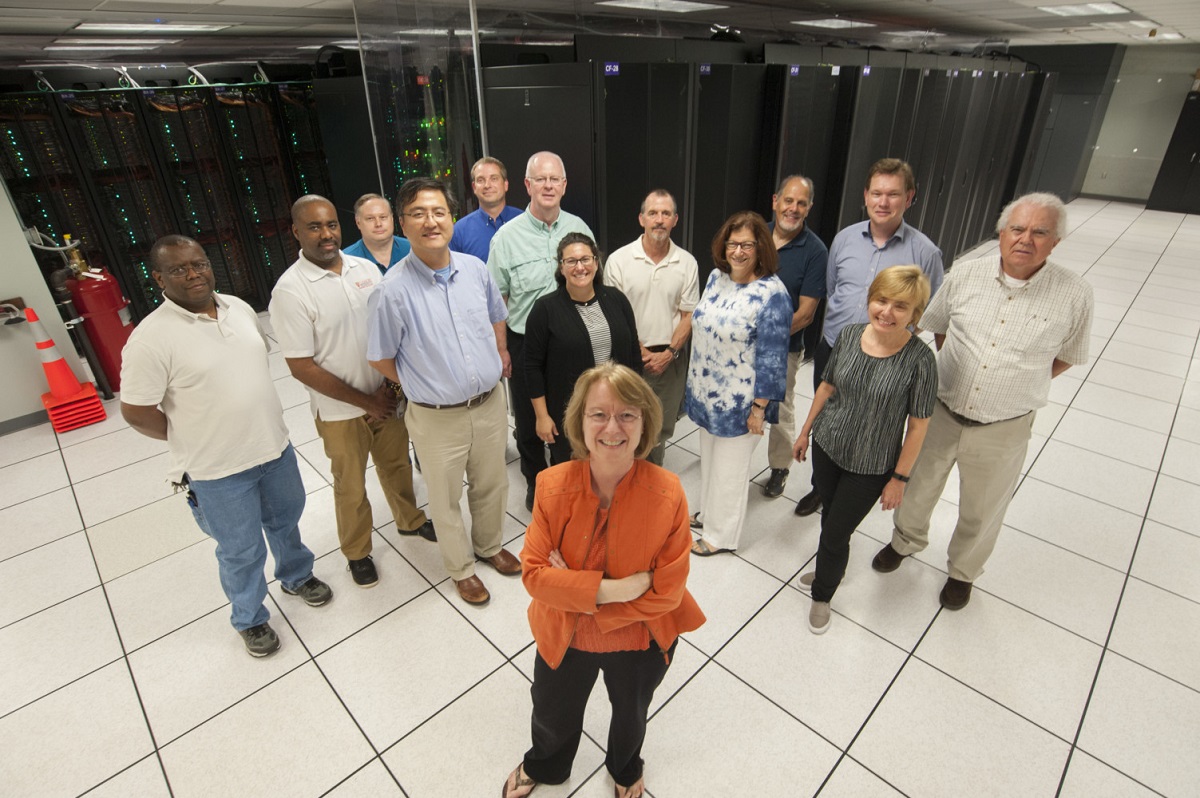
Amy Apon in front, and L-to-R behind her:
Dennis Ryans, Will Robinson, Jay Harris, K.C. Wang,
Randy Martin, Paul Wilson, Lindsay Shuller-Nickles, Robert Latour,
Jill Gemmill, Matt Saltzman, Ulf Schiller, Olga Kuksenok, and Jim Pepin.
Photo from the article.
-
NSF has also supported the purchase of
compute nodes for Palmetto through awards:
-
MRI 1228312, Jill Gemmill (Principal Investigator), 2012, $1M+;
-
II NEW 1405767, Amy Apon (Principal Investigator), 2014, $700K+;
and,
-
MRI 2018069,
Feng Luo (Principal Investigator), 2020, $651K.
- Bailey Troutman,
"High-Performance Computing Enhancements Bolster Artificial
Intelligence/Machine Learning Research,"
Clemson News, August 5, 2024.
Palmetto 2
- Note that the Palmetto 2 name has been used in TOP500
entries since
2013.
Cloud Lab
-
Marla Lockaby,
"Clemson Selected for $10M CloudLab Project,"
Upstate Business Journal, August 25, 2014.
- Dmitry Duplyakin, et al.,
"The Design and Operation of CloudLab,"
USENIX Annual Technical Conference, 2019.
- See Section 13.3, CloudLab Clemson, in the
description of CloudLab hardware.
Engineering Computer Laboratory
- The hybrid computer was purchased with funding from NSF and
the Appalachian Regional Development Act,
cited on page 12 in the
President's Report to Board of Trustees, 1969-1970.
- A grant from the Self Foundation allowed the College of Engineering
to provide dial-in service to a PDP-8 minicomputer running TSS/8, a
time-sharing operating system later marketed as the DEC EduSystem, as
part of teaching programming to students at sixteen high schools.
See Ross Cornwell,
"Boobtubes and Computers - Newest Members in Class,"
Citadel vs Clemson Football Program, September 9, 1972, pages 7-8.
Chemical Engineering
-
"Chemical Engineering Receives $200,000 Computer from Dow Chemical,"
Clemson Newsletter, vol. 8, no. 1, August 15, 1968, p. 13 (p. 220 of the pdf):
The Chemical Engineering Department received a gift of a GE 312 Computer
from the Dow Chemical Company. The computer, valued at over $200,000, will
be used for studies in direct digital control and process simulation.
-
"New Computer System,"
The Tiger, vol. 62, no. 2, August 30, 1968, page 6. [source of photo used above]
- Charles Littlejohn, Jr.,
"ChE Educator: Duane Bruley of Clemson,"
Chemical Engineering Education, vol. 4, no. 2, Spring 1970, pages 58-61:
Dr. Bruley is in charge of the department's process control
computer laboratory. This facility includes a
GE-312 digital process control computer and
peripheral equipment which was a competitive
gift awarded by Dow Chemical Co., Midland,
Mich., on the basis of a proposal submitted by
the department. The laboratory also contains a
TR-48/DES-30 analog/digital logic package
which was granted by the National Science Foundation.
Note that Bruley was also Clemson University's tennis coach.
Electrical and Computer Engineering
- CLASSIC 8: See Tom and Carolyn Drake,
"Tribute to Dr. Lyle Wilcox,"
Clemson News, October 15, 2018:
Lyle had purchased a DEC PDP-8 minicomputer which arrived in the
fall of 1966. Maurice Wolla and I were the only faculty members
with prior computer experience at Michigan State University. I
had been a member of the Engineering Computer Laboratory at
Michigan State with both software and hardware experience. The
PDP-8 became our launching point into computer engineering.
The PDP-8 was followed by a PDP-15/EAI-680 hybrid and a PDP-11.
- The equipment list appeared in the August 1975 edition of the
ECE "Graduate Study and Research" booklet, and Tom Drake sent me a
photo of the list.
- Tom Drake remembers:
The PDP-15/EAI-680 system was upgraded several times:
- DEC VT-15 Graphics Display with Light Pen
- VW-01 Writing Tablet
- MAP-300 Interfaced to DEC PDP-11/Uni-channel
- 9-Track Magnetic Tape Drive
The MAP-300 performed FFTs and was used in a speech recognition project.
The Self Foundation purchased the following:
- PDP-8 running TSS/8 with 16 Dial-in Modems
- PDP-11 running RSTS with 16 Terminals (Instruction Development Facility?)
- Add interfaces to PDP-8
...
Various research projects had minicomputer systems associated with
specialized research.
- Tom Drake also remembers some computer systems that were donated
to the ECE department but that were not put into use. Instead, they were
surplussed due to lack of space and support funds:
- two RCA 301 computers donated by Southern Bell in 1971
(see
Clemson Newsletter, vol. 11, no. 7, November 15, 1971, page 14,
which is page 135 of the pdf)
- a PDP-11 system donated by Greenwood Mills
- a PDP-8 systems donated by a chemical company near Greenville
- Tom Drake does not remember a Packard Bell (later Raytheon)
TRICE digital differential analyzer that was described as loaned
from NASA in 1971.
TRICE stands for Transistorized Realtime Incremental Computer Expandable.
See
Clemson Newsletter, vol. 11, no. 7, November 15, 1971, page 14
(which is page 135 of the pdf).
- Harris 800:
Clemson Newsletter, vol. 23, no. 15, November 30, 1983, page 1
(which is page 170 of the pdf):
$329,000 Harris 800 computer system donated by the
Harris Corp. of Melbourne, Fla.
- PARL
- This 1997 web capture of the
PARL home page has links that describe the
Clemson Dedicated Cluster Parallel Computer
and Grendel. See later captures of the page for descriptions of
subsequent clusters.
- In 1999, PARL hosted the
Beowulf Underground as the earliest centralized forum for dissemination
of information on how to build and use Beowulf systems. This site
continued until 2003.
See Dan Orzech,
"Slaying Costs: Linux Beowulf," Datamation, August 30, 1999,
which cites Beowulf Underground. (Note that the Beowulf Underground
domain name has been used for other purposes by a new owner
since 2021.)
- An early overview of the Minigrid is presented on the web page,
Clemson Computational Minigrid Supercomputing Facility:
A collection of Beowulf Clusters interconnected to form a
computational grid. The grid consists of 4 Beowulf clusters;
Adenine, a 64 node cluster located in the Parallel Architecture
Research Lab and used primarily for system software research;
Thymine, a 32 node cluster dedicated to the Center for the
Advanced Engineering of Films and Fibers; Guanine, a 32 node
cluster dedicated to the Clemson University Genomics Institute,
and Cytosine, a 128 node cluster shared by all the groups.
Each node in each cluster contains two 1 GHz Pentium III
processors. The clusters internal networks are connected
together through multiple trunked gigabit fiber links.
With these links, and the modifications we've made to the
Scyld Beowulf Linux Operating System running on the machines,
it is possible for us to "borrow" nodes from clusters
connected to the grid, allowing up to 512 processors to be
assigned to a single job on any of the attached clusters!
The Mingrid was funded in 2000 by
NSF Award EIA-0079734, Walt Ligon (Principal Investigator), $662K.
The expanded system is described in
"Computational Mini-Grid Research at Clemson University,"
Parallel Architecture Research Lab, November 19, 2002.
- Walt Ligon remembers:
The first cluster built by PARL was 4 DEC Alphas (mikey, donny, leo,
and raph) with switched FDDI 100mbps networking. That was later
expanded to 12 (all super heroes and their alt). These did not run
Linux, and so were technically not Beowulf. These were used by the
wireless communication group and the electromagnetics group with
assistance from PARL.
Grendel, the 3rd Beowulf (the first two being Wiglaf and Hrothgar
at NASA Goddard) was built next with switched 100mbps ethernet
(the first Beowulf with switched 100mb). The switch to Goddard for
the summer and was used on Hrothgar with a sizeable improvement -
pushing for switched networking as the standard after that.
The "mini-grid" was the first large cluster on campus with 256
dual-processor nodes and switched gigabit networking. The cluster
had 4 sections connected by dedicated fiber. 3 sections were
dedicated to different groups (PARL, Genomics, CAEFF) and the
remaining 128 nodes shared. This was the basis for the condo system
that became Palmetto. Corey Ferrier learned about managing parallel
systems on this system. 512 processors total between the 4 chunks:
128 shared, 64 PARL, 32 CAEFF, 32 Genomics. This system was widely
used by ECE, ME, Math, Genomics, and CAEFF.
There were a few other project clusters:
Travelwulf - 5 POS nodes velcro'ed together. When we got to
security we disassembled it and each student carried part.
When we got to Supercomputing we re-assembled.
Aetherwulf - 16 nodes, the next generation of Travelwulf made
with SBCs in a transparent box with a case. Did NOT go on an
airplane. Both of these were used primarily as portable
demonstration systems for parallel computing and parallel I/O.
Webwulf - 8 nodes were used with a satellite information system
developed at Goddard Space Flight Center. Users could come in
via WWW, search for data using temporal, geographic, and sensor
queries, the system would kick off a parallel job to load the
data, process it with standard algorithms, and make it available
for download. The data was captured in the lab with dishes
provided by NASA.
- WCNITC: Randy Martin believes that this was the first cluster
at Clemson University to benchmark at just over 1 TFlops.
Computer Science (later School of Computing)
- see
Robert Geist CV
- see DoD Internet Host Tables listed above in the reference section
for VAX/Sun
- Mike Westall remembers about the BladeCenter:
The server had 3 chassis each containing up to 14 blades.
When acquired at most 2 chassis were fully populated.
At the end there were actually 3 (at least) generations of
blades in that box - which was a nice incremental upgrade
aspect of it.
The bulk of our TRD work (if not all) was run on 12 to 14
blades of the last generation divided among two chassis and
the blades were funded by TRD. All blades in a single chassis
shared a single shared I/O bus. An interesting problem that
we never really investigated was what was the optimal way to
distribute N blades among M chassis depending on workload.
Each chassis had a dedicated gigE switch that handled all
IPC traffic on the chassis and an external e-net connection.
Our TRD work did not use blade-to-blade IPC but, during races,
massive output to the NFS servers and significant INPUT external
network traffic used the external e-net port of the switch.
Dividing the new blades between 2 chassis was just a guess and
never studied.
We also ended up with 3 NetApp NAS boxes. The original one was
a small one with 144 GB disks in a single shelf that was bought
with the blade server. It was called "bluefish" two additional
racks were acquired via partial or full NetApp donations.
I think they were called blueshark and bluewhale and were
successively OLDER in tech but LARGER in capacity and they were
previously used in house by NetApp or maybe trade ins. Bluewhale
must have had close to 100 RAID disks and we had probably 2
failures a month near the end of the project. Its originals were
72 GB but surprisingly they could be replaced with 144's or maybe
larger which I think they would format at full capacity.
Mathematics
- FPS T-20
- The T-20 was installed in the fall of 1986. See
D.E. Stevenson and R.M. Panoff, "Experiences in Building
the Clemson Computational Sciences Program," Supercomputing '90,
Proceedings of the 1990 ACM/IEEE Conference on Supercomputing,
New York, 1990, pp. 366-375.
- A description of the research grant that provided the
T-20 is available in the
Notices of the American Mathematical Society,
vol. 33, no. 5, October 1986 on page 739 as part of the report
on recent ONR grants:
The Department of Mathematical Sciences at Clemson University
received $3,216,259 over 5 years to conduct basic research in
discrete mathematics and computational analysis. William R. Verry
is named as the principal investigator and is primarily involved
with administration of the project. Charles Johnson is the
coordinator for the discrete mathematics portion of the program
which will focus on combinatorial matrix analysis, network
reliability, and the theory of linear algorithms. Dan Warner
is the coordinator for the computational analysis portion,
concerned with hierarchical systems, large scale distributed
control systems and parameter estimation and dynamical systems.
Plans for the program include an experimental FPS 16-node
hypercube computer. During the first year of the program
several of the researchers will familiarize themselves with
the computer and write or obtain software for it in order to
make it accessible to the entire group. A major feature of
the program is educational as it provides 43 years of combined
graduate student support. In addition, the program includes plans
for 1-2 postdocs, visiting faculty, and exchanges with naval
research laboratories.
The final project report, dated March 1990, is available
here. [Budget and expenditure summaries are
mentioned as attachments; however, none are included in the pdf.]
- The T-20 acquisition is described in
"Science and Technology Centers: New Opportunities for Research
Support in the Mathematical Sciences,"
Notices of the American Mathematical Society, vol. 35, no. 6,
October 1987, on page 883 as follows:
After receiving the URI grant from the Office of Naval Research,
the group purchased an eight-node Floating Point Systems hypercube
computer. The university then augmented the award by adding eight
more nodes and an advanced computing facility.
A similar description of the acquisition appears on pp. 10-11 in
"The Department of Defense University Research Initiative Research
Program Summaries," June 1987.
- A 1988 article in Clemson Weekly valued the T-20 at $1M. See
"New Building to be Dedicated April 25 at Clemson Research Park,"
See Clemson Weekly vol. 29, no. 29, April 13, 1988, p. 1 (p. 156 of the pdf),
which states, "Equipment at the on-campus Poole Computer Center consists
of VAX computers and a $1 million hypercube parallel processor."
- The
T-20 was housed in a single cabinet, with physical dimensions of
24.1 inches wide, 24 inches deep, and 58 inches high. It weighed
300 lbs. and was rated by FPS at 192 MFLOPS peak performance.
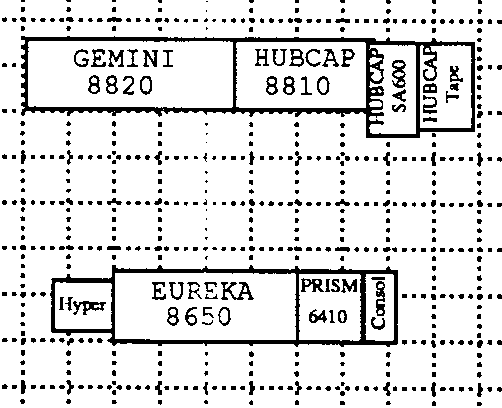
footprint of T-20 (labeled as "Hyper"
in lower left) as compared to VAXes.
From DCIT Update Newsletter, vol. 14,
no. 2, November 1990, p. 22.
To compare with Clemson University's mainframe in 1986, the
physical dimensions of the combined CPU and memory cabinets
for an AS/XL 60 were 35 inches wide, 173 inches deep, and 68 inches high,
with a weight of almost 8,000 lbs. Jack Dongarra
reported in 1988 that a AS/XL V60 with integrated vector processor,
matching the Clemson mainframe upgrade in 1987, solved a system of
equations of order 1000 with a measured performance of 82 MFLOPS.
- A good overview of the design of the first-generation T-series
is given in John Gustafson, Stuart Hawkinson, and Ken Scott,
"The Architecture of a Homogeneous Vector Supercomputer,"
Journal of Parallel and Distributed Computing, vol. 3, no. 3,
September 1986, pp. 297-307.
(bitsavers version)
- Karen Frenkel in
"Evaluating Two Massively Parallel Machines,"
Communications of the ACM, vol. 29, no. 8, August 1986, pp. 752-758,
notes the involvement of physicist
Ken Wilson
of Cornell University in the design of the T-series:
... Cornell University's Kenneth G. Wilson, Nobel laureate and
director of the Center for Theory and Simulation in Science and
Engineering, ... approached FPS President and CEO Lloyd D. Turner
to request such a machine and then collaborated in its design ...
The article also mentions six upcoming benchmarks for the T-series,
which were later published for the T-100 (64 nodes) and the T-200
(128 nodes) in
Douglas Miles, Paul Kinney, Judson Groshong, and Rodney Fazzari,
"Specification and Performance Analysis of Six Benchmark Programs
for the FPS T Series," Proceedings of the 1987 Array Conference,
Montreal, April 1987, pp. 113-128. For the T-100, the results range
from a top rate of 596 MFLOPS for 1024 by 1024 matrix multiply to
81 MFLOPS for solving a system of 1023 linear equations and
47 MFLOPS for 1024 by 1024 two-dimensional FFT.
[This is an
FPS-sponsored conference for the Array users group.]
- Published measures of performance of T-20 systems also include:
- A T-20 at the Science and Engineering Research Council (SERC)
Daresbury Laboratory in England ran a quantum Monte Carlo simulation
and was "estimated to be performing at roughly half Cray-lS peak
vector speed." See R.J. Harrison and M.F. Guest,
"Quantum Monte Carlo on the FPS T-Series Parallel Vector Processor,"
Information Quarterly for Computer Simulation of Condensed Phases, no. 26,
September 1987, pp. 51-60.
To compare with contemporaneous Cray computers,
Ray Longbottom rated
the maximum MFLOPS of the 1980 single-processor-only Cray-1S as 160,
the maximum MFLOPS of a 1984 four-processor Cray X-MP4 as 842, and
the maximum MFLOPS of a 1987 four-processor Cray-2 as 1,951.
A partial picture of the open cabinet of the Daresbury T-20 is shown in
"Double Event at Daresbury,"
SERC Bulletin, vol. 3, no. 9, Autumn 1987, p. 11.
- A T-20 at FPS using a library of asynchronous communication routines
solved a set of 512 linear equations in double precision using a C program
at 28 MFLOPS. See Bradley Carlile and Douglas Miles,
"Structured Asynchronous Communication Routines for the FPS T-series,"
Proceedings of Hypercube88, The Third Conference on Hypercube Concurrent
Computers and Applications, Pasadena, CA, January 1988, pp. 550-559. The
references for this paper include a 1987 paper by Dan Warner of Clemson
University on hypercube communication algorithms.
- Published drawbacks of the first-generation T-series include:
- The Transputers
within the T-20 nodes initially had to be programmed in Occam.
Faculty and students at Clemson University, and users at other T-series
locations, including Cornell University, worked on compilers and
preprocessors for C and Fortran programs to be able to generate code
for the T-series.
See, for example, D.E. Stevenson, et al., "A Vector C and Fortran Compiler
for the FPS T-series: Experiences with Compiling to Occam I,"
Software: Practice and Experience, vol. 22 , no. 5, May 1992, pp. 371-390.
-
Daniel Reed and Richard Fujimoto discuss the design of the
first-generation T-series in section 8.1.5 of Multicomputer Networks:
Message-Based Parallel Processing, MIT Press, 1987, and analyze the
performance of the T-series in section 8.2.2.
Some excerpts from their analysis:
With a 125 nanosecond clock, each of the FPS T Series' vector pipelines
is theoretically capable of 8 megaflops. As figure 8.20 shows, vector
addition achieves only 3.5 megaflops for vectors of length 32,768, and
does not reach one half of this maximum until the vector length exceeds
256 elements. Because DAXPY drives both the addition and multiplication
pipelines, it should approach an asymptote of 16 megaflops for long
vectors. Instead, the asymptote is less than 5 megaflops, and 512
element vectors are needed to achieve one half of this maximum.
...
Because the vector unit can only process unit stride vectors, data
must be gathered prior to vector operations. Gather operations
are extremely time consuming, requiring approximately 9 microseconds
per data element. Consequently, a 128 element, non-contiguous vector
can be processed at roughly ... 0.00087 megaflops. If the power of
the FPS T Series nodes is to be realized, it is clear that vectors
must be contiguous and of substantial length. Unfortunately, these
conditions are frequently not met in practice.
...
The current FPS T Series system software supports only nearest neighbor
communication. To implement routing in the general hypercube topology,
both endpoints of each link must establish a connection before the data
can be transmitted. Because there is no internode signaling mechanism,
the nodes must poll one another by establishing connections via
set.links in a predetermined cycle. Given the overhead for set.links,
it is more efficient to adopt a torus interconnection and route messages
using its fixed connectivity.
...
The limitations of the FPS T Series hypercube are many and varied.
The vector memory organization is the most striking. Constant stride
access to vector operands is imperative if the vector unit is to
reach its peak performance. Similarly, the large overhead for
reconfiguring the network interconnections pragmatically limit the
topology to a 2-dimensional torus. The associated routing costs for
large tori leave the performance of large T Series systems in doubt.
Finally, the imbalance of computation and communication speeds make
the system severely communication limited when operating in vector mode.
- Similar performance problems were reported by
Donna Bergmark, et al., in "On the Performance of the FPS T-Series
Hypercube," Second Conference on Hypercube Multiprocessors, SIAM,
1987, pp. 193-199.
- David Barkai, who worked for FPS in 1985-1986, is very critical
of the T-series design and its unbalanced performance. See
the T-series history and concerns that he recounts in his memoir,
Unmatched: 50 Years of Supercomputing, Chapman and Hall / CRC Press, 2023,
which includes a quote from John Gustafson:
There was a terrible delay in the transputer. It was actually two and
a half years late. It meant that we couldn't develop much software and
have it ready with the hardware. We had to just give raw hardware out
to the customers that have been waiting for it.
- In 1988, the new FPS President and CEO Howard Thrailkill
decided that the T-series was a market miscalculation
and suspended investment in the T-series. See his assessment in
"FPS Computing: A History of Firsts,"
in Karyn Ames and Alan Brenner (eds.), Frontiers of Supercomputing II:
A National Reassessment, University of California Press, 1994.
- A second generation of the T-series was being designed
at the time FPS stopped work on the T-series. See
Rodney Fazzari and John Lynch,
"The Second Generation FPS T Series:
An Enhanced Parallel Vector Supercomputer,"
Proceedings of Hypercube88, The Third Conference on Hypercube
Concurrent Computers and Applications, Pasadena, CA, January 1988, pp. 61-70.
- D.E. ("Steve") Stevenson of Clemson University was chairman of the
Special Interest Group for T-Series users within the broader Array users
group for FPS equipment users from 1986 to 1990.
He was also the founder and first moderator of the Usenet group
comp.hypercube in 1987, which was renamed to comp.parallel in 1988.
See his
CV.
- FPS acquired Celerity in 1988, and the FPS/Celerity team,
working through later acquisitions by Cray in 1991 and then Sun in
1996, helped produce the very successful Sun E10K. See
"Oral History of Clark Masters," Computer History Museum,
interview by Uday Kapoor, recorded November 18, 2021.
- The axiom cluster was purchased using a
2005 NSF equipment grant
awarded to lead-PI Matt Saltzman and other co-PIs in the Clemson University
Department of Mathematics.
Matt remembers that the cluster was in service at CCIT from
10/2007 until 9/1/2010, and, before that, it was in the CES
machine room in Riggs Hall.
Physics and Astronomy
- These clusters were built by Murray Daw.
augustine was funded by an NSF ITR grant,
and aquinas was funded by an DOE EPSCoR grant.
Office for Business and Finance
- IBM punched card accounting machines were first rented in 1948
for use by the Registrar and other offices. They were located
in the Registrar's basement office in Tillman Hall, which becomes
known as the "IBM Room".
-
President's Report to Board of Trustees, 1948, on p. 8 of the pdf:
In early January the Registrar's Office installed five machines
which are being rented on a contractual basis from the International
Business Machines Company.
...
The installation of IBM equipment in the Registrar's Office for
the use of the central administrative offices of the college and other
departments as the occasion may demand should mean much to the college in
the years ahead. With sufficient cooperative planning, business procedures
of various sorts, alumni records, and many other worthwhile activities
of the institution may be facilitated with the use of these machines.
- Bill Gibbons,
"IBM Machines Eliminate Red Tape,"
The Tiger, vol. 51, no. 9, November 14, 1957, p. 3:
Clemson presently has eight separate machines. They are a 602-A
electronic calculator, an interpretor, a collator, a reproducer,
a sorter, a 402 Tabulator, two key punchers, and one verifier.
The need for a new tabulator at Clemson has become evident recently
because of the greatly increased volume of material. There are plans
for this new tabulator in process.
- "DP at Clemson - Business & Finance,"
Computer Center Newsletter, vol. 2, no. 2, October 1978, p. 6:
Business & Finance's Data Processing Department was formed in
1956, several years prior to the establishment of the Computer
Center, and made use of two IBM 402 tabulating machines and a
variety of other tab card equipment.
...
The workload increased steadily and in 1966 the department acquired
an IBM 360/20 computer with 8k of memory,
...
Core memory on the 360/20 was soon increased to 16k, and in 1968 [sic]
the 360/20 was tied in as a workstation to the IBM 360/50 at the main
computer center. Small jobs were run on the 360/20, but large jobs
were submitted to the 360/50 for processing. Use of the 360/20 as
an RJE station to the main computer center continued until the spring
of 1978 when it was replaced by a 3777-II communications terminal.
I believe the 1968 date is mistaken. The Model 50 wasn't acquired
until 1970, and the
President's Report to Board of Trustees, 1970-1971,
labels the connection as "new" on p. 17:
A new centralized administrative data processing system, linking the
Center with the computing facility operated by the Office for Business
and Finance in Tillman Hall, is proving to be an extremely valuable
computing innovation at the University.
In using this system, the Model 20 unit in Tillman Hall is connected
to the Center's larger Model 50 unit by telephone lines, allowing for
greater tape and disk storage capabilities and freeing the Model 20
unit to serve as a special input/output station.
- The Model 20 is also discussed briefly in
"History of Computing at Clemson - Part III,"
Computer Center Newsletter, vol. 2, no. 2, October 1978, p. 11.
I believe the 1968 date stated in this article as the start of the
use of the Model 20 is a mistake. This late date of 1968 is
contradicted by the "DP at Clemson" article in the same
newsletter issue and by the appearance of classified ads in The
State newspaper for an "IBM S/360 Model 20 Programmer" for the
"Accounting Division at Clemson University", which ran November 14
through November 19 of 1966.
CAEFF
- The Onyx Reality Engine was acquired in 1994 as part of
a virtual reality curriculum initiative funded by the Clemson
University Innovation Fund, Robert Geist and Larry Dooley
(Co-Principal Investigators), $236,601.
- The Onyx2 Reality Monster was acquired in 1997 as part of
NSF Award MRI CDA-9724271,
Robert Geist (Principal Investigator), $500,000.
- The distributed rendering system was built in 2002 as part of
NSF Award CISE/ACI/ITR 0113139,
Robert Geist (Principal Investigator), $284,834, and funding from
the W.M. Keck Foundation. See also:
-
"Seeing And Sharing Data: Researchers Get Virtual Lab,"
HPCwire, February 16, 2001.
- Karl Rasche, "Out of Order Rendering on Visualization Clusters,"
IASTED Int. Conf. on Modeling and Simulation (MS 2003), Palm Springs,
February 2003.
- Robert Geist, "A Distributed Rendering System for Scientific
Visualization," 41st Annual ACM Southeast Conference,
Savannah, March 2003.
- An equipment list for the CAEFF Visualization/Virtual Reality
and Computation Laboratory was published online in
1999.
- A 16-node Intel iPSC/2 hypercube is listed,
which is the same system that Intel had donated to
Clemson University in 1988 to support the research of Roy Pargas.
- A 64-node Intel Paragon is also listed, but this is
a reference to the 56-compute-node Paragon XPS Model A4
that was bought by USC at discount in 1993, located at USC,
and accessible by Clemson University researchers via the
"South Carolina Supercomputing Network" [or Supercomputer Network];
see
Sidebar: In-State Competition for a Supercomputer.
- Neither Intel system is listed in the February 2001 facilities
page capture nor in subsequent captures. According to page 61 of
a November 2002
Departmental Self-Study by the USC Department of Mathematics,
the Paragon was relocated to Texas A&M in 2001.
CCGT
CCMS
- The initial cluster is described in
James Hammond,
"ICAR Powers Up for Research -
University Buys One of the World's
Fastest Supercomputers to Boost its High-Tech Automotive Campus,"
news release, Clemson University Advocates Program, March 12, 2007,
and in a
2007 press release.
- The revised cluster is described in
Beth Schultz,
"Clemson's Computational Colossus,"
Computerworld, October 19, 2009, and in a
2008 press release.
- After the dissolution of the center, the Arev cluster resources
were merged into the Palmetto cluster. Custom Myrinet 10G cards were
manufactured for the Sun blade systems and were used for many years.
CUGI
Clemson University Institute for Human Genetics (IHG)
Nvidia DGX-2
Sidebar: In-State Competition for a Supercomputer
Late 1980s Requests for Supercomputers
- Bottom line:
the "South Carolina Supercomputer Network" in 1994, which
provided access to a 56-computing-node Intel Paragon computer
system, was a compromise result of both Clemson University
and the University of South Carolina at Columbia (USC) wanting
supercomputers in the late 1980s.
- For Clemson University documents, see "Super Computer, 1988-1992,"
Box: 31, Folder: 4, Office of University Research Records,
Series-0073,
Clemson University Libraries Special Collections and Archives.
- In the late 1980s, Clemson University had a 16-node FPS T-20
hypercube computer system, and USC had a 1024-node
Paralex Gemini 1000 massively parallel hypercube computer system.
As mentioned in the discussion of
computers associated with
the Clemson University Department of Mathematics above,
the T-20 was valued at $1M. According to
Michael Stockdell's memoir of his time at DEC and then Paralex,
the Paralex Gemini consisted of a 1024-processor nCUBE/10 with
a Sun workstation front end; see We're on Our Way: My Year as
a High Tech Entrepreneur, self published, 2020. Stockdell states
that USC paid $2.5M for the Gemini system, while newspapers reported
at the time that the system was valued at $3.3M.
The one-of-a-kind Paralex Gemini computer system, also later called the
Perceptics computer system since the contract was signed with
Perceptics rather than directly with Paralex, was delivered to USC
in the summer of 1988. In later references to this computer system
in research publications, USC faculty members cited it as an nCUBE/10.
- In 1987 Clemson University became an affiliate of the National Center
for Supercomputing Applications (NCSA) at the University of Illinois,
which provided approved researchers access to the supercomputers
at NCSA. These computers include a Cray X-MP/48 and an Alliant FX/8.
The approval process for individual researchers and for classroom use
was managed by NSF. See Amitava Ghosh, "Supercomputing Update,"
DCIT Newsletter, vol. 11, no. 2, Winter 1988, pp. 8-10.
Also in 1987, Clemson University added a vector processor to its
NAS AS/XL-60 mainframe and received a grant from NAS to develop
software for the vector processor. See "Clemson Gets Software Grant,"
The State, November 4, 1987, p. 13-A.
- During 1988, there were internal discussions at Clemson University
about acquiring its own supercomputer with computing power
beyond the FPS hypercube and the NAS AS/VXL-60 mainframe,
specifically a single-processor Cray Y-MP 4, which could scale
up to four processors. These discussions reached the
Clemson University Board of Trustees
in February 1989:
Dr. Ron Nowaczyk presented the Faculty Senate report.
Funding for the Cray computer was briefly discussed. Dr.
Chris Duckenfield explained that Clemson University is
missing out on several multi-million dollar federal
contracts because of our lack of computing capabilities
which are provided by the Cray or a similar supercomputer.
See also Adrienne Aucoin,
"University Requests Funds for Supercomputer,"
The Tiger, vol. 82, no. 16, February 10, 1989, page 1:
The University extended a formal request for $10 million
in state funds to upgrade the mainframe computer and to
purchase a supercomputer.
This request was made in an attempt to create a computer
center to be located in the Information Technology Center at
the Research Park. From there, the system would be accessible
to the entire state.
...
Even though the University also has a parallel system, it
only contains 16 small computers compared to the 1,024
computers at USC.
- The USC contract for the Paralex Gemini computer system,
signed in December 1987, was, in part, the outcome of
previous negotiations in 1987 with DEC for a
"megacomputer". See Scott Johnson, "'Megacomputing' Coming to USC,"
The State, November 4, 1987; John Monk, "USC Gets Powerful
Computer," The Charlotte Observer, November 4, 1987;
Scott Johnson, "USC Signs Computer Contract," The State,
December 19, 1987; and, Scott Johnson, "Digital Not Sure of Status
with USC," The State, December 22, 1987.
In early 1988, the USC Board of Trustees passed a strategic plan
that included the creation of a "megacomputing complex" at USC by
2001. See Mary Pearson, "Trustees Pass Plan for USC,"
The Gamecock, vol. 80, no. 49, January 13, 1988, pp. 1-2.
- In early 1989, USC received an offer from IBM of a
"50% off" for an IBM 3090-600s and the promise of establishing
a supercomputing center in Columbia with three IBM employees
on loan for multiple years. The cost of the computer system
was discounted to $14M rather than the normal $28M.
See Lynn Gibson, "IBM Approaches USC about Supercomputer,"
The Gamecock, vol. 81, no. 74, March 24, 1989, pp. 1-2.
For more about the USC plans, see pages 26-27 of
USC-Salkehatchie Faculty Senate Minutes, February 17, 1989,
and page 32 of
USC-Beaufort Faculty Senate Minutes, April 21, 1989.
- In 1989, both Clemson University and USC approached the state
legislature for funding for supercomputers. See David Reid,
"Supercomputer Struggle Still Continues,"
The Tiger, vol. 82, no. 20, March 10, 1989, page 1,
and Carolyn Mooney,
"Flamboyant President Pursues Favorite Hobby: Putting
The U of South Carolina 'On the Map',"
Chronicle of Higher Education,
May 1989:
After his speech at the center, Mr. Holderman has a strategy
session with top administrators. He mainly wants to know how the
university's request for state money to help buy a $14-million
supercomputer is faring over in the State House nearby.
AN END RUN CHARGED
The supercomputer debate is yet another symbol of the clashes
that sometimes occur when Mr. Holderman's ambitions for the
university exceed what the state wants to spend. South Carolina's
statewide coordinating board, which has budget authority over
public higher education, refused to approve the request, saying
it wasn't clear the university needed a supercomputer. So the
university teamed up with Clemson, which is seeking state money
for its own supercomputer, and the two institutions went directly
to legislators for the money. The issue was pending last week.
Fred R. Sheheen, the state's higher-education commissioner, whose
brother happens to be Speaker of South Carolina's House of
Representatives, calls the tactic an "an end run." Says Mr. Sheheen:
"There's a clear difference between institutional ambition and the
public interest."
- Both funding proposals met with strong opposition from the
South Carolina Commission on Higher Education and from a number
of legislators in the South Carolina House during the spring and
summer 1989. South Carolina Governor Carroll Campbell voiced support
for only one "supercomputer" but was open to an "administrative"
computer at the school that did not get a supercomputer.
A number of Senators in the South Carolina Senate were more open
to both proposals, and a compromise was reached: a task
force was appointed to study the proposals, and $2M for each
school was placed on a wish list of possible funding for the
new fiscal year, which depended on a surplus in state tax revenues.
There was a fair amount of coverage of these developments in The State
newspaper and the Charlotte Observer newspaper. As some examples of
this coverage, see John Monk,
"Super Controversy - Clemson, USC Battle for Ultra Fast Computers,"
Charlotte Observer, April 16, 1989;
John Monk, "In S.C., We Need But One - Campbell Stakes Computer Position,"
Charlotte Observer, June 27, 1989;
Bobby Bryant, "Call for 1 Computer Endorsed,"
The State, July 15, 1989; and,
Associated Press, "USC, Clemson Possible Sites for Supercomputer,"
Charlotte Observer, August 11, 1989.
- The state budgets in 1989 and 1990 did not allow for either
school to proceed with their plans. Part of this was due to Hurricane Hugo,
which struck South Carolina in September 1989. A few weeks after Hugo,
the supercomputer panel suggested renting computer time instead
of going ahead with purchases; see
Clark Surratt, "Renting Computer Proposed -
Panel Wants to Determine School Needs Before Buying,"
The State, November 21, 1989.
- In November 1991, Governor Campbell announced
the purchase of a single supercomputer, which was to be shared.
According to internal documents, the announcement took Clemson University
President Max Lennon by surprise and he then felt politically compelled
to support Governor Campbell's decision.
The shared computer was a $1.7M, 56-computing-node Intel Paragon XP/S A4,
which was ordered in late 1992 and installed at USC in 1993. With an
educational discount, and with further grants from both Intel and the
U.S. Department of Energy, the supercomputer cost the state only $300,000.
Researchers at Clemson University and the Medical University of South
Carolina were able to access the Paragon via the South Carolina
Supercomputer Network.
See Bill Robinson, "S.C. to Buy Colleges a Supercomputer,"
The State, November 6, 1991.
See also Paul Huray,
"Final Report on Award for 'Partnership in Computational Science',"
February 24, 1999, which includes clipped newspaper articles and
other documents about Governor Campbell's decision and the public
unveiling and demonstration of the Paragon in November 1993.
(A brief recounting of Huray's career, including serving as a faculty member
at UT Knoxville, creating a Center of Excellence between UTK and ORNL,
serving as a senior policy analyst for President Ronald Reagan, leading
various committees and subcommittees for the federal government,
and then serving as Senior Vice President for Research at USC,
is given in
his obituary. I believe that Huray was instrumental in obtaining
DOE support for the Paragon.)
- My impression is that the Paragon was not used very
much by Clemson University faculty. Two papers from Clemson University
Mathematics faculty cite it, and James Brannon from Clemson University
was a co-author with USC Math faculty members on a paper that cited it.
However, it may have given weight to research funding proposals since
several Paragons were in the initial supercomputer TOP500 list in July 1993.
USC's Paragon was
189th in the July 1993 list, while the four-processor Cray Y-MP4/432
at Florida State University was 235th in that list.
The IBM 3090-600s at the University of Utah was 487th in the November
1993 list (it did not appear in the June 1993 list).
Clemson University and USC Supercomputers on TOP500 Lists, 1993-present
Although not on the TOP500 list, USC currently has multiple
high-performance cluster computer systems, including Hyperion.
See a list
here.
Acknowledgements
I am very grateful to Don Fraser, who kept detailed notes about the
mainframe systems spanning 1978 to 2009 and to Randy Martin who had
detailed information about a number of campus clusters;
to Rong Ge, Walt Ligon, and Matt Saltzman for describing their
clusters; and, to Tyler Allen, Amy Apon, Murray Daw, Tom Drake,
Andrew Duchowski, Alex Feltus, Corey Ferrier, Stephen Ficklin,
Robert Geist, Terry Huntsberger, Olga Kuksenok, Becky Ligon,
Mike Marshall, Richard Nelson, Linh Ngo,
Joe Padgett, Don Parrot, Jack Peck, Thomas Randall, Harlan Russell,
Dan Stanzione, Robert Underwood, Mike Westall, and Ken Wrenn
for providing additional information and corrections.
Don Fraser also provided me access to numerous copies
of the Computer Center and DCIT newsletters, as well as
other historical Computer Center documents.
I am grateful to Dr. Tara Wood, Olivia Brittain-Toole, and
the Clemson University Libraries Special Collections and Archives
for access to much of the archival material I have used.