Mark Smotherman
Note that information about the School of Computing for Fall 2023 and afterwards is not included on this page. The last major update of this page was in August 2023, and some minor corrections were made in August 2025 and in January and February 2026.
Suggestions and corrections are welcome!
Six oral histories of Computer Science and School of Computing faculty members have been collected by Hallie Knipp, Ph.D. student in Digital History. The six faculty members are Robert Geist, Eleanor Hare, Eileen Kraemer, Jack Peck, Joe Turner, and Mike Westall.
Note: the links to dissertations/theses will require being on the Clemson network either by being on campus or through VPN.
This page is one of a series of timelines and highlights about the history of computing at Clemson University. The other pages are:
July 2023 marks the 45th anniversary of the founding of the
Department of Computer Science at Clemson. Over those 45 years,
the scope of the curricula and the research has successively
broadened into the current School of Computing, which pursues
not just Computer Science but also Applied Computing,
Biomedical Data Science and Informatics, Computer Information
Systems, Digital Production Arts, and Human-Centered Computing.
In the 1960s there are various efforts at Clemson to use computers
for both education and research, and by the 1970s several departments
are teaching computer programming courses.
The Department of Computer Science is established in 1978 based
on the leadership of Joe Turner and his colleagues in the Department
of Mathematical Sciences.
In the 1980s the educational and research scope of the
Department of Computer Science broadens beyond its former
emphasis on mainframe computer systems.
Under the leadership of Robert Geist and several of his colleagues,
the Department of Computer Science adds a program in Digital Production
Arts in 1999 and becomes the School of Computing in 2007.
In 2008, Larry Hodges is hired as the first permanent School Director
and works to build up the School into multiple divisions.
As part of this effort, Larry recruits Juan Gilbert in 2009,
who designs the Ph.D. program in Human-Centered Computing. More recently,
Eileen Kraemer, Brian Dean, and colleagues from other departments at
Clemson and at
the Medical University of South Carolina add a joint Ph.D. program
in Biomedical Data Science and Informatics.
1958 - A faculty committee at Clemson College is appointed to study
the feasibility of acquiring a computer for faculty to use. Nine months
later the committee recommends renting a small computer from the Royal McBee
company. [From L. Benjamin. Although not recorded by Benjamin, this is
likely an LGP-30 desk computer,
which is a popular computer available from Royal McBee.]
1959 - In a memo to Acting President Robert Edwards in February,
Jack Williams, Dean of the Graduate School at Clemson College,
requests $40,000 in funding for an "electronic computer installation
and expenses related to its operation" to expand research activities
in the Department of Mathematics.
1961 - In March, Clemson College purchases its first computer.
It is a Royal Precision
RPC-4000 from the Royal McBee company.
This is a larger and more powerful desk computer than the popular LGP-30
and has an 8K-word magnetic drum for main memory. The computer is installed
in Poole Hall, and Merrill Palmer of the Department of Mathematics is approved
to serve as the Director of the Computer Center on a half-time basis.
For a comparison with early computers at other regional schools, see a review of
college and university computers in the Southeast US, 1955-1961.
1962 - The Computer Center moves to Martin Hall, a newly-completed
building that will house the Department of Mathematics in one of its three
sections. Charles Kirkwood of the Department of Mathematics joins the Computer
Center on a part-time basis to develop computer courses beyond the initial
MATH 310, Programming the Digital Computer.
1964 - Clemson College becomes Clemson University.
1965 - In the Announcements for 1965-1966 (contained in the
1964-1965 Catalog), the Bachelor of
Applied Mathematics changes to the Bachelor of Mathematics, and a
Computer Science option appears in the Mathematics curriculum.
1966 - In the Announcements for 1966-1967 (contained in the
1965-1966 Catalog), six Computer Science
courses
An article appears in the Greenville News in April about the Clemson
University Computer Center, "Computer Center Solves Problems,"
and it mentions the interest in Computer Science by Clemson students:
Clemson University acquires an
IBM System/360 Model 40 mid-range mainframe computer system
with 66,536 bytes (64KiB) of memory for academic and research support.
This marks the start of many decades of using IBM
and IBM-compatible mainframe computer systems.
(Because of space needs for more equipment and staff,
the Computer Center will move to the basement
of Poole Hall, also known as the Plant and Animal Science building,
in summer of 1967. The Computer Center will stay in Poole Hall until
a new Information Technology Center in the Research Park in
Anderson County opens in late 1986.)
1970 - The Department of Electrical Engineering changes its
name on July 1 to the Department of Electrical and Computer Engineering.
One year later, on July 1, 1971, the Department of Mathematics will
change its name to the Department of Mathematical Sciences.
1971 -
Jack Peck joins the Department of Mathematics in February. He is the
first faculty member at Clemson University with a Ph.D. in Computer Science
and is initially recruited by Art Pellerin, a friend from
the University of Southwestern Louisiana who is now in graduate school at
Clemson. (Both Art and his wife Carolyn will later join the
Department of Computer Science as faculty members.)
Arriving part way through the spring semester at Clemson after finishing
his teaching duties at USL, Jack works as an analyst at the Computer
Center and co-writes the first automated payroll system for the university.
1972 - The courses in Computer Science are renumbered,
and courses in COBOL and PL/I are added.
1974 - Under the leadership of the Dean of the Graduate School,
Arnie Schwartz, the Computer Center is reorganized, and two faculty
members in the Department of Mathematical Sciences take on new roles:
Darrell Hickman becomes Director of the new Division of Administrative
Programming Services (DAPS), and Jack Peck becomes Director of
the new Division of Information Systems Development (DISD).
Former Provost Jerry Reel, in his history of Clemson University, states:
Overview
Timeline
Eras
Prior to the Department of Computer Science
pictured: a promotional photograph of an RPC-4000 computer
[source: Jürgen Müller, e-basteln.de]
pictured: Martin Hall as seen from the direction of Sikes Hall
[Clemson University Historical Images, ua100_002058]
The faculty for Computer Science are:
[from Clemson Catalog, 1965-1966, Volume 41]
In keeping with its policy of continuously strengthening its academic
programs, Clemson offers a bachelor of science in mathematics with an
option in computer science. The response to this program is evidenced
in that almost 40 percent of the 200 students majoring in mathematics
select the computer science option.
The second unit in the center, the Division of Information
Systems Development (DISD), offered contractual programming for
research grants and for state and local government agencies. As a
result, Clemson's Computer Center became essential to the state's
management of its social services. The value of the outside contracts
grew from $5,000 to $2.5 million between 1970 and 1979.
Jack Peck will also lead an effort to develop a Medicaid Management
Information System (MMIS) for the S.C. Department of Social Services
In 1981, this system will become the
first federally-certified, database-oriented MMIS in the nation.
Services like this to the state of South Carolina will provide
the basis for multiple upgrades to the mainframe computer system
over the upcoming years, well beyond what would be expected for
a university of the size of Clemson, and for many part-time job
opportunities for Computer Science students.
A picture of students using card punch machines to prepare their programs to submit to the mainframe computer system appears in the 1974-1975 Catalog.
![]()
[from Clemson Catalog, 1974-1975, Volume 49]
1975 - Joe Turner joins the Department of Mathematical Sciences. Joe has significant previous experience, having served as an Assistant Professor of Mathematics and Systems Manager of the Computer Center at West Georgia College for six years before attending the University of Maryland for a Ph.D. in Computer Science, which will be granted in 1976.
1976 - Mike Westall, an Assistant Professor in the Department of Mathematical Sciences who joined Clemson University in 1974, has been working for the Computer Center and develops the Clemson Editor (CEDIT). This editor is more resource efficient than the standard IBM TSO editor, and it will be licensed worldwide by the Computer Center to IBM mainframe computer system customers.
1977 - The Computer Science Option now has its own course map in the 1977-1978 catalog, rather than appearing as a footnote, and now requires a COBOL course.
Planning committees are established to evaluate the direction of computing at Clemson University and the possibility of a separate Department of Computer Science. A first committee is established within the Department of Mathematical Sciences, and a second committee includes representatives from the Department of Electrical and Computer Engineering. With the support of President Edwards, Henry Vogel, Dean of the College of Sciences, and John Kenelly, the Department Head of Mathematical Sciences, the committees plan for a separate Department of Computer Science, which will focus on mainframe computer system concepts and software. The Department of Electrical and Computer Engineering will continue to focus on minicomputers, microcomputers, and network communications. One faculty member suggests that the initial dividing line between the two departments can be the number of bits in the memory word of a computer: the Department of Computer Science will focus on computers with 32-bit words and above.
1978 - The Department of Computer Science
formally starts on July 1 with Joe Turner
as the acting Department Head.
The initial faculty members are:
1980 - The South Carolina Commission on Higher Education
approves the B.S. and M.S. in Computer Science programs in April,
and the first three B.S. students graduate in December:
John Graham, Jr., Michael Talbert, and Thomas Williamson.
(These students are seniors in Mathematics who are able to switch to the
newly-approved Computer Science degree program.)
Courses are renumbered in the new curriculum, and three different programming
languages are covered in the first three semesters: FORTRAN in CPSC 110,
COBOL in CPSC 130, and PL/CS, a block-structured language derived from
PL/I, in CPSC 210. Courses in IBM S/370 assembly language (CPSC 230) and
data structures (CPSC 340) round out the sophomore year.
Computer Science majors participate in the Cooperative Education program.
Pictured below from the 1980 TAPS Yearbook is Ann Bechtler, a Computer
Science major, who is shown as a co-op student in the management section
of Owens Corning Fiberglass in Anderson. (Ann will later work for the
Division of Administrative Programming Services on campus before
graduating in May of 1983.)
1981 - The first two M.S. in Computer Science students graduate
in May: Scott Walden and Frank Watts. Charles Hallowell also graduates
with the M.S. in Computer Science in December.
Eleven students will graduate with the B.S. in Computer Science this
calendar year, including the first four women: Marie Rapp, Francina Smith,
Nancy Hartsell, and Deborah Vance.
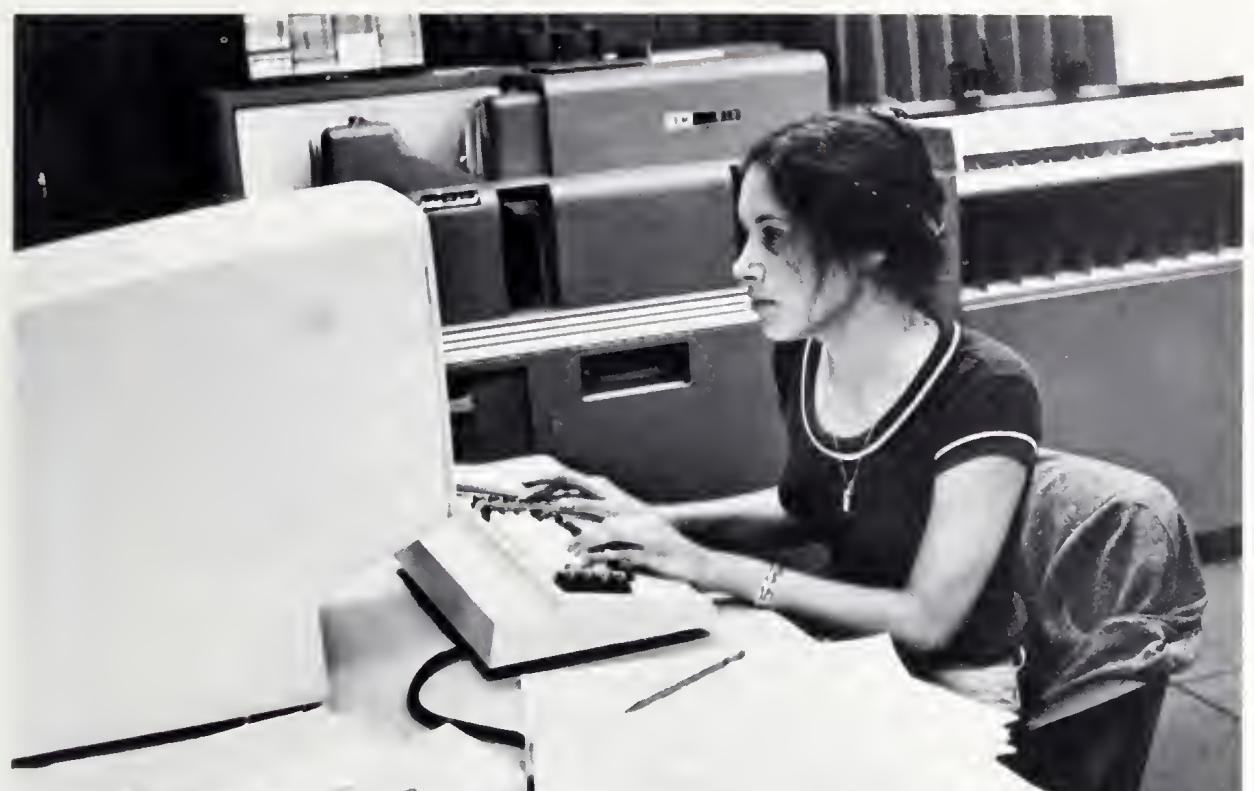
A picture of a program written for the mainframe computer system
on a terminal appears in the 1981-1982 Catalog.
1982 - Based on negotiations for "temporary space" by Dean Schwartz,
the department moves from Martin Hall to the fourth floor of the College
of Nursing building (which is renamed as R.C. Edwards Hall in 1992).
This "temporary" arrangement will last for some twenty years.
Harold Grossman, Wayne Madison, and Ed Page begin a distributed simulation
research project for the U.S. Department of Defense. The electronic mail
and other communication tools that they establish for the project greatly
impress their DoD program manager, and after this first year they will
turn their attention to providing these tools as an unclassified network
for DoD.
1983 - The B.S. in Computer Information Systems program begins.
The 1984-1985 catalog states:
The $8M, 25-year-long effort for the U.S. Department of Defense
to build and maintain the Test and Evaluation Community Network
(TECNET) officially starts. See US Patent
USH2111H1.
An NCR Tower 32 supermicro computer running UNIX and produced at
the NCR plant in West Columbia, SC,
serves as the first host for the network services. These services
came before the development of the web and are TELNET and FTP based.
The TECNET computer will be connected to the Defense Data Network
(DDN), which is a follow-on to ArpaNet.
The TECNET project will employ numerous students and
eventually be housed in the basement of Jordan Hall.
1984 - The Ph.D. in Computer Science program begins. Joe
Turner credits the successful research efforts and external funding of
the TECNET project as a significant factor in obtaining approval for the
Ph.D. program.
Robert Geist joins the faculty and leads the introduction of UNIX
into the curricula, which to this point has been largely dominated by
IBM mainframe computer software and concepts. As part of his efforts,
Robert arranges for Perkin-Elmer to donate a
Model 3230, along with UNIX source code, to be used in
graduate courses.
CPSC 101 and 102 are now the beginning two programming courses for
Computer Science and Computer Information Systems majors.
Each course includes both lecture time and instructional lab time.
The ACM's Curriculum '78 had recommended instructional labs for CS1,
CS2, and several other model courses, and many schools add instructional
labs to their curricula in response. CPSC 101 and 102 will be taught
using various programming languages over the next forty years,
including Modula, Ada, Java, and C/C++, but always with instructional labs.
1986 - The B.S. in Computer Science program is one of the first 22
Computer Science programs accredited nationally by the Computing Sciences
Accreditation Board (CSAB).
Joe Turner has been a leader in the national efforts, and Steve Hedetniemi
and Harold Grossman will also take on active parts in the national efforts.
Jack Peck works with Chris Jarvis in the Department of Textiles to
establish the Clemson Apparel Advanced Manufacturing Technology
Demonstration Center, which is part of a $3.5M research project funded
by the U.S. Army's Defense Logistics Agency to study state-of-the-art
manufacturing technology and equipment. The Center will open in 1988
and lead to US Patents
US5375063A and
US5748843A.
A number of graduate students and faculty at Clemson will receive
research support from these efforts,
and they will be critical to the production and supply chain of
sewn products like chemical protective suits and boots during the First
Gulf War and provide software to manage the Clothing and Textile Army
Combat Uniform (successor to the Battle Dress Uniform) supply chain for
the Defense Personal Supply Center (DPSC) during the Second Gulf War.
1987 - Tom Wimer is the first student to graduate with the
Ph.D. in Computer Science. His dissertation is entitled
"Linear Algorithms on k-terminal Graphs" and is completed under the
direction of Steve Hedetniemi. (After graduation Tom returns to a faculty
position at Clarion University of Pennsylvania.)
1988 - A picture of the faculty and staff of the Department
of Computer Science is taken for the 1989 TAPS yearbook.
1991 - The B.A. in Computer Science program begins.
The B.A. degree provides a more liberal arts approach to pursuing a
degree in Computer Science than the B.S.
It requires the same computing courses in the freshman and sophomore
years as the B.S. degree but offers more choice in the junior and
senior years. It additionally requires two years of a modern language
and a minor.
Two seminar courses in professional issues are added to the
B.S. in Computer Science and the B.S. in Computer Information Systems.
CPSC 491 Seminar in Professional Issues II 1(1,0) The impact of
computing system development on society is considered. Ethical
issues in the design and development of computer software are
discussed. Standards for professional behavior, the professional's
responsibility to the profession, and techniques for maintaining
currency in a dynamic field are discussed by students.
1992 - The departmental computing systems available to faculty,
staff, and students this year:
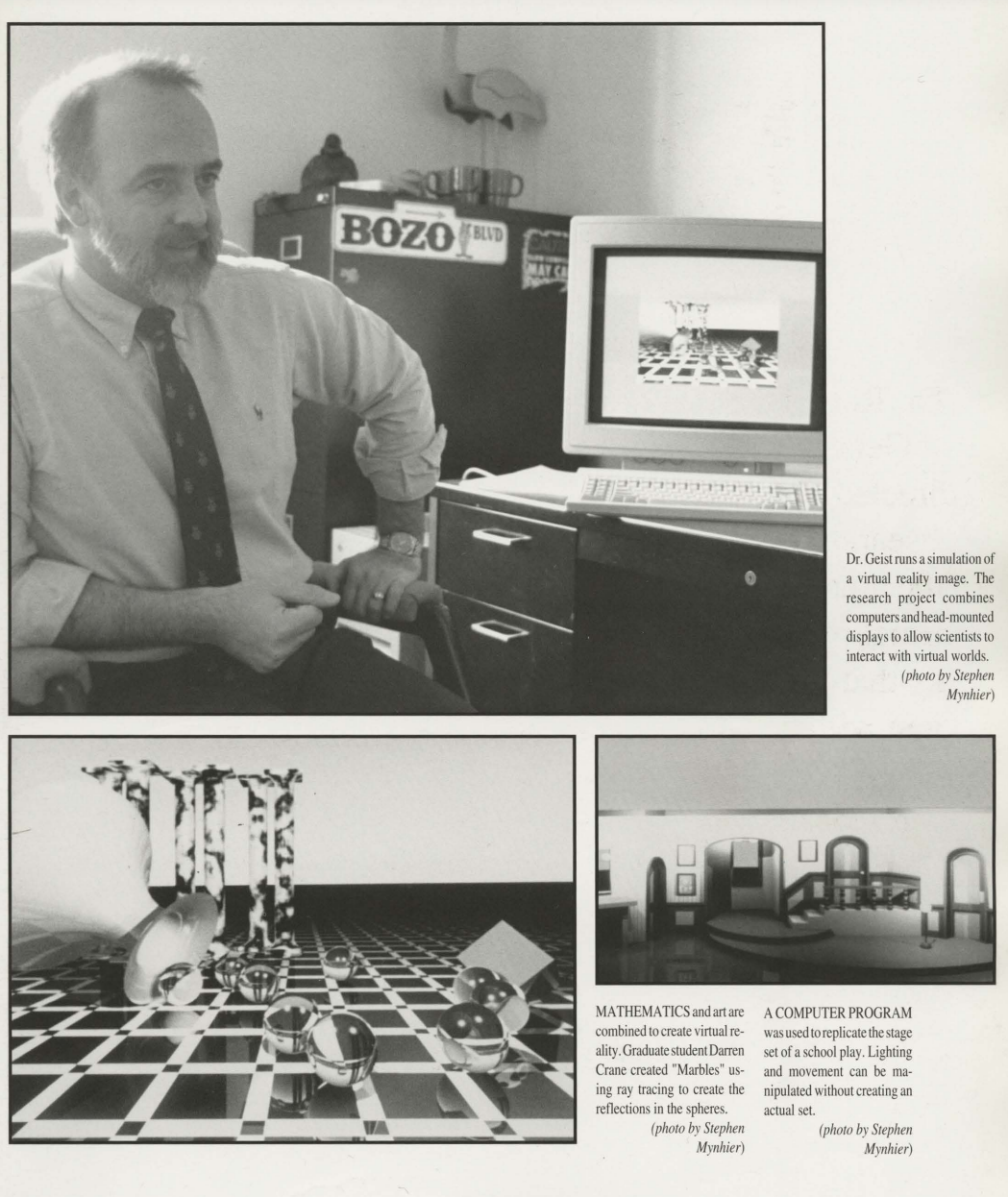
1994 - The 1994 TAPS yearbook features an interview with
Robert Geist about his work in virtual reality.
1995 - The number of colleges at Clemson is reduced initially
to four and then in July is increased to five. The College of Sciences
is dissolved, and the Department of Computer Science joins the new
College of Engineering and Science.
Various groupings within the new college were considered during 1994,
including a school that combines Computer Science, Electrical and
Computer Engineering, and Mathematics into a single budget center
as well as merging Computer Science either with Electrical
and Computer Engineering or with Industrial Engineering.
Ultimately, Computer Science remains an independent department.
1997 -
The department had set up web pages ca. 1994, and the first capture
of the pages by the Internet Archive is made in
December 1997.
The
"welcome letter" on the department's web site lists a number of
areas of specialization for graduate studies, reflecting faculty interests:
1999 - The M.F.A. in Computing program begins and is
administered by the Graduate School. The planning for this new degree
has been led by Robert Geist of the Department of Computer Science
and Sam Wang of the Department of Art.
The Master of Fine Arts degree is a terminal degree in Art requiring
at least 60 graduate credits and an M.F.A. thesis. M.F.A. holders can
pursue tenure track positions in Art and related disciplines.
The name of the degree will later change to the M.F.A. in Digital
Production Arts in 2002, and the home for the program will be
transferred to the Department of Computer Science. The program is
administered by a joint board consisting of faculty from the Department
of Computer Science, Department of Art, and the Department of Performing Arts.
The goal of the program is to teach both the artistic and the technical
aspects of animation. The program thus has two entry paths: one to
provide technical knowledge to students from artistic backgrounds, and
one to provide an introduction to art to students from technical
backgrounds.
2001 - Jim Soukup and David Wentworth are the first two
students to graduate with the M.F.A. in Computing.
Soukup's thesis is entitled
"Synthetic Ambience"
and is completed under the direction of Robert Geist.
Wentworth's thesis is entitled
"Reality and Illusion"
and is completed under the direction of David Hartmann of the
Department of Performing Arts.
Shown below are images from the Soukup and Wentworth theses, respectively.
2003 - Provost Dori Helms provides crucial support for a new
building for the Department of Computer Science.
In May, the Clemson University Board of Trustees approves
renovation and expansion plans for McAdams Hall.
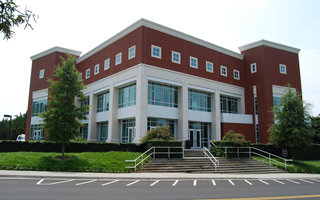
2004 - The department moves from Edwards Hall to a newly-constructed
wing of McAdams Hall.
2005 - Planning for a School of Computing starts at the Fall 2005
departmental retreat, with the support of Provost Helms. The proposed
School will have an overall Director rather than a head or
chair. Multiple divisions are proposed within the school that
will recognize different tenure and promotion expectations
(e.g., participation in film festivals),
and each division will be led by a chair.
2006 - As part of a strategic plan to upgrade the campus network
and computing facilities and to provide statewide and national leadership
in cyberinfrastructure, Provost Helms recruits Jim Bottum from Purdue
University to be Clemson University's Chief Information Officer
(CIO) and Vice Provost for Computing and Information Technology.
Vice Provost Bottum offers his help and support for a School of Computing.
2007 - The School of Computing formally starts on January 1
with Robert Geist as Interim Director. The initial faculty members are:
Various configurations of divisions and various division titles
continue to be considered for the School, including a
public proposal for six divisions, the link for which is included in
the position advertisements for a permanent Director:
2008 -
Larry Hodges is hired as the new Director. As part of his vision for
the School, he believes that the new area of Human-Centered Computing
holds the most potential for growth. So, the School is organized into
three divisions: Computer Science,
Visual Computing (renamed from Computational Arts so that the division
clearly includes visualization), and Human-Centered Computing.
Robert Geist recruits Don House from Texas A&M to lead the
Visual Computing division.
C. Tycho Howle and his family give $2.5 million to
Clemson University to establish two endowed chairs, one of which
becomes the C. Tycho Howle Director of the School of Computing.
Sebastien Goasguen leads an effort to scavenge otherwise unused time from
the computers in instructional labs across campus using a system
known as Condor. This arrangement allows faculty across campus to
use the spare computer time for research computing. Sebastien
also establishes a World Community Grid Team at Clemson University
to contribute otherwise unused computer time for humanitarian efforts
through the World Community Grid. According to an interview
in the student newspaper, Clemson University consistently ranks among
the top 10 universities in the United States for contributing computing
power to humanitarian groups through the WCG, such as the Nutritious
Rice for the World project.
2009 - Larry Hodges recruits Juan Gilbert from Auburn
to lead the Human-Centered Computing Division and to plan a new
Ph.D. degree in Human-Centered Computing.
2010 - The three divisions are being described as follows to
prospective graduate students:
2011 - The Ph.D. in Human-Centered Computing program begins.
The proposal for the new degree states:
Amy Apon joins Clemson as the new Division Chair in Computer Science.
Amy is the former director of the Arkansas High Performance
Computing Center, and Vice Provost Bottum is instrumental
in recruiting her. Amy will soon assist in the high performance cluster
supercomputing efforts at Clemson University.
2012 -
Inside Higher Education
reports that, based largely on Juan's recruiting,
approximately 10 percent of African-American Computer Science
professors and Ph.D. students nationwide are currently employed
or enrolled at Clemson University.
2013 - Kinnis Gosha is the first student to graduate with the
Ph.D. in Human-Centered Computing. His dissertation is entitled
"The Application of Embodied Conversational Agents for Mentoring
African American Stem Doctoral Students" and is completed under the
supervision of Juan Gilbert. (After graduation, Kinnis takes a
faculty position at Moorehouse College, where he is now the
Hortenius I. Chenault Endowed Professor of Computer Science.)
A DreamWorks Animation outreach program is held this summer at
Clemson University. From the inception of story, to the creation of
models, along with the art of texturing, animation, and lighting,
and the final look applied through compositing, two teams of six are
tasked with making the
best possible short films they can with the
mentorship of several DreamWorks Animation artists and supervisors.
The teams produce
Robo+Repair
and
QA-ARM-A.
2014 - Several graduate degree programs in the college are
approved for delivery in Charleston, including the M.S. and Ph.D.
in Computer Science and the M.F.A. in Digital Production Arts.
An article about the DPA program,
"Making Magic,"
appears in the Spring issue of Glimpse, published by the
Clemson University Office of the Vice President for Research.
2015 -
Chris Plaue proposes a new course in Computing, Ethics and Global Society,
which is also designed to provide General Education credit in the Science
and Technology in Society category. The course is approved and begins
to be offered the following year.
Two teams participating in the DreamWorks summer mentoring program
produce short animations,
To Shell and Back
and
Craving Crustacean.
2016 -
Eileen Kraemer asks
Alex Herzog to design and teach special sections of CPSC 4910 as a senior
design / capstone experience, modeled in part on the successful capstone
program at NC State.
Alex pairs teams of three to four students
with projects from industry partners. BMW is an early industry partner
along with NVIDIA and Sensus. AWS, Boeing, Capegemini, and SYNNEX will
become major partners in subsequent years.
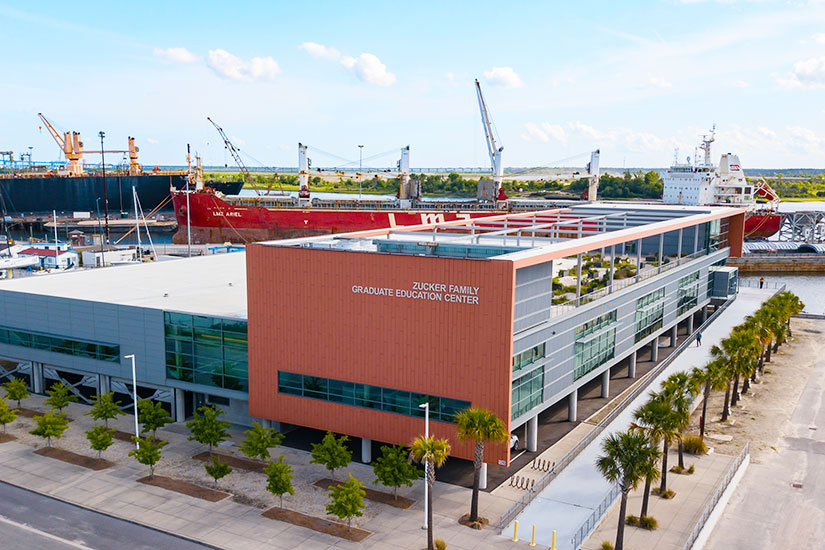
The Zucker Family Graduate Education Center opens in
Charleston, S.C. The M.F.A. in DPA is offered there as well as on
main campus.
2017 - The M.S. in Digital Production Arts program begins
in Spring, and the Ph.D. and M.S. in Biomedical Data Science and
Informatics programs begin in Fall. The Ph.D. in BDSI is a joint
degree program with the Medical University of South Carolina, with
the degree proposal prepared by Eileen Kraemer.
Two teams participating in the DreamWorks summer mentoring program
produce short animations,
Disposable
and
Swept Up.
2019 - The M.S. in Computer Science is approved for
delivery in Greenville at the CU-ICAR campus.
The School of Computing faculty and staff hold a retreat in the
Watt Family Innovation Center to start the fall semester.
2020 - Benafsh Sapra is the first student to graduate with the
Ph.D. in Biomedical Data Science and Informatics. Her dissertation is entitled
"EdgeCrafting: Mining Embedded, Latent, Non-linear Patterns
to Construct Gene Relationship Networks"
and is completed under the
supervision of Alex Feltus of the Department of Genetics and Biochemistry.
Her
dissertation defense is conducted via Zoom because of the Covid-19
pandemic. (After graduation Benafsh takes a position of Bioinformatics
Scientist with Fulgent Genetics.)
Thirty-five academic years after the first Ph.D. student in Computer
Science graduated from Clemson University,
thirteen Ph.D. students will graduate in 2021-2022,
including five in December 2021 shown below.
pictured:
Jason Anderson (CPSC, advisor Amy Apon),
Robert Underwood (CPSC, Apon),
Farah Al Shanik (CPSC, Apon),
Meg Fowler (HCC, advisor Murali Sitaraman),
Divine Maloney (HCC, advisor Andrew Robb),
Prof. Apon
MSCS Ready, a Readiness Sequence for the M.S. in
Computer Science, begins under the leadership of Eileen Kraemer. The
School of Computing also joins the national MS Pathways to Computing
Consortium.
Graduate courses begin to be offered in the One Research Drive building
on Clemson University's ICAR campus in Greenville.
Office space and research lab space also begin to be available for a
limited number of school faculty in the ORD building.
2022 - The Master of Applied Computing program begins.
The program is designed for students without a background in computer
science who wish to obtain that background as well as a sequence of
graduate-level courses in one of six interest areas:
Brygg Ullmer and his students collaborate with faculty and students in
Clemson University's School of Architecture to build the "Fargates
for Bridging People, Places, and Digital Content" active exhibit for
the ACCelerate Creativity + Innovation Festival held in April at the
Smithsonian's National Museum of American History in Washington, D.C.
2023 - Dan Roberts graduates in May with a Masters in
Computer Science,
50 years after his B.S. degree in Math.
Department Head (later Chair)
Director
Computer Science Division Chair
Human-Centered Computing Division Chair
Visual Computing Division Chair
Faculty of Instruction Division Chair
The changes in enrollment reflected in the chart above match the
nationwide historical data.
Note also the
observation from the Computing Research Association (CRA) in the
Generation CS report that
"Analyses that look only at the number of CS majors understate the
demands being placed on academic units."
Academy of Motion Picture Arts and Sciences Award for
Technical Achievement - J.A. Tessendorf, 2008,
for the development of the system of fluid dynamics tools at Rhythm & Hues.
U.S. Patents
Clemson University has established the
University Research, Scholarship and Artistic Achievement Awards (URSAAA)
to recognize Clemson University faculty who have achieved rare career
milestones. Ten faculty members from the School of Computing
have been recognized:
Regarding publications, as of February 3, 2023, seventeen School
of Computing faculty members are listed among the top 200 Clemson
University faculty members by citation count.
Faculty in the Department of Mathematics
(later Mathematical Sciences)
listed as teaching Computer Science courses, 1965-1977
Department of Computer Science,
1978-2006
School of Computing,
2007-2023
Current Faculty
YouTube Videos
Computer Science at Clemson University
web site developed by Hallie Knipp celebrating the 45th anniversary and
featuring oral histories.
Christian Ihekweazu,
"The History of Clemson Computing,"
2022
Selected excerpts from Annual Reports of the
Clemson University Board of Trustees regarding Computer Science (1977-1986,
1992-1993)
Board of Trustees minutes containing the approval of the Department
of Computer Science (January 14, 1978), see Item 19 on page 15
Board of Trustees minutes containing the approval of the McAdams Hall
renovation and expansion (May 16, 2003)
Board of Trustees minutes containing the approval of the School
of Computing (October 20, 2006), see last action in Item 6 on page 5
Selected excerpts from Clemson University Catalogs
regarding the descriptions of Computer Science and Computer Engineering.
TigerPrints Digital Repository
Timeline of campus computing facilities (1948-2006), prepared
by CCIT student interns
YouTube video,
"Clemson Computer Center Tour, 1980,"
including a line printer playing the Tiger Rag at minute 9:30 of the video
Major Computer Systems at Clemson University
Department History for The Department of Mathematical Sciences
of Clemson University (1964-2002)
J.V. Reel, The High Seminary, Volume 2: A History of Clemson University,
1964-2000, Clemson University Press, 2013
L.L. Benjamin, Clemson University College of Engineering: One Hundred
Years of Progress, Clemson University Press, 1989
Clemson University Interactive Factbook (provides enrollment and
completion data for the past ten years)
G. Engel, et al.,
"A Brief History of the Computing Sciences Accreditation Board (CSAB),"
ACM Inroads, Volume 1, Issue 2, June 2010
Department of Computer Science
pictured: the initial B.S. in Computer Science curriculum
[from Clemson Catalog, 1981-1982, Volume 56]
[from Taps (1980)]
[from Clemson Catalog, 1981-1982, Volume 56]
pictured: College of Nursing Building (Edwards Hall)
[Clemson University Historical Images, ua100_001222]
The Bachelor of Science program in Computer Information Systems
emphasizes computer applications in commerce and industry. It combines
appropriate courses from computer science with courses from accounting,
finance, management, and marketing to prepare students for careers in
business data processing and information systems applications.
pictured: Steve Hedetniemi, Tom Wimer, and Joe Turner
[courtesy Steve Hedetniemi]
[from School of Computing files]
CPSC 291 Seminar in Professional Issues I 1(1,0) The impact of
computer use on society is considered. The ethical use of software
and protection of intellectual property rights are discussed. The
profession is viewed historically, organizations important to the
profession are discussed, the development process for standards
is presented, and the student is introduced to the professional
literature.
CPSC 491 will later expand into a three-credit course in 2009 with a
team project component.
University computing systems available for general use:
[from Taps (1994)]
[from Internet Archive]
Course requirements for the MS degree and areas of preparation for
the PhD qualifying exam include four core areas: computer architecture,
operating systems, programming language design and implementation,
and theory. Apart from these core areas, students typically tailor
their programs of study to individual interests, including algorithm
analysis, computational science, database systems, graphics and
virtual reality, parallel computation, and software engineering.
[Clemson University Archived Theses,
left image from J. Soukup, "Synthetic Ambience" (2001) and
right image from D. Wentworth, "Reality and Illusion" (2001)]
pictured: expansion wing of McAdams Hall as seen from the direction
of Edwards Hall
[SoC promotional photo]
School of Computing
Human-Centered Computing (HCC) is a relatively new discipline that
solves real world problems through the integration of computing with
people, technology, information, policy and sometimes culture.
We define HCC as follows:
Human-Centered Computing (HCC) is focused on understanding how to
design, build and evaluate computational technologies as they relate
to the human condition and how these technologies affect society.
As such, HCC researchers design and build computing artifacts and
evaluate them through studies with human subjects and measures
their usability as well as their affect on society; therefore,
HCC researchers often connect computing artifacts with policy.
pictured: Kinnis Gosha
[courtesy Kinnis Gosha]
pictured: frames from Robo+Repair and QA-ARM-A
[screenshots from Vimeo.com]
pictured: frames from To Shell and Back and from Craving Crustacean
[screenshots from Vimeo.com]
pictured: Zucker Family Graduate Education Center
[CECAS promotional photo]
pictured: frames from Disposable and Swept Up
[screenshots from Vimeo.com]
[from @socclemson Twitter post, August 22, 2019]
pictured: screen capture from the Zoom session
[from the linked Clemson News article, April 20, 2020]
Of the thirteen Ph.D. graduates in 2021-2022:
one is BDSI, eight are CPSC, and four are HCC.
Joining them in completing degrees from the School of Computing during this
academic year will be seven M.F.A. graduates, 50 M.S. graduates,
and 212 baccalaureate graduates (27 B.A. and 185 B.S.).
[from @socclemson Twitter post, December 21, 2021]
pictured: One Research Drive building
[SoC promotional photo]
pictured: Kelly Caine and Dan Roberts
[from the linked Clemson News article, May 9, 2023]
Leadership
Department of Computer Science (1978-2006)
School of Computing (2007-2023)
Degree Programs and Approved Delivery Sites as of 2023
and Master of Applied Computing Delivery Sites
Enrollments
Majors in the Department of Computer Science / School of Computing
Fall 2022 Enrollment
Faculty Honors and Service
ACM Distinguished Educator - R.M. Geist, III, 2009
ACM Distinguished Scientist - P.K. Srimani, 2008
ACM Fellow - A.J. Turner, Jr., 1998
(and after leaving Clemson University, M.J. Harrold, 2003,
and J.E. Gilbert, 2013)
ACM Vice President - A.J. Turner, Jr., 1998
ABET Fellow - A.J. Turner, Jr., (Emeritus Professor), 2007;
Harold Grossman (Emeritus Associate Professor), 2012
ABET Linton E. Grinter Distinguished Service Award - A.J. Turner, Jr., 2011
ASPA Director - A.J. Turner, Jr., 1993
CAC Chair - Harold Grossman (Emeritus Associate Professor), 2012
Clemson University Alumni Distinguished Professor - R.M. Geist, III, 2015
Clemson University Board of Trustees Faculty Award for Excellence
- C.S. Joerg, 2019
Clemson University Junior Faculty Researcher of the Year
- N.J. McNeese, 2022
Clemson University M.J. Pinson, Jr. '46 Distinguished Professorship
in Artificial Intelligence - F. Luo, 2021
Clemson University Student Accessibility Services' Accessibility
Advocate of the Year - C.M. Plaue, 2019
CRA Board of Directors - A.J. Turner, Jr., 1989
CSAB Fellow - A.J. Turner, Jr., (Emeritus Professor), 2004
CSAB Fellow - H.C. Grossman (Emeritus Associate Professor), 2014
CSAB President - A.J. Turner, Jr., 1991;
Harold Grossman (Emeritus Associate Professor), 2018
CSAB Vice President - H.C. Grossman (Emeritus Associate Professor), 2015
CSAC Chairman - A.J. Turner, Jr., 1988
FOCUS Director - A.J. Turner, Jr., 1997
Fulbright Scholarship - D.P. Jacobs, 2006; J.M. Sorber, 2019
IEEE Fellow - P.K. Srimani, 1999
IFIP Vice President - A.J. Turner, Jr., (Emeritus Professor), 2008
Murray Stokely Award - B.A. Malloy, 2019, for excellence in
teaching in a Engineering, Computing, and Applied Science discipline
NSF Presidential Young Investigator Award -
M.J. Harrold, 1993
NSF CAREER Award -
A.T. Duchowski, 2000;
J.O. Hallstrom, 2008;
B.C. Dean, 2009;
R. Ge, 2015;
J.M. Sorber, 2015;
C.S. Joerg, 2017;
I. Karamouzas, 2021;
H. Hu, 2021;
B. Knijnenberg, 2021;
Y. Yang, 2022;
L. Cheng, 2023;
N.J. McNeese, 2023
NSF CISE/CNS Program Director - A.W. Apon, 2015
NSF CISE/OAC Program Director - A.W. Apon, 2023
Science Without Borders - D.P. Jacobs, 2014-2016
Faculty Lists
Links to Additional Information
School of Computing
Current Staff
Affiliated Faculty
Digital Production Arts website (with links to more animations)
Digital Production Arts alumni page
Student Organizations
Computing at Clemson Student Project
Clemson University Archived Documents
Computer Center History Resources
Other Clemson University History Resources
Computer Science Accreditation History