updated March 18, 2026
Corrections are welcome!
The purpose of this page is to provide a timeline of Clemson University's efforts to connect its computers and computer networks beyond the campus. In particular:
There have been many significant efforts over the years to build strengths at Clemson University in computer networking and high-performance computing. In 2006, when Jim Bottum joined Clemson University as CIO and Vice Provost, he emphasized strategic partnerships between CCIT and Clemson University researchers. The funding and the research results that have come from these combined efforts further propelled the university into national prominence in high-speed networking and high-performance computing, which are now often grouped together under the broader term of cyberinfrastructure.
Furthermore, the Palmetto Cluster supercomputer has been financed as a condominium cluster, based on the model developed at the University of Southern California and then brought to Clemson by Jim Pepin. The computing node owners at Clemson University have been remarkably willing to allow other researchers, both on-campus and off-campus, to use what would otherwise be idle cycles.
Clemson University has also certainly made significant efforts in establishing a first-class on-campus network over the years and has been recognized multiple times as one of the nation's most wired and unwired (i.e., wireless connectivity) campuses by publications such as U.S. News & World Report and The Princeton Review.
Major Sections
This page is one of a series of timelines and highlights about the history of computing at Clemson University:
Note on DCIT/CCIT acronyms: the Clemson University Computer Center became part of the Division of Computing and Information Technology (DCIT) in 1985, which was renamed as Clemson Computing and Information Technology (CCIT) in 2007.
1971 - A grant from the Self Foundation allows the College of Engineering to provide dial-in service to a PDP-8 minicomputer running TSS/8, a time-sharing operating system later marketed as the DEC EduSystem, as part of teaching programming to students at sixteen high schools [1].
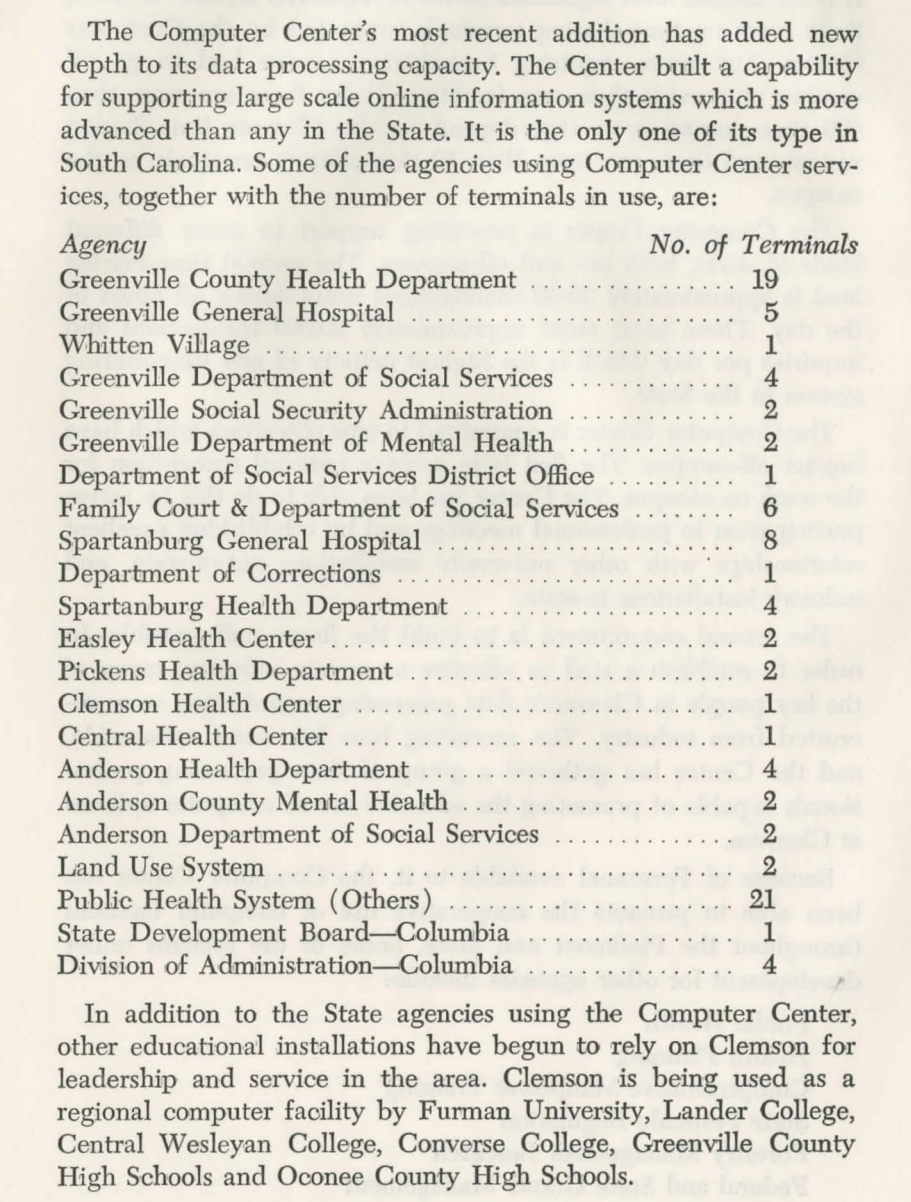
1972 - Dial-in service is provided for a health information system for six counties in the Upstate, which is sponsored by the South Carolina Department of Health and Environmental Control [2]. This is just the beginning of several contracts for online application support of state agencies and educational institutions, including the South Carolina's Department of Social Services and the Division of Administration in the Office of the Governor [3]. A PR release in 1977 [4] stated:
More than 200 terminals connect the computer to more than a dozen different state agencies, nine high schools, four neighboring colleges and 19 remote sites on the Clemson campus itself.
1983 - The Department of Computer Science joins CSNET, which provides an email service among the Computer Science departments and ARPANET sites across the U.S. [5] Clemson's connection is via PhoneNet using the MMDF (Multichannel Memorandum Distribution Facility) protocol; email addresses are of the form user%clemson.csnet or user%clemson.csnet@CSNET-RELAY.ARPA. Later examples include user@clemson.csnet.
Ed Page, Wayne Madison, and Harold Grossman, faculty member in the Department of Computer Science, begin the development of TECNET (Test and Evaluation Community Network) for the U.S. Department of Defense [6]. An NCR Tower 32 supermicro computer running UNIX serves as the first host for the network services, which are TELNET and FTP based.
1985 - Clemson University joins BITNET, a store-and-forward network among universities across the U.S. that provides email and file transfer services [7]. Clemson's connection is via the mainframe using the NJE (Network Job Entry) protocol; email addresses are of the form user@clemson on BITNET itself or user@clemson.bitnet if the email is being sent from a non-BITNET mail service.
Telenet is available in 1985, running on a VAX 11/750 computer under Unix [8]. Telenet provides off-campus dial-up access to the Clemson computer systems, as well as on-campus access to off-campus computers and networks [9]. Unix had been introduced to campus in 1983 [10] and ran on a node named hubcap, which is the nickname for Mike Marshall, the Unix system administrator.
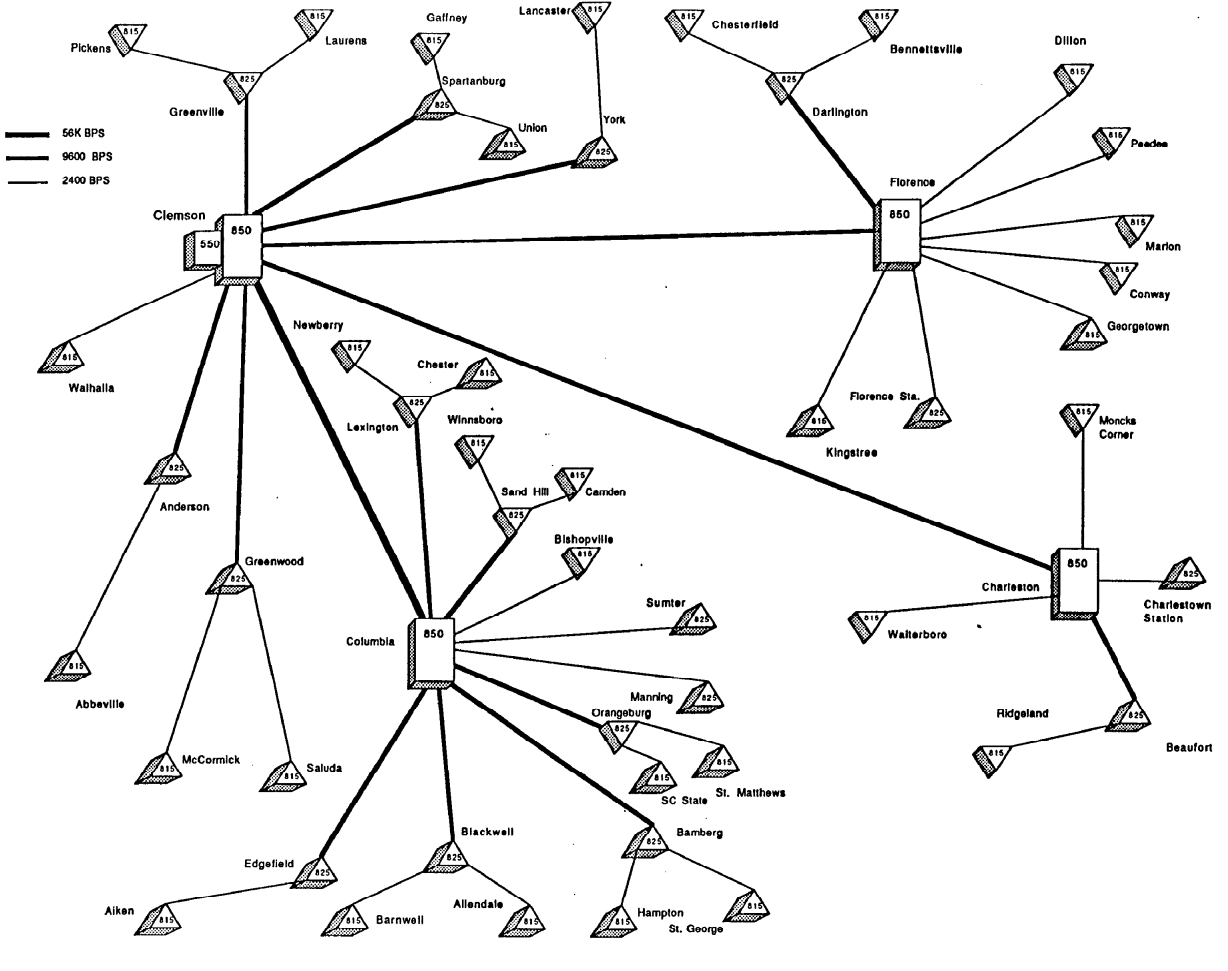
1986 - Jerry Lambert, a faculty member in the Department of Agricultural Engineering, establishes CUFAN (Clemson University Forestry and Agriculture Network), a statewide agricultural information network with local number dial-in accessibility across the state [11]. A map of CUFAN in 1986 is [12]:
hubcap is now the name for a VAX 11/780 computer running Ultrix, which is DEC's version of Unix, and UUCP (Unix-to-Unix copy) is available [13]. Email addresses using uucp start with a well-known node, trace the node-to-node route for the message path using exclamation points to separate the node names, and then end in the user name, e.g., gatech!hubcap!user. This is called a "bang path". user@hubcap.UUCP also seems to be used.
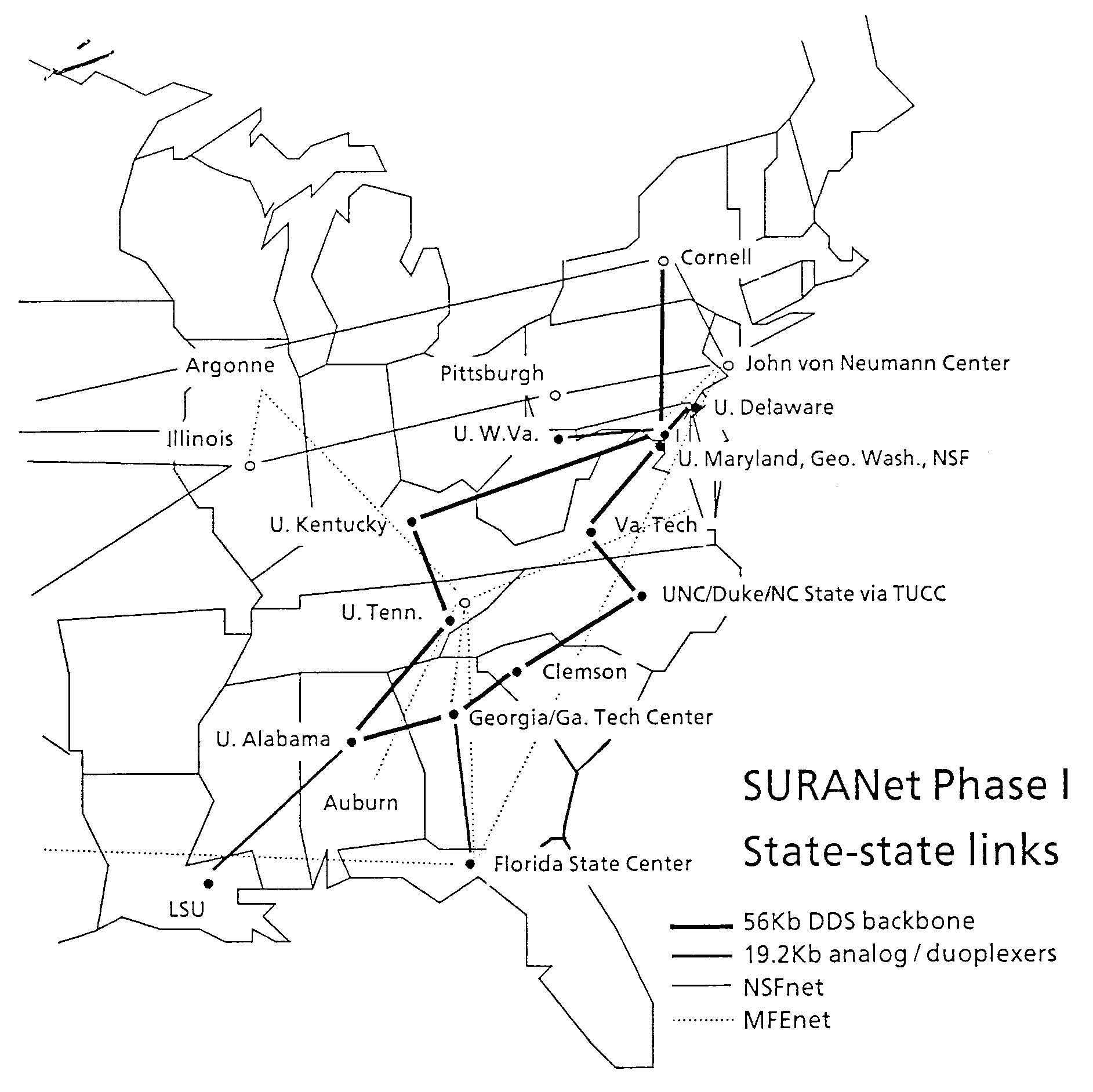
1987 - Clemson University becomes the South Carolina node for SURAnet, an IP-based regional network that is part of NSFnet and thus part of what is considered the early Internet. A Proteon p4200 router was acquired in 1986 to provide connections at 56 kbps to Triangle Universities Computing Center (TUCC) in North Carolina and to Georgia Tech through AT&T Digital Data Services [14]. hubcap is running TCP/IP and supporting SMTP (Simple Mail Transport Protocol).
.edu as a top-level domain had been established in 1985, and the clemson.edu domain record is activated on February 19, 1987 [15]. Early department-level domain names include cs.clemson.edu, eng.clemson.edu, and math.clemson.edu.
D.E. ("Steve") Stevenson, a faculty member in Computer Science, establishes and becomes the first moderator for comp.parallel (Parallel Processing News Group) on the USENET discussion boards [16]. Note that the USENET feed to Clemson in 1987 was via SURAnet [17].
1989 - The CSNet connection is currently running on a VAX 8650 system, named prism, using VMS and VMS Mail [18]. Some email users append a signature block to their emails that list different networks and the corresponding email addresses for those networks.
1993 - Clemson University sets up a Gopher server [19]. The URL is gopher://gopher.clemson.edu.
1994 - Barry Johnson, a staff member in DCIT, creates www.clemson.edu [20]. See a 1997 capture of www.clemson.edu.
1997 - Clemson University upgrades its internet connection to three T1 lines to InfoAve/iSCAN/SCNet [21]. (A T1 line can support 1.54 Mbps.)
1998 - Clemson University receives support from an IBM Shared University Grant to help prepare to connect to Internet2 [22].
An article in the winter DCIT newsletter explains why internet access is slow and notes an increase in the number of students in residence halls who now have Ethernet connections to the campus network (ResNet) rather than having to use dial in lines to a commercial ISP [23]. The article also notes that most employees and students will not have access to the Internet2 research network.
1999 - Clemson University upgrades to OC-3 optical fiber. (An OC-3 line can support 155 Mbps.) One OC3 line is for commodity internet and is set at 10 Mbps, burstable to 20 Mbps. A second ATM OC3 line connects the university research efforts to MCI Worldcom's very high performance Bandwidth Network Service (vBNS), a high-speed research network open only to universities. This connection is made via Columbia, SC, and then to the Southern Crossroads (SoX), which is hosted by Georgia Tech in Atlanta. This is a cooperative effort between Clemson, USC, and MUSC [21,24,25].
2000 - An internet site providing free long distance service is blocked by DCIT in January. The student newspaper reports that "Dialpad.com is the first Internet content provider that the University has specifically blocked or censored." [26] After an outcry from students, the blocking is lifted after one week [27].
On April 5, Clemson University officially connects to Internet2 via Southern Crossroads (SoX) [28].
2001 - In January, the New York Times reports that the university is considering charging students for Internet usage [29].
Because of a spike in the use of Napster in February, DCIT blocks internet traffic to Napster servers between 7:30 a.m. and 6:30 p.m. on weekdays. Napster is a file sharing application that is being used to share MP3 music files [30].
2003 - DCIT installs a Cisco 7606 router with an integrated firewall services module as the university's gateway to the internet [31].
ca. 2005 - Clemson University connects to the internet using a 1 Gbps link via AT&T Metro-E to a Qwest POP in Greenville [21].
2006 - Provost Dori Helms recruits Jim Bottum from Purdue University to become Clemson University's Chief Information Officer (CIO) and Vice Provost for Computing and Information Technology [32].
The North Carolina Research and Education Network (NCREN) establishes a research-only fiber network to support the Carolina MicroOptics Triangle, a regional optical research partnership among UNC Charlotte, Western Carolina University, and Clemson University [33].
2007 - Clemson University upgrades its commodity internet connection to OC-12 [25]. (An OC-12 line supports 622 Mbps.)
The Division of Computing and Information Technology (DCIT) is renamed to Clemson Computing and Information Technology (CCIT), and new team members join, including Jill Gemmill from the University of Alabama at Birmingham and Jim Pepin from the University of Southern California. A Cyberinfrastructure Technology Integration (CITI) group is formed with Jill Gemmill as executive director.
Clemson University establishes the South Carolina Computing Consortium (SC3) to highlight and coordinate "cyberinfrastructure-enabled research, education, and economic development projects in South Carolina." SC3 sponsors a booth at the 2007 Supercomputing Conference (SC07) [34].
The Clemson University Research Foundation (CURF), uses gifted fiber to create the C-Light state network, which is a direct fiber link between Atlanta and Charlotte, giving researchers direct access to the National LambdaRail, Internet2, and other national and international research networks [35].
2008 - The South Carolina General Assembly funds the South Carolina Light Rail (SCLR) network to connect Clemson University, the University of South Carolina in Columbia, and the Medical University of South Carolina in Charleston [36].
Sebastien Goasguen, a faculty member in the School of Computing, leads an effort to scavenge otherwise unused time from computers in instructional labs across campus using a system known as Condor. He establishes a World Community Grid Team to contribute otherwise unused computer time for humanitarian efforts through the World Community Grid [37].
Barr von Oehsen, a staff member in CCIT, becomes a Campus Champion to help connect Clemson University researchers and educators to computational resources from eleven NSF-funded national supercomputing centers and the TeraGrid [38].
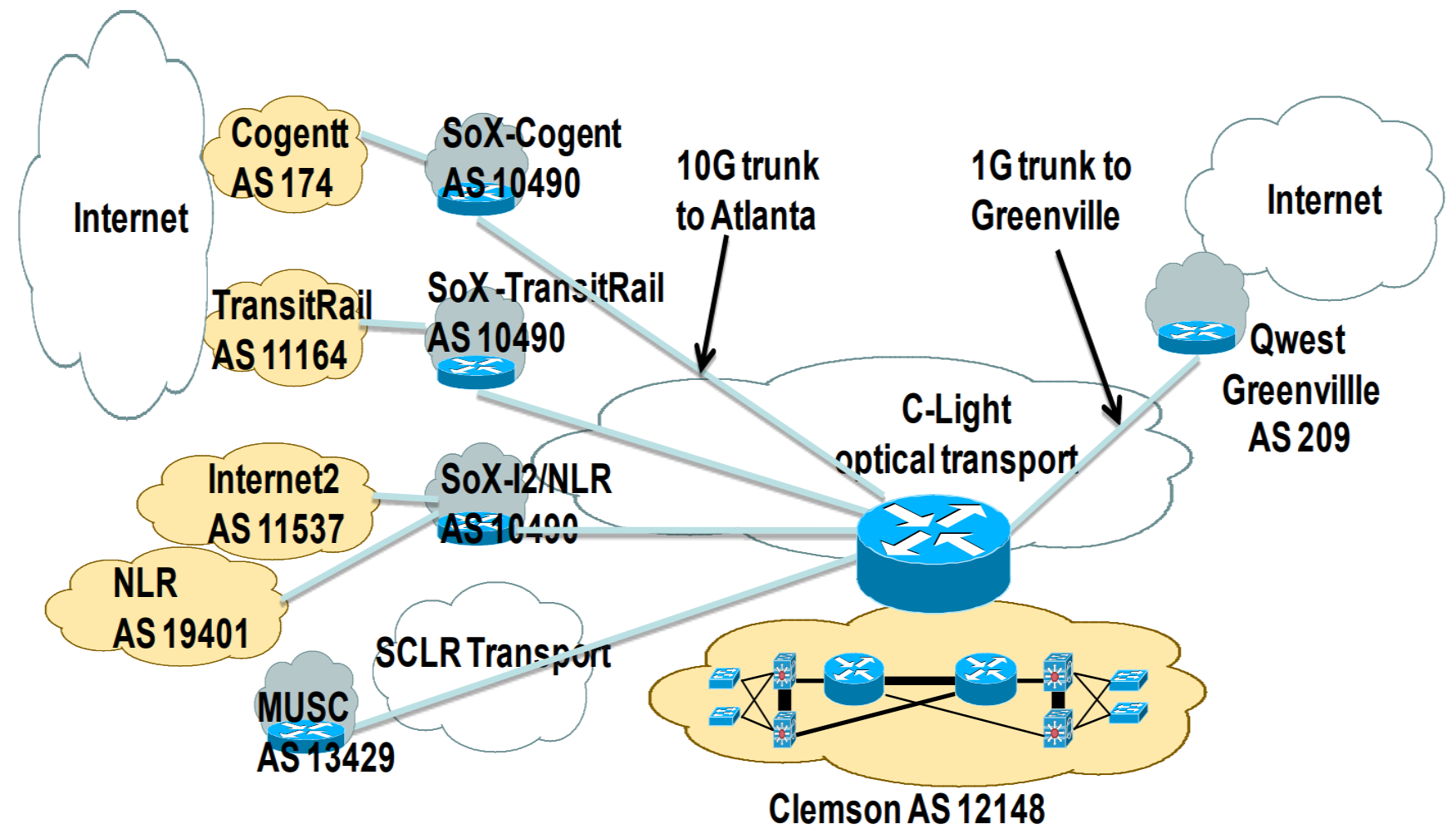
2009 - External network connections in 2009 [39]:
2010 - Jim Bottum is elected to the Internet2 Board of Trustees [40]. He will also be named as an Internet2 Inaugural Presidential Fellow in 2012 [41].
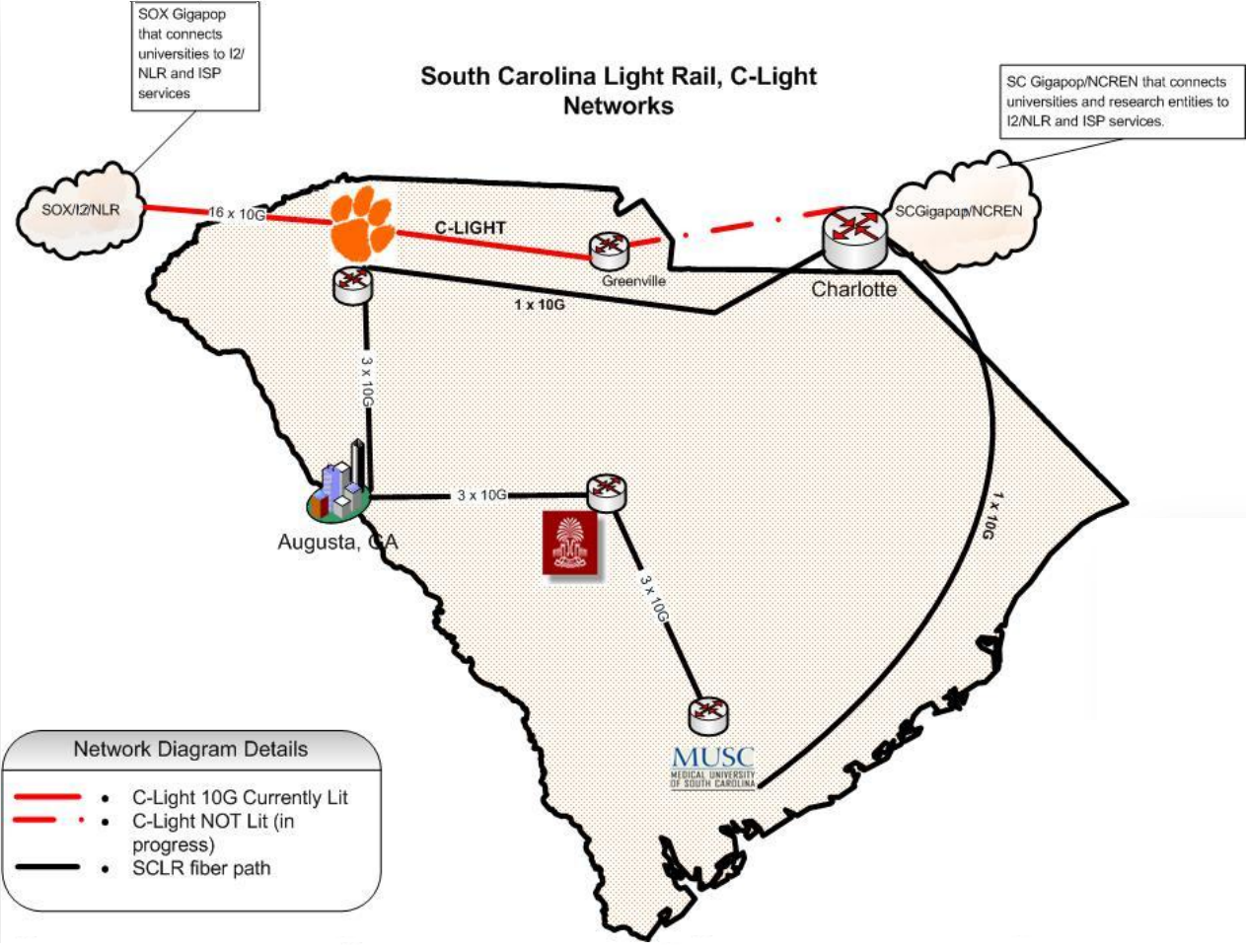
2011 - Map of C-Light and South Carolina Light Rail [42]:
2012 - Kuang-Ching "KC" Wang, a faculty member in the Electrical and Computer Engineering Department, partners with CCIT to establish Clemson NextNet with a NSF Campus Cyberinfrastructure award [43] to explore production use of the emerging software defined networking (SDN) technology for high performance data transfer on campus (across campus backbone and 10 academic buildings) and off-campus over Internet2, reaching partners such as NCBI/NIH [44] and University of Utah [45].
CCIT partners with Jason Thatcher, a faculty member in the Department of Management, to open a Social Media Listening Center in the College of Business and Behavioral Science (Sirrine Hall) and then in 2013 with Joe Mazer, a faculty member in the Department of Communication, to open a center in the College of Arts, Architecture, and Humanities (Daniel Hall) [46].
2013 - Clemson University connects to the Internet2 Innovation Platform, which provides a 100 Gbps high-speed backbone [47].
2014 - KC Wang leads NSF-funded CloudLab collaborative research effort among Clemson University, University of Utah, and University of Wisconsin-Madison to build a distributed data center across the three universities but operating as one system, connected at 100 Gbps over Internet2; University of Massachusetts-Amherst, Raytheon BBN Technologies, and the US Ignite foundation are later added as partners [48].
NSF also funds the Advanced Cyberinfrastructure - Research and Education Facilitators (ACI-REF) project, with Clemson University as the lead institution [49].
Kate Mace from CCIT leads the development of SCinet at the 2014 Supercomputing Conference (SC14). SCinet is a temporary network specifically designed and built to support the conference and showcase new technology and network innovations [50].
Clemson University's Palmetto Cluster is now integrated into the OSG Connect service for the Open Science Grid (OSG). This allows university researchers across the country to use some of the spare capacity of the Palmetto Cluster [51].
Clemson University is now a disaster recovery mirror site for the digital archives of the Shoah Foundation at the University of Southern California [52].
2015 - Spirit Communications donates services connecting Clemson University to the South Carolina LightRail optical network [53].
Clemson University joins the South Big Data Regional Innovation Hub (South BD Hub), managed jointly by Georgia Tech and UNC-Chapel Hill as one of four NSF-funded Regional Big Data Hubs [54].
2017 - Alex Feltus, a faculty member in the Department of Genetics and Biochemistry, and KC Wang lead the development of the Big Data Smart Socket (BDSS) open-source software to improve the performance of data transfers over networks [55]. Alex Feltus is also elected to the Internet2 Board of Trustees [56].
2018 - Clemson University hosts an NSF-funded workshop for the Chief Information Officers from several historically Black colleges and universities (HBCUs). This workshop leads to the formation of the Minority Serving - Cyberinfrastructure Consortium (MS-CC) [57].
2019 - K.C. Wang leads the NSF-funded FABRIC project to develop a national testbed for future Internet research [58]. To enable research of a new Internet core, FABRIC spans 29 sites across U.S. over the Department of Energy's ESnet v6 network and connects internationally with Europe, South America, and Asia. Clemson University is one of the 29 sites.
2023 - FABRIC announces the 1.2 Tbps TeraCore national ring network entering production service [59].
2024 - The current description of Clemson University's computer network, as provided by CCIT, is below [60]:
At the core of Clemson's local area network are two fully redundant, 100 Gbps-connected Juniper QFX10008's. These have multiple 40 Gbps-connected links to Cisco Nexus 7700's in diverse campus locations. The Nexus switches aggregate dual 10 Gbps connections from Cisco 9300 switch stacks that serve as building network distribution and access switches. The multi-gigabit Cisco 9300s allow end user connections of up to 5 Gbps. This network design has zero single points of failure in the core and distribution layers, is consistent across Clemson's entire campus, is easy to troubleshoot, and behaves deterministically, should link or equipment failure occur.The C-Light Network is Clemson University's upstream connection to the national research community via direct fiber between Clemson, Atlanta, and Charlotte. C-Light connects to Internet2, a national high-speed research and education network in Atlanta and Charlotte, including a dedicated 100Gbps connection to Internet2's Advanced Layer 2 Service (AL2S) network, to provide Clemson University's research community high speed and redundant connections for their research needs. C-Light currently provides over 160Gbps upstream capacity to its membership with geographically redundant connections in Atlanta, Charlotte, Clemson, Anderson, and Columbia. C-Light's network brings Clemson the technological infrastructure that faculty and researchers need to collaborate nationally and internationally with colleagues and access resources, maintaining Clemson University's in the national research conversation.
A special computer and the communications equipment necessary to implement an experimental program with 16 upstate high schools on a limited, short-term basis were purchased with the Self Foundation funds. At the 16 schools now linked through telephone lines to a computer on the Clemson campus, curricula in Mathematics, Physics, and Chemistry are being enriched as high school students learn computer programming and explore problems in areas that were previously inaccessible.A user with id "DrCharles" on the Vintage Computer Federation Forums reminisces:
Mid '70's, Clemson Univ. had a PDP-8/E with a hard disk and a couple of DECtape drives. It ran EduSystem 50 (TSS/8) and we dialed in from my high school, 60 miles away, via an acoustic coupler on an ASR-33. Not sure what else the university did with it though. I do remember us junior hackers figuring out how to log in to two accounts at once (from our single Teletype), and even how to log on to the same account twice from our one terminal. Both required the operator to reboot the system so we didn't make a habit of it :)Associate Dean of Engineering Lyle Wilcox received an additional grant from NSF in 1972 to continue the effort. The Clemson effort is cited in Digital Timeshared-8, Digital Equipment Corporation, 1972, and on page 22 of 1,000,000 Students, Digital Equipment Corporation, 1982.
See also Ross Cornwell, "Boobtubes and Computers - Newest Members in Class," Citadel vs Clemson Football Program, September 9, 1972, pages 7-8.
See Jack's reminiscences recorded in Major Software Systems at Clemson University, which include:
... I met Francis Crowder, an executive in the Appalachian District Health Department, who asked if we could design and develop an online Health Records System. I hired a Math Sciences graduate student, Kevin Davidson, and a Math Sciences undergraduate student, Harry Ragland, to work with me on the system. After about 4 months, we had an operational system using an IBM 3270 terminal connected to the Clemson mainframe and shortly after had 4 or 5 IBM 3270s connected in the Greenville Health Department where Francis worked. This was the start of networking at Clemson ...
See also John Peck, "The University - A Systems Development Center for State Government, or How to Solve the Education vs. Training Problem," ACM SIGCSE Bulletin, Vol. 9, Issue 3, 1977.
In personal communications with Mike Westall in April 2024, he remembers:
I had research funding from DOD from 1983 - 1985 and I remember email comm with our contact at Kirtland AFB in Albuquerque NM.On-campus communication among users was common going back to 1974 (when I showed up) via IBM TSO's "send" command, which was an early version of today's smart phone "text messages". They were delivered in real time if the target user was logged on but you could also specify that if the recipient was not, the message should be delivered at next logon.
In the late 70's I wrote a simple 3270-only app called chat that was a connection-oriented extension to "send" that split the screen and allowed real time multi-message duplex communication between two TSO users.
The Computer Center operates an IBM 3081-K computer with 32 megabytes of main storage using the MVS/XA operating system and TSO. This system is located in the basement of the Poole Agricultural Center. The Computer Center also operates a network of five DEC VAX computers, four using the VMS operating system and the fifth running under ULTRIX. Access to the IBM system from a VAX terminal and to the VAX network from an IBM terminal is facilitated by DECNET. Computing facilities off campus can be accessed via Telenet.
The Computer Center operates an IBM 3081-K computer with 32 megabytes of main storage using the MVS/SP operating system and TSO. This system is located in the basement of the Poole Agricultural Center. The Computer Center also operates a network consisting of two DEC VAX 11/780 processors and one DEC VAX 11/750 processor, all using the VMS operating system. UNIX is available on one of the VAX machines.
A computer network that has saved the College of Agriculture thousands of dollars in communication costs is now offered to the public. CUFAN (Clemson University Forestry and Agriculture Network) covers topics ranging from weather to home horticulture to home economics and commercial agriculture. CUFAN includes the capability to send electronic mail to other subscribers who contract with Clemson and pay a monthly charge.
See also the descriptions of CUFAN appearing in:
Clemson University's statewide computer network that offers a variety of information services to the public is now on-line and looking for subscribers.The system is named CUFAN, an acronym for the Clemson University Forestry and Agriculture Network.
CUFAN contains a variety of information ranging from weather maps and home horticulture to home economics and commercial agriculture.
The service is available to any South Carolina resident with a personal computer, a modem and communications software.
Clemson computer specialist Jerry Lambert, who helped put the system together, said CUFAN users must sign a contract with the university and agree to a minimum monthly charge of $10 plus a connect charge of 15 cents per minute.
In addition to being able to access the data bases, subscribers also will be able to exchange electronic mail with each other and members of the university staff.
Clemson University has established a statewide data communications system to provide service to the South Carolina Cooperative Extension Service Offices located in each county. The network is composed of four major nodes linked by 19.2-kbps lines and 9.6-kbps lines to the other 47 locations. The host computer is a VAX located at Clemson University. Schools in South Carolina access CUFAN with a local telephone call to the communications equipment located in the county Extension offices. Cufan is the communications portion of the statewide telecommunications network, Pathways, which is operated by the Department of Education for the transfer of administrative information.
This network consists of multiplexers in each county seat in the state tied to larger multiplexers in central locations in the state, with corresponding multiplexers connect to the VAX 8600 at Clemson. Each county multiplexer has hard-wired lines and local dial-in lines. A user at the county office can log in to the host computer without having to dial a telephone number, while a user in the county can dial a local telephone number and connect with the host computer at Clemson.
See also an MP4 video of the DEC VTX system at Clemson University, ca. 1986, which includes an interview of Jerry Lambert and a demonstration of CUFAN, courtesy of Richard Nelson.
By June 1987 the connections were:#N hubcap #S DEC VAX-11/780; ULTRIX-32 1.2 #O Clemson University Computer Center #C Mike Marshall, W. Gregg Stefancik #E hubcap!postmaster #T +1 803 656 3155 #P 50 New Cherry Street, Clemson University, Clemson, SC 29634 #L 34 41 N / 82 49 W #R #U #W hubcap!wstef (W. Gregg Stefancik); Wed Sep 3 16:34:57 EDT 1986 # hubcap gatech(EVENING), midlyd(EVENING)
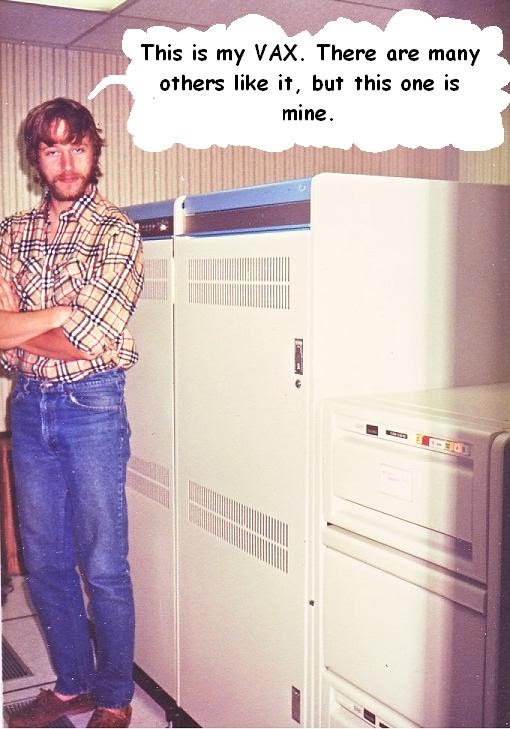
Mike Marshall shared a picture of hubcap from 1987:#N hubcap #S DEC VAX-11/780; ULTRIX-32 1.2 #O Clemson University Computer Center #C Mike Marshall, W. Gregg Stefancik #E hubcap!postmaster #T +1 803 656 3155, +1 803 656 6557 #P 50 New Cherry Street, Clemson University, Clemson, SC 29634 #L 34 41 N / 82 49 W #R Our link with gatech is over SURAnet via a 56Kbd line #U gatech ncrcae #W hubcap!wstef (W. Gregg Stefancik); Tue Mar 17 13:44:32 EST 1987 # hubcap akgua(DEMAND), gatech(DEDICATED), midlyd(DEMAND), usceast(POLLED), ncrcae(POLLED), dolqci(DEMAND)
See also:
See also the Wikipedia article List of the oldest currently registered Internet domain names, which lists Clemson University in a tie as the 86th educational institution to register an .edu doman name.
Clemson University "mirrors" the board and can be accessed by the following three paths: a.) anonymous ftp to: ftp.deming.eng.clemson.edu; b.) gopher.deming.eng.clemson.edu: 70/l; 3.) Or, lastly, via mosaic - http://deming.eng.clemson.edu. For more information about the Clemson University TQM files, send a message to: kimbler@eng.clemson.edu. Currently, the TQM BBS carries over 350 documents (e.g., articles, speeches, research papers, government research, position papers, etc.) on quality related topics. The TQM BBS also is home to the TQM Conference, an ongoing discussion forum on quality issues.
See also Ron Barnett, "Gopher Bringing New Information into Light of Day," The Greenville News, January 2, 1994, in the collection "Series-0037: Computer Center 1990s," courtesy of Dr. Tara Wood, Clemson University Libraries Special Collections and Archives.
An initial web page for Clemson University was set up by Barry Johnson in November 1993 with the URL http://clancy.clemson.edu/home.html and announced in the November 21, 1993, entry on the NCSA What's New November 1993 page. [The www.clemson.edu URL appears in an entry about the Clemson University MBA program on the September 1994 What's New page.]
See also:
In 1997, Clemson upgraded to several (I can't recall how many - 3 maybe?) bonded T-1's to InfoAve/iSCAN/SCNet. We thought it was a big deal to use a special "long-haul" 100Mb/s converter to go to the SCNet POP at the tower on US76. There, we went to a Cisco Router then to a T-1 Multiplexer via a 45 Mb/s HSSI interface. This represented Clemson's first internet link that was > than 1.54 Mb/s. Last I knew, the MUX was still in the rack, holding Clemson's rack space in that POP.Around 1999 (need to confirm this), Clemson, USC, and MUSC network engineers worked together to get connectivity to the Southern Crossroads (SoX), hosted by GaTech in Atlanta. Each of us turned up an ATM OC-3 to Columbia (over InfoAve/SCNet/iSCAN), and then shared an OC-3 from Columbia to Atlanta. This was significant because it provided Clemson's first connection to Internet2 via the MCI-operated vBNS service. We established layer 2/3 connectivity over this ATM link (I still remember the first pings) to SoX and established Clemson's first BGP session, where we received the Internet2 routing table. We configured Clemson's border router to prefer I2 routes and magically connectivity between Clemson and most big schools got much quicker. This represented Clemson's first real connectivity to the US R&E backbone infrastructure.
At the same time, we turned down the MUXed T1's and established an ATM PVC to InfoAve for our commodity (non-I2) connectivity. Now Clemson had up to 155 Mb/s available to InfoAve/SCNet/iSCAN (they kept changing their name, but this was/is the CLEC in SC).
Over the next few years, the need for bandwidth went through the roof and it wasn't long before the OC3 was saturated. I believe we turned up a second, but by then, the SCNet ATM network was swamped, and we spent several years arguing with them about what they were going to do to get more bandwidth. I remember sending them flatlined MRTG graphs to illustrate that we were not getting what we were paying for.
During this time was when Napster came along and gobbled up bandwidth like we had never seen before. In order to make things keep working, we initially used a timed ACL to block Napster during the day and open it up at night. We later switched to Packeteers inline with the border network to do "packet shaping," which did tricks to slow down file-sharing apps so we could stay inside of the bandwidth we had.
To solve this, in about 2005, we turned up a 1Gb/s link via AT&T Metro-E to a Qwest POP in Greenville (224 Westfield, I believe) and from there were able to get much better connectivity to SoX (I'm not recalling what/how much that connectivity was). Unfortunately, the AT&T Metro-E was very unreliable, despite having allegedly been engineered to be "redundant" and we had several very significant outages.
See also Comprehensive Annual Financial Report of Clemson University for the year ended June 30, 1998:
Each of the seven recipients -- Clemson, Duke, Indiana, Northwestern, South Carolina, Chicago and Michigan -- will receive equipment worth an estimated retail value of $300,000.
Now the circuits become fully loaded around 9 a.m. and stay that way through midnight until about 3 a.m. What happened? Well, the primary "happening" was the University Housing Office had several thousand additional Ethernet connections installed in the residence halls during spring and summer. Students who had been using dial-in line to an Internet Service Provider (ISP), which had its own Internet connection, now have a 10 Mb connection to the campus network and are sharing the three T1 lines with everyone else.Well, that sounds like a simple problem to solve, just buy a bigger connection to the Internet. Unfortunately, that's easier said than done. Projects that use "one-time money", like installing Ethernet in the dorms, often find funding. ... So Internet services, which require funding year after year, have a difficult time getting additional funding. (Also, it's hard to fight the uphill battle for additional infrastructure funding when you know some of the existing funds are being wasted. When we look at the Web sites being accessed, at least one of the top three sites is always pornographic.)
1999- When I started at Clemson, we had just transitioned from using a bonded 3 x T-1 lines, to using several ATM OC3's via fiber to Highway 76 tower. One OC3 was for commodity internet and set at 15mb/s burstable to 20mb/s. The other OC3 was for research networks. This allowed us to use the entire 155mb/s to connect to the VBNS and Abilene networks. I believe these merged into becoming Internet2 at some point.2000-2004-There were multiple incremental increases in internet bandwidth during 2003-2004. Increasing from 20mb/s to ~100mb/s. I have email from this period archived somewhere, but I'm going off of memory for this one.
8/2004- I have emails stating that we are hitting 90-100mb/s outbound because of a new file sharing app called bit torrent. It is a pretty safe bet that our internet bandwidth was about 100mb/s at this time. We used the packeteer packet shaper appliance to limit file sharing during the day.
10/2006- Even with packet shaping the internet connection is overwhelmed to the point of creating many user complaints during the day. We increase our internet bandwidth to 150mb/s, which is at the max the OC3 can carry. We are disappointed to find the real world overhead of ATM cells when we max out around ~132mb/s.
1/2007 - We lease an ATT metro-e circuit to a Charter POP on Lindsey avenue in Grenville. From there we connect dark fiber to a Qwest location around the corner and upgrade to an OC12. This allows us to increase internet bandwidth to 240mb/s. I believe the research networks (internet2) are still on the old OC3 (155mb/s)at this time. Planning and initial build of c-light fiber path in progress around this time as well.
8/8/2007- Press release announcing the c-light network comes out. This gives Clemson 16x10gig optical paths from Atlanta to Charlotte. Internet is still using the previous OC12 setup, but metro-e circuit portion is replaced with new c-light fiber path from Greenville to Clemson.
10/3/2007- Clemson uses c-light path to configure first backup internet connection via SOX in ATL. I can not find a reference, but around this time we would have transitioned our Internet2 research connection over to clight at 10gb/s.
2/2010- Commodity internet is 400mb/s over same OC12.
4/2010 - OC12 is decommissioned, and all internet traffic is transitioned over to use the c-light fiber network. At this point we continue to add multiple internet providers and increase bandwidth going forward.
3/2012- We have continued to use the packeteer to rate limit filesharing, but it becomes overwhelmed at this time and decommissioning is discussed. It is gone by September and filesharing is no longer ratelimited.
6/2013- We stand up our first 100gb/s path across c-light to Atlanta. It is connected to Internet 2's AL2S network which allow mapping of layer 2 paths to any other connected institution.
In February, the student newspaper reports on the amount of internet bandwidth being used. John Wickliffe, "DCIT Forms Commission to Address Issue of dialpad.com," The Tiger, vol. 93, no. 14, February 11, 2000:
The University currently has Internet connectivity services that provide a base rate of 10Mbps that can burst to 20Mbps. Clemson's utilization of this Internet connection is well above the base rate and at times exceeds the maximum rate the University's ISP will allow. ... Several carriers carry the University's Internet connection before it reaches the Internet service provider, Robinson explained, which adds to the expense of the connection. The current costs for Internet bandwidth is $5,712 per -month, plus $1,725 per month to cover carrier charges. In order to upgrade the base Internet connection to a base of 15Mbps that can burst to 30Mbps, an additional $2,150 is needed. This comes out to around 12 cents per student each month. No figures for additional carrier charges were available.
See also Kurt Mueller, "Report of the Study Group on Voice Over the Internet," computing@clemson.edu Newsletter, vol. 5, no. 3, Spring 2000, pages 5-6.
See also Mike Westall, "Network Status and Objectives," April 12, 2000.
Clemson University, a public university in Clemson, S.C., is also studying the question of whether to charge students for Internet access based on how much bandwidth they consume, according to Chris Duckenfield, vice provost for computing and information technology.Right now, "we charge for telephone access, but we offer the network access free," Duckenfield said. "What we should be doing is charging for the network to keep it up." Such a charge might be more acceptable to students if the university began offering advanced services, like videoconferencing, over the network, he said.
Duckenfield said the question of cost was a serious one at rural Clemson because the school must pay more than an urban university would for its 45 megabits-per-second connection to the Internet. But Clemson is in the same boat as most other colleges and universities when it comes to the problem of bandwidth, or network capacity: students can't get enough of it. "What we've found is that whatever bandwidth you provide, the student use will expand to fill that," he said.
The leading bandwidth hogs on campuses are music trading services, principally Napster, which has caused some campus networks to buckle under the load of fat song files. Some colleges and universities initially responded by trying to shut off access to the service. But some, including Clemson, have tried a more sophisticated approach, using so-called "bandwidth shaping" systems that are designed to minimize drain on the network.
One of the ways that Bottum and his team are funding all of these initiatives is through grants. Five years ago "the grant money didn't really exist," Bottum says. "And we're running about $5.5 million this year."The majority of the grants are for specific faculty. Wilson and Ligon, for example, have grants for parallel virtual file system work. "It's usually almost a 50-50 split between what goes to the faculty and their departments and what goes into IT's account, so it's a nice healthy IT/faculty partnership," Bottum says.
See also https://clight.sites.clemson.edu/.
In 2008, SC LIGHTRAIL went online. SC LIGHTRAIL is a dedicated, high-speed communication network which links the state's senior research universities to the National LambdaRail. (Think Super Internet: complex data feeds that once required considerable time to send now blaze across the state in mere seconds.) Funded by the General Assembly, SC LIGHT-RAIL offers multiple economic development benefits. It provides support for the development of new or expanding business segments that rely heavily on imaging (biomedicine, bio-engineering, etc.). It reduces costs by enabling universities to pool resources instead of purchasing duplicate systems. And it takes South Carolina's research universities to the next level of computing power - which makes our state more competitive for major research grants and serves as an essential recruitment tool to attract top CoEE Program faculty.
According to WCG team statistics posted Sept. 9, Clemson's team has calculated 188 years, 243 days, 8 hours, 14 minutes and 28 seconds worth of data."By joining WCG, we maximize our utilization by virtually donating computers when we don't use them," said Goasguen.
In doing so, we contribute to humanitarian causes."
The mission of the WCG is to create the world's largest public computing grid to tackle projects that aid humanity.
Humanitarian efforts include such things as computing power supplied by World Community Grid volunteers for the Nutritious Rice for the World project and a partnership between the Ontario Cancer Institute (OCI), Princess Margaret Hospital and University Health Network.
They will work to improve the results of protein X-ray crystallography in order to increase understanding of cancer and its treatment.
See also 2014-15 Clemson Computing and Information Technology Annual Report, 2016, page 8.
During 2013, Clemson University joined other leading research universities from around the nation in deploying the groundbreaking Internet2 Innovation Platform - the next generation network initiative to bring a 100Gb/s research and education connection to campuses.
See also 2015-16 Clemson Computing and Information Technology Annual Report, 2016, page 8.
FY15 saw the integration of the Open Science Grid (OSG) with Clemson's Palmetto Cluster and OSG Connect. OSG, sponsored by the National Science Foundation and the US Department of Energy, is a freely accessible distributed computing resource for scientific calculations designed to handle a large number of computational tasks. OSG provides common service and support for resource providers and scientific institutions using a distributed fabric of high throughput computational services, and provides software and services to users and resource providers alike to enable the opportunistic sharing of resourcesSee also B. Jayatilaka, et al.,
While most resources available on the Open Facility continue to be from ATLAS and CMS computing sites, an increasing fraction comes from University resources that are not directly affiliated with an existing OSG VO. Clusters at the Syracuse University, the University of Washington, and Clemson University are three such sites and together provide over 10 million CPU hours to OSG Open Facility users.
Jim Pepin brought the condominium cluster idea to Clemson from USC; see Jim Pepin, "High Performance Computing and Communication (HPCC)," Chapter 8, in Edward Blum and Alfred Aho (eds.), Computer Science: The Hardware, Software and Heart of It, Springer, 2011. Clemson University researchers who own computing nodes within the Palmetto cluster have been remarkedly open to allowing shared use of their nodes when otherwise idle.
See also Jim Bottum, "Advancing the University's Mission Through Cyberinfrastructure," University of Missouri CI Day presentation, March 3, 2015.
Spirit Communications donated broadband services valued at $1.4 million to Clemson University in September, which will connect South Carolina's premier research universities with a state-of-the-art fiber optic backbone. The gift allows Clemson University, the Medical University of South Carolina and the University of South Carolina access to the South Carolina LightRail (SCLR), a high-speed optical network. The access provides network connectivity for research and education between the three major research universities and other entities, both private and public. It is a public-private partnership to provide a broadband, high-speed optical network that will extend throughout the state and link to regional and national networks, such as Southern Light Rail, National Lambda Rail, Internet2 and SURAgrid and TeraGrid.
The National Science Foundation (NSF) unveiled the Big Data Regional Innovation Hubs (BD Hubs) program in November to bring together academia, the private sector, non-governmental organizations and other interested parties to solve big data problems and accelerate innovation. Clemson joined the South Big Data Regional Innovation Hub (South BD Hub), managed jointly by Georgia Tech and UNC-Chapel Hill as one of four Regional BD Hubs. The new initiative brings together researchers and industries to work together on big data problems in different areas and underlying cyberinfrastructure. The university already maintains multiple major Big Data research projects in genomics, connected transportation, smart grid and smart cities along with its leadership role in advancing the cyberinfrastructure necessary for big data computing through multiple NSF initiatives.
See also https://portal.fabric-testbed.net/.
Timelines
Papers
Videos
Other Resources
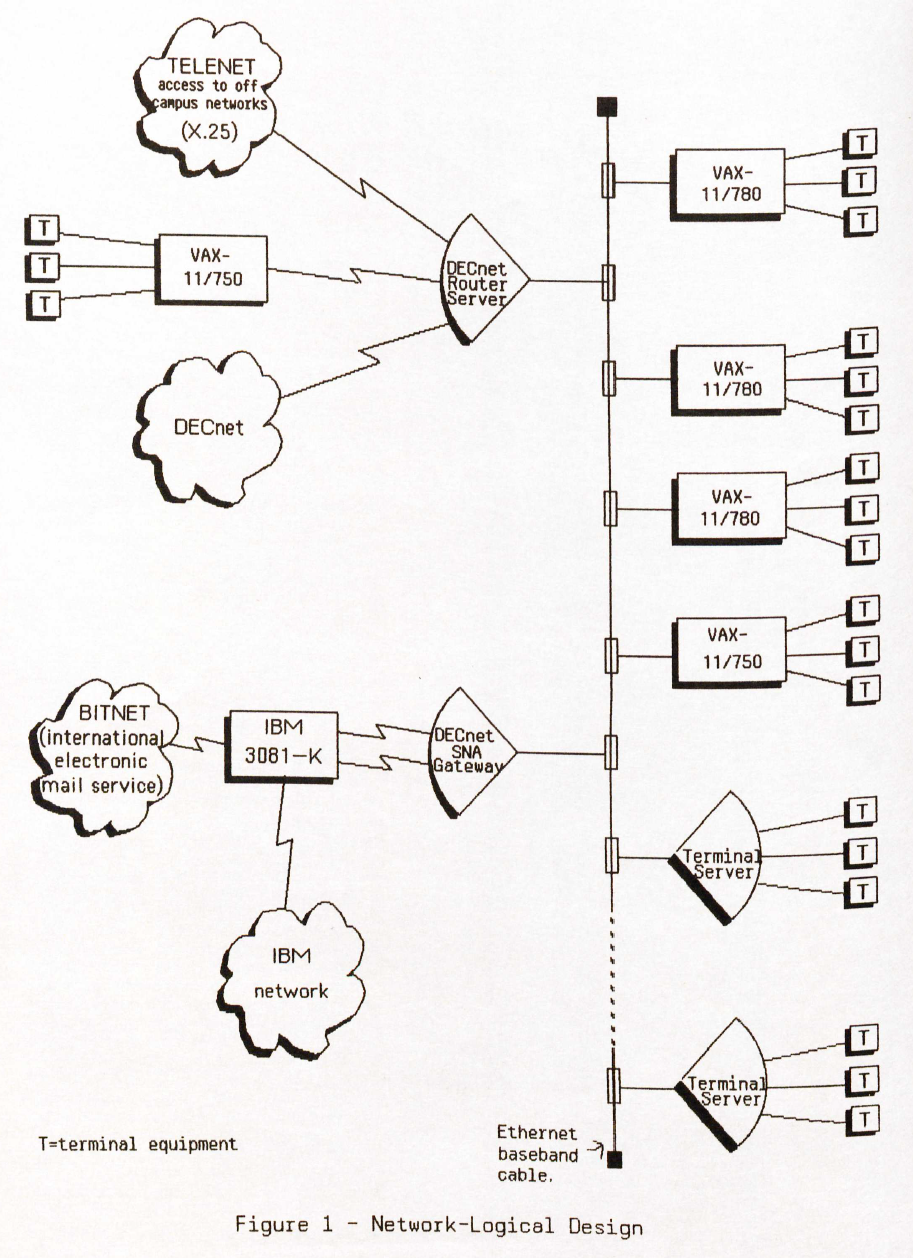
Network Map for 1985 [8]:
Description from Clemson University student handbook, 1985-1986, page 11:
Computer Center
R.F. Poole Agricultural Center Basement (3466)The Computer Center operates an IBM 3081-K computer with 32 megabytes of main storage using the MVS/XA operating system and TSO. This system is located in the basement of the Poole Agricultural Center. The Computer Center also operates a network of five DEC VAX computers, four using the VMS operating system and the fifth running under ULTRIX. Access to the IBM system from a VAX terminal and to the VAX network from an IBM terminal is facilitated by DECNET. Computing facilities off campus can be accessed via Telenet.
You have access to terminal and microcomputer clusters in Poole Agricultural Center, Martin, Sirrine, Riggs, Brackett, Lee, Lowry and Daniel halls, the Cooper Library and Greenville Tech. Many departments have their own terminals for use by their faculty and students.
Staff members are available for consultation on computing problems and can be reached by calling the Help Desk at 3494. See the Answer Sheet for hours of operation.
Network Map for 1988 [61]

[Note: identifying the UUCP-connected Ultrix system as running on a microVAX in the center left of the diagram is a mistake. That system is running on either an 11/780 or, by November 1988, a VAX 8810. See the VAX network diagram in DCIT Update Newsletter, vol. 12, no. 2, November 1988, pp. 10-11.]
Description from Clemson University student handbook, 1987-1988, page 13:
DCIT Computing Facilities
R.F. Poole Agricultural Center Basement (3466)The Clemson University Division of Computing and Information Technology (DCIT) supports student course work and research through a network of on-campus computers. This network consists of an NAS AS/XL-60 with 128 megabytes of main memory and 32 I/0 channels running the MVS/XA operating system and several VAX computers ranging in size from the MicroVAX II to the VAX 8650. Two VAXes, an 8600 and an 8650, along with an intelligent disk and tape controller, form what is known as a VAX cluster running the VAX/VMS operating system. A VAX 11/780 computer running the Ultrix operating system and a Floating Point Systems T20 Hypercube are also available.
Remote sites containing a variety of computers, terminals and peripheral equipment are maintained in Martin, Riggs, Daniel, Lee, Lowry and Sirrine halls, the Hunter Chemistry Laboratory and in Cooper Library. Among these, the facilities in the library, Daniel, Martin and Lowry halls contain large laboratories of microcomputers. Dial-up telephone numbers are available for use with portable terminals or suitably equipped personal computers. An extensive campus Ethernet connects all major buildings on campus to the VAX network. Terminals attached to this network have interactive access to all computers on campus. There is also an extensive network that supports the NAS system only. However, RJE facilities are available to allow file transfer between the NAS and other systems. A variety of national and international networks are accessible. The division supports connections to BITNET, UUCPnet, CSnet, SURAnet and Telenet. The first three provide national and international electronic mail. SURAnet is comprised of major Southeastern universities and is a subnet of the NSFnet. It provides researchers medium speed (56Kb) access to supercomputing facilities. Telenet is a public packet switching data network that provides access to other off-campus computers and services, as well as a link back to the University's systems when away from campus (with the proper equipment).
Consulting and Technical Services (CTS) provides students with free short courses to teach them to use the Clemson systems. CTS maintains a Help Desk (3494) to assist users with their computer-related questions and problems. CTS handout material is available free of charge at the Help Desk, and inexpensive manuals can be purchased from the University Bookstore.
The administrative offices of the DCIT Computer Center, as well as the Help Desk, are located in the basement of Poole Agricultural Center. See the Answer Sheet for hours of operation.
SCINET/High Speed Connection
Award Number: 9810141
Principal Investigator: Larry Druffel
Co-Principal Investigator: Vance Stone, Gary Gajewski
Organization: South Carolina Research Authority
NSF Organization: CNS
Start Date: 10/01/1998
Award Amount: $1,159,410
This award is made under the high performance connections portion of ANIR's "Connections to the Internet" announcement, NSF 96-64. Under the auspices of the South Carolina Research Authority (SCRA), it provides partial support for two years for DS-3 connections from three South Carolina institutions: Clemson University, the Medical University of South Carolina and the University of South Carolina to Columbia, SC and OC3 from that point to the vBNS. This award will assist the SCRA with Phase I of a planned set of major enhancements to their SC Information Network (SCINET).
Expanding and Improving the C-Light Regional Optical Network
Award Number: 0963199
Principal Investigator: James Bottum
Co-Principal Investigator: Jill Gemmill, James Pepin
Organization: Clemson University Research Foundation
NSF Organization: OIA
Start Date: 07/15/2010
Award Amount: $1,431,340
This project will renovate the existing regional optical research and education network infrastructure in South Carolina, the South Carolina Light Rail and C-Light. The project will lead to a higher bandwidth connection between South Carolina campuses and national research and education networks.The project will replace an existing router at the border of the C-Light network, in Greenville, with a carrier-class router and use this to peer with Internet2 and the North Carolina Research and Education Network in Charlotte, and with Southern Crossroads/Southern Light Rail, Internet2 and National Lambda Rail in Atlanta. The bandwidth of the connection between Atlanta and Greenville will be expanded and multiple optical waves will be used to connect Greenville and Charlotte. Campus Points of Presence within South Carolina Light Rail will be augmented with new switches.
South Carolina Inter- and Intra- Campus Cyber Connectivity (C2)
Award Number: 1006833
Principal Investigator: Bill Hogue
Co-Principal Investigator: Timothy Little, Jill Gemmill
Organization: South Carolina Research Authority
NSF Organization: EPS
Start Date: 09/01/2010
Award Amount: $1,176,470
The proposal builds on South Carolina's investment of over $6M in South Carolina Light Rail, a high-speed, high-capacity fiber optic network linking the Medical University of South Carolina (MUSC), Clemson University, and the University of South Carolina (USC). The activities build on C-Light, Clemson's fiber optic backbone that extends between Atlanta and Charlotte, providing a physical, direct connection to high-speed, high-capacity research networks such as Internet2 and National Lambda Rail. The proposal also builds on the Palmetto State Providers Network, a major building block for reaching some of South Carolina's 2- and 4-year colleges and universities.
EAGER: TIGER - Tight Integration of Grid Enabled Researchers
Award Number: 1063679
Principal Investigator: James Bottum
Co-Principal Investigator: Jill Gemmill, James Pepin, Timothy Davis,
Jennifer Cash
Organization: Clemson University
NSF Organization: OAC
Start Date: 10/01/2010
Award Amount: $299,887
The intent of the TIGER project is to implement and evaluate a "campus bridge" model that addresses the growing need for Cyber-Infrastructure (CI) support for researchers at campuses of every size requiring resources that may not be of petascale size, but that outstrip the infrastructure that can be supported at most institutions. The project will support regional access to HPC/HTC facilities, computational and visualization expertise as well as leveraging of expertise from each participating institution.
EAGER: Developing a Framework for a Cyber-Infrastructure General
Practitioner Program
Award Number: 1251544
Principal Investigator: Edward Duffy
Former Principal Investigator: Galen Collier
Co-Principal Investigator: James von Oehsen, James Pepin, Amy Apon
Organization: Clemson University
NSF Organization: OAC Start Date: 10/01/2012
Award Amount:$298,870
This project will perform an in-depth study on the development of a framework for a cyberinfrastructure (CI) general practitioner education and internship program targeted at creating highly-capable and innovative information technology (IT) professionals. This project will establish a methodology by which to develop a prototype model that implements an applied internship program within an academic setting. This methodology will include evaluating both undergraduate and graduate curriculum content needs, exploring a set of desired practical workforce competencies, forging the appropriate mix of private sector partnerships, conducting a fit/gap analysis of current curriculum offerings, and developing the prototype offering of a CI general practitioner program that explores an internship style model for instructional delivery.
CC-NIE Integration: Clemson-NextNet
Award Number: 1245936
Principal Investigator: Kuang-Ching Wang
Co-Principal Investigator: James Bottum
Organization: Clemson University
NSF Organization: OAC
Start Date: 11/01/2012
Award Amount: $990,898
Clemson Next-Net models a next-generation evolutionary campus network and services for productive and innovative research and education. The project builds upon existing work to expand Clemson's networking capabilities, enable Software Defined Networking (SDN) in at least 20 buildings on campus, and integrate high-speed campus research and education locations into the campus and national OpenFlow based infrastructure. The completed network extension will support significant new scientific research and education opportunities for multiple departments, colleges, and research groups across Clemson that require access to remote instruments and/or transfer large datasets. The project also facilitates future advances in Clemson's networking infrastructure and its ability to connect to the national infrastructure.
Advanced Cyberinfrastructure - Research and Educational Facilitation:
Campus-Based Computational Research Support
Award Number: 1341935
Principal Investigator: James Bottum
Co-Principal Investigator: Gwen Jacobs, Paul Wilson, James Cuff,
Maureen Dougherty, Lauren Michael, Scott Yockel
Organization: Clemson University
NSF Organization: OAC
Start Date: 03/01/2014
Award Amount: $5,901,465
The Advanced CyberInfrastructure - Research and Educational Facilitation: Campus-based Computational Research Support project develops and implements strategies that serve to advance our nation's research and scholarly achievements through the transformation of campus computational capabilities and enhanced coupling to the national cyberinfrastructure environment. Among the project's collaborating institutions are the University of Hawaii, the University of Southern California, the University of Utah, the University of Wisconsin, and Clemson and Harvard Universities. The project brings together education and research institutions that are committed to the vision of advancing scientific discovery through a national network of Advanced Cyberinfrastructure (ACI) Research and Education Facilitators (ACI-REFs). Working together in a coordinated effort, the project is dedicated to the adoption of models and strategies to leverage the expertise and experiences of its members to maximize the impact of investment in research computing. Located on the campuses and fully embedded in their local environment, the mission of the ACI-REFs is to extend the reach and impact of campus and national research computing infrastructure on the science conducted by students and faculty.
CC*IIE Region: Southern Partnership in Advanced Networking (SPAN)
Award Number: 1440659
Principal Investigator: James Bottum
Co-Principal Investigator: Damian Clarke, Gregori Faroux,
Samuel D'Angelo, Guy Cormier, William Gruszka, Neranjan Edirisinghe
Pathirannehe, Anthony Caldwell, Ronald Hutchins
Organization: Clemson University
NSF Organization: OAC
Start Date: 09/01/2014
Award Amount: $149,009
SPAN is a partnership between Clemson University, South Carolina State University, Georgia State University, and the University of Georgia that is building a regional community of practitioners across the South that supports next-generation networking. In collaboration with the Southern Crossroads initiative, Internet2, and ESnet, SPAN offers a program of workshops, site visits, and best practices documentation to administrators, campus IT groups, and researchers at institutions across the South that includes hands-on training, expert presentations, and in situ recommendations on topics such as network upgrades and cybersecurity to assist in the development and deployment of their own Campus Cyberinfrastructure Plans.Significantly, SPAN facilitates the creation of distributed science communities and enables new collaborations that can leverage advanced networking solutions to make new science discoveries. The creation of this regional network of expertise distributed across multiple institutions in support of faculty-led research that benefits from advanced networking capabilities will transform the way research is done across the region.
EAGER: Towards a Traffic Analysis Resistant Internet Architecture
Award Number: 1643020
Principal Investigator: Kuang-Ching Wang
Co-Principal Investigator: Richard Brooks
Organization: Clemson University
NSF Organization: CNS
Start Date:11/01/2016
Award Amount:$249,999
Many nation states restrict citizen access to information over the Internet by analyzing Internet users' traffic and then blocking traffic deemed controversial or antithetical to the views of the nation state. This project explores an alternative end-to-end network architecture that removes the vulnerability of citizens to traffic analysis. The researchers propose alternative Internet architecture and protocol designs, assesses the impact of such designs on Internet stakeholders, and provide assessment methods for correctness, performance, and scalability of the alternative design. The project broadly impacts multiple domains and research communities, from the network security and anti-censorship communities to those who design and run the Internet. Assuring that individuals around the world can easily access information over the Internet is one of the core, driving principles behind this project.
CC* Cyber Team: Cyberinfrastructure Empowerment for Diverse
Research, Scholarship, and Workforce Development (CI Empower)
Award Number: 1659297
Principal Investigator: James Bottum
Co-Principal Investigator: Jill Gemmill, Richard Alo,
Victor McCrary, James Brenn
Organization: Clemson University
SF Organization: OAC
Start Date: 02/01/2017
Award Amount: $248,624
CI Empower proposes a new model for more effective engagement of Historically Black Colleges and Universities (HBCUs) in the cyberinfrastructure ecosystem through a collaboration among Morgan State University (Maryland), Jackson State University (Mississippi), Claflin University (South Carolina), and South Carolina State University (South Carolina), and Clemson University (South Carolina). The project plans a regional, long term empowerment model expected to have a permanent impact on each institution's research capacity, and transform the way research is done on partner HBCU campuses.In the planning year, each campus: develops a written cyberinfrastructure (CI) plan and an on-campus team committed to implementing the plan; establishes cyberinfrastructure governance for on-going input; identifies external funding opportunities; and further develops a campus engagement plan. A focused external advisory group informs the efforts of the project. By developing campus CI plans, a strategic path for improving campus physical CI resources provides the basis to seek both internal and external funding sources. Technology transfer occurs by sharing of best practices among campuses, among proposal partners and also with the broader NSF-funded CI communities. The mix of technical staff, scientists, research administrators and information technology administrators involved in the planning effort come together to develop plans to help researchers achieve their research goals through access to better on-campus and more off-campus research resources.
CC*Data: National Cyberinfrastructure for Scientific Data
Analysis at Scale (SciDAS)
Award Number: 1659300
Principal Investigator: Frank Feltus
Co-Principal Investigator: Melissa Smith, Stephen Ficklin, Ray Idaszak,
Steven Cox, Claris Castillo
Organization: Clemson University
NSF Organization: OAC
Start Date: 02/15/2017
Award Amount: $2,952,217
On a technical level, SciDAS federates access to multiple national CI resources including NSF Cloud, Open Science Grid, the Extreme Science and Engineering Discovery Environment (XSEDE v2.0), petascale supercomputers such as COMET, and campus resources. Central to SciDAS is the use of ExoGENI dynamic networked infrastructure to enable Layer-2 connectivity and data movement between these resources and data repositories. SciDAS relies on the integrated-Rule-Oriented-Data-System (iRODS), enhanced with software-defined-networking (SDN) capabilities, to support network-aware data management decisions and efficient use of network resources. The distributed and scalable nature of both the data-sharing and the compute infrastructure are exploited to optimize for computer and data locality, boosting the performance of workflows and scientific productivity. Scientific discovery use cases in systems biology and hydrology will drive cyberinfrastructure development at the petascale level while simultaneously generating useful results for domain scientists.
Collaborative Research: IRNC: Testbed: FAB: FABRIC Across Borders
Award Number: 2029260
Principal Investigator: Kuang-Ching Wang
Co-Principal Investigator: Benjamin Kirtman, Richard Brooks
Organization: Clemson University
NSF Organization: OAC
Start Date: 09/01/2020
Award Amount: $509,952
FAB enables placement of four additional nodes in partner data centers in Tokyo, Amsterdam, Bristol and the particle physics lab CERN in Geneva and connects them via NSF-funded International networks, on which it's possible to conduct experiments without impacting production science. FAB offers programmable peering with production networks and specialized testbeds, allowing experimenter topologies to be joined with production networks, vastly expanding the possibilities for the types of resources and users that can utilize the infrastructure. FAB creates new software services and tools for researchers at the facilities, and interfaces with existing and evolving data delivery services to efficiently move and process scientific data globally and test novel data analysis approaches that scale to massive volumes. Metrics of success are driven by the science experiments themselves: more efficient handling of both high energy physics data from CERN experiments to worldwide collaborators and Cosmic Microwave Background data collected in South America and the South Pole; successful proofs of concept for the sharing of Smart City sensor data for urban planning as well as the establishment of global, private 5G networks. All software associated with FAB will be open source and posted in a publicly available repository: https://github.com/fabric-testbed/
Thank you to Browning Blair, who asked me about Clemson University's first connection to the Internet. Her question sparked my interest in collecting this history. I am grateful to Don Fraser, Jill Gemmill, Mike Marshall, Richard Nelson, Jack Peck, Brian Parker, Jim Pepin, Chandler Robinson, Dan Schmiedt, KC Wang, and Mike Westall in providing suggestions and corrections to this information. Don Fraser provided me access to numerous copies of the older Computer Center newsletters. I also am grateful to Dr. Tara Wood, Olivia Brittain-Toole, and Clemson University Libraries Special Collections and Archives for access to much of the archival material I have used.